
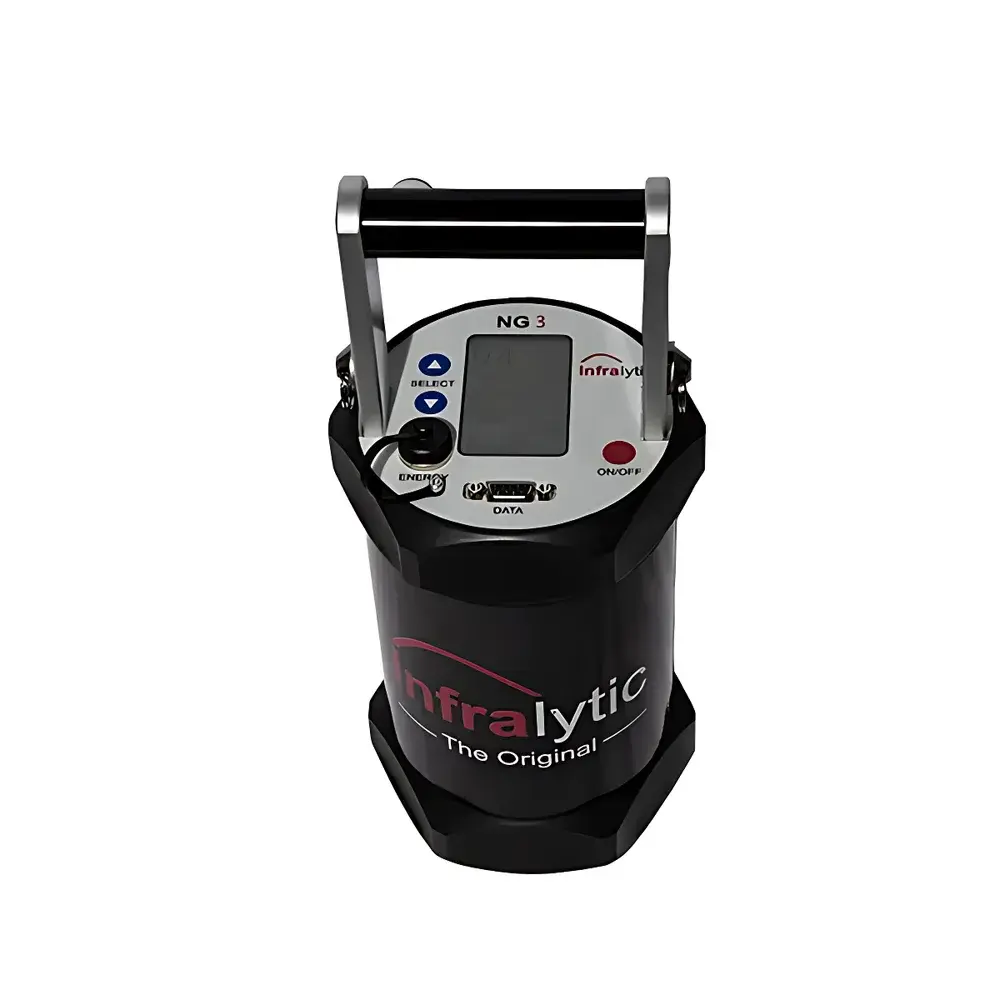
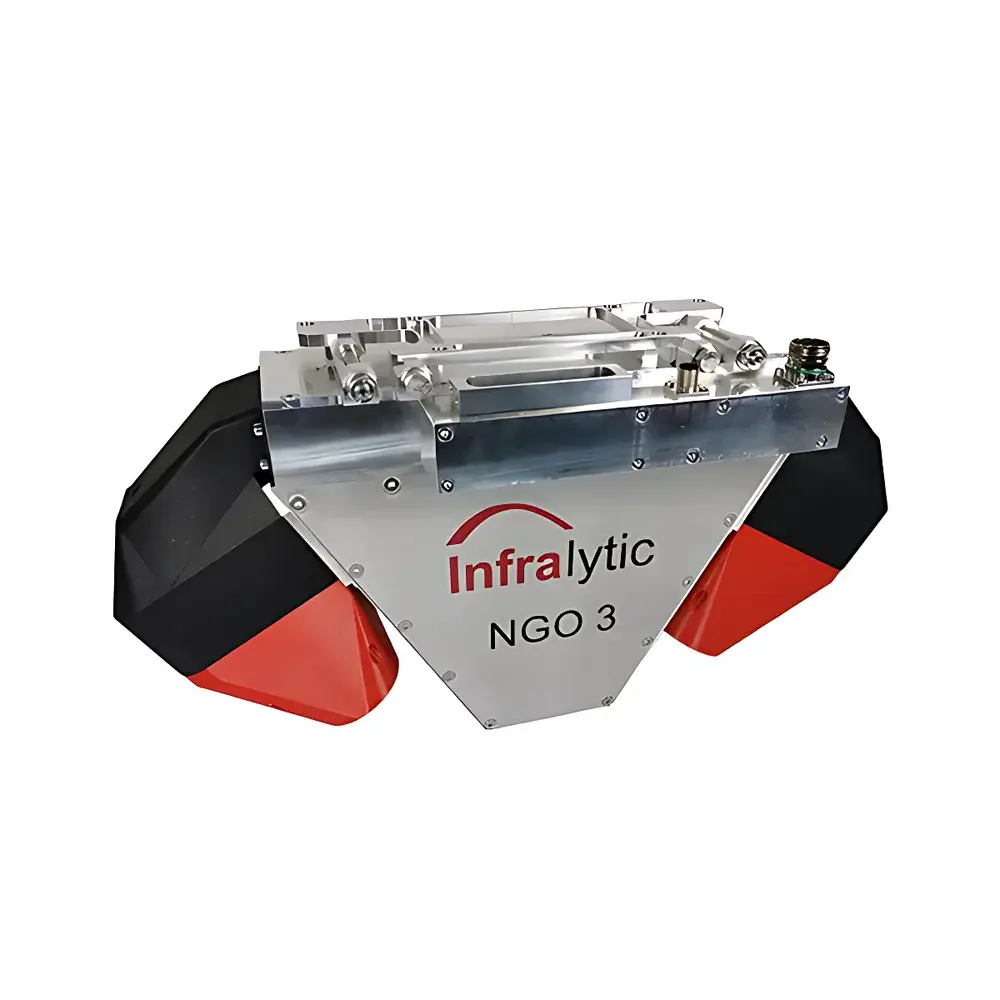
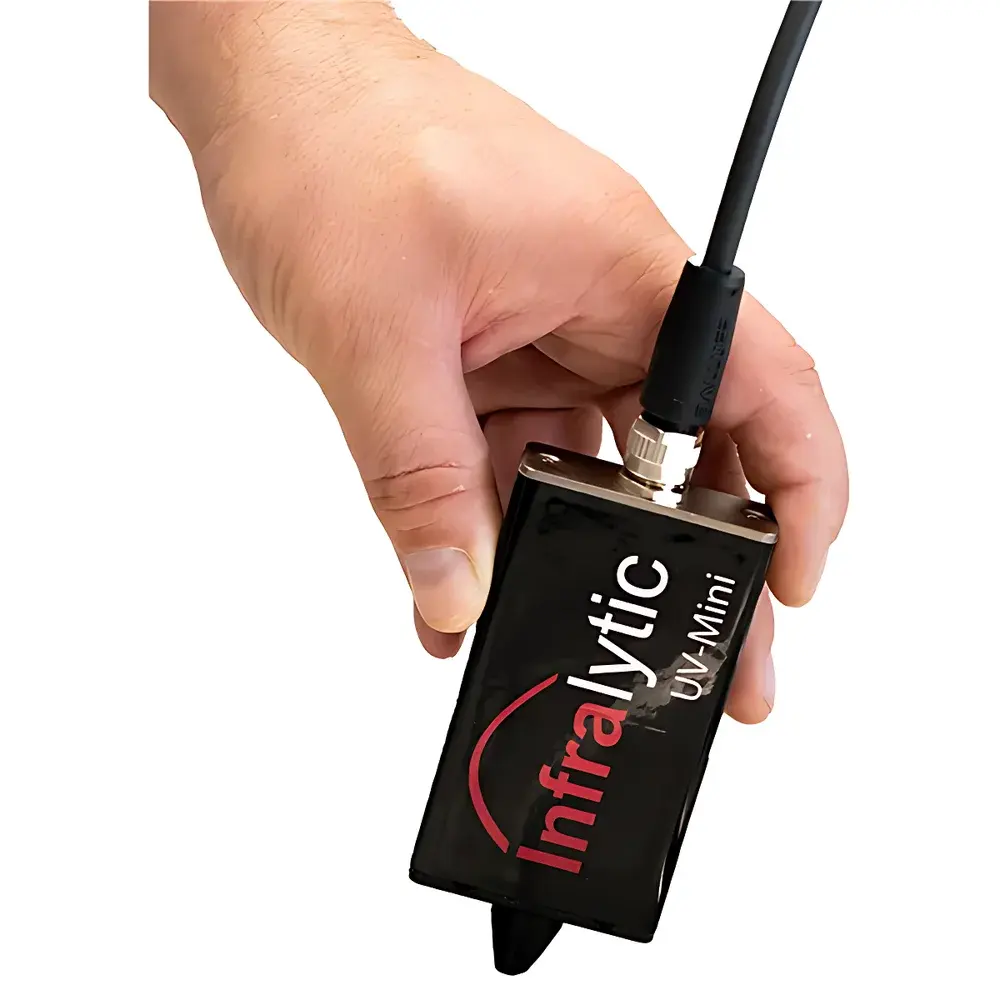
Infralytic NGO02 Non-Contact Infrared Oil Film Thickness Meter
| Brand | Infralytic |
|---|---|
| Origin | Germany |
| Model | NGO02 |
| Measurement Principle | Near-Infrared (NIR) Absorption Spectroscopy |
| Measurement Range | 0.05–6 g/m² |
| Accuracy | ±0.015 g/m² (0.02–0.3 g/m²), ±0.2 g/m² (0.3–2 g/m²), ±10% of reading (>2 g/m²) |
| Repeatability | <0.0010 g/m² |
| Resolution | 0.001 g/m² |
| Measurement Distance | 8 mm (+5/−2 mm) |
| Operating Temperature | 0 °C to 45 °C |
| IP Rating | IP65 |
| Power Supply | Internal rechargeable battery (≥12 h runtime) |
| Sample Surface Compatibility | Cold-rolled steel, hot-dip galvanized (HDG), electrogalvanized (EG), phosphated EG, annealed galvannealed (GA), aluminum (polished & EDT-treated), ZnMg-alloy coated, bare or pre-treated substrates |
| Lubricant Compatibility | Mineral oils, thixotropic mineral oils, hot-melt adhesives, waxes, and other organics (with custom calibration) |
| Compliance | Designed for ISO/IEC 17025-aligned QC environments |
Overview
The Infralytic NGO02 is a handheld, non-contact infrared oil film thickness meter engineered for precise, real-time quantification of organic lubricant layers on metallic substrates in industrial sheet metal processing lines. Unlike contact-based profilometers or gravimetric methods, the NGO02 employs near-infrared (NIR) absorption spectroscopy—leveraging characteristic C–H bond vibrational overtones in hydrocarbon-based lubricants—to determine mass per unit area (g/m²) without physical interaction, sample preparation, or surface damage. Its optical design enables stable operation at fixed working distance (8 mm ± tolerance), making it suitable for inline verification, offline lab checks, and mobile quality assurance across coil coating, stamping, and cold rolling facilities. The instrument operates independently of ambient lighting and is insensitive to minor surface topography variations typical of mill-finished metals.
Key Features
- Non-destructive, non-contact measurement using calibrated NIR spectral analysis
- Integrated auto-validation routine ensuring optical path integrity and detector stability before each measurement cycle
- Real-time material recognition and automatic compensation for substrate type—including cold-rolled steel, HDG, EG, GA, aluminum, and ZnMg alloys
- On-device directional sensing to detect strip travel direction, enabling synchronized data tagging in dynamic production environments
- Smartphone-integrated documentation: direct image capture with embedded measurement metadata (time, location, substrate ID, g/m² value) via Bluetooth-connected iOS/Android app
- IP65-rated enclosure for resistance to dust ingress and low-pressure water jets—validated for use in humid, oily, or temperature-variable shop-floor conditions
- Rechargeable lithium-ion battery supporting ≥12 hours of continuous operation under typical measurement frequency (one reading every 15 seconds)
Sample Compatibility & Compliance
The NGO02 is validated for quantitative analysis on industrially relevant metallic surfaces including uncoated cold-rolled steel, hot-dip galvanized (ASTM A653/A924), electrogalvanized (ASTM A591), phosphated electrogalvanized (ISO 10110-3), galvannealed (ASTM A653 Type A), and aluminum substrates (EN AW-1050, EN AW-5005). It accommodates both untreated and pre-treated surfaces (e.g., chromate-free passivation, silane-based primers). Lubricant compatibility extends to conventional mineral oils (DIN 51502 KP), thixotropic formulations (e.g., stamping oils with rheological modifiers), hot-melt adhesives (ISO 1133), and paraffinic waxes—provided traceable calibration standards are established per ASTM D7462 or internal method validation protocols. While not certified to IEC 61326-1 for EMC in explosive atmospheres, its design meets functional safety expectations for Class 1 Div 2 zones when operated per manufacturer guidelines.
Software & Data Management
Data output conforms to CSV and XML formats compliant with LIMS integration requirements. Optional Infralytic DataBridge software enables batch export with timestamped audit logs, user authentication (role-based access), and electronic signature support aligned with FDA 21 CFR Part 11 Annex 11 principles. All measurement records include embedded environmental metadata (ambient temperature, battery level, optical alignment status) and can be linked to ERP identifiers (e.g., coil ID, lot number, shift code). Calibration history—including date, operator, standard reference values, and deviation reports—is stored locally and exportable for ISO/IEC 17025 internal audits or third-party accreditation reviews.
Applications
- Pre-stamping verification of lubricant uniformity on automotive body panels to prevent die wear and surface scoring
- In-process monitoring of oil application consistency after roll-coating or spray-lubrication units
- Post-annealing verification of residual oil removal efficiency in continuous galvanizing lines
- Validation of phosphating pretreatment efficacy by correlating oil mass loss with phosphate crystal density (per ISO 9717)
- Quality gate checks prior to painting or adhesive bonding—ensuring optimal surface energy and interfacial adhesion
- R&D support for lubricant formulation development, where rapid g/m² feedback informs viscosity, additive package, and drying behavior studies
FAQ
Does the NGO02 require periodic recalibration with NIST-traceable standards?
Yes. Infralytic recommends annual calibration using certified reference foils traceable to PTB (Physikalisch-Technische Bundesanstalt) or equivalent national metrology institutes. Field verification against master samples is advised before each shift.
Can the NGO02 measure oil films on painted or polymer-coated substrates?
No. The NIR absorption model assumes a metallic reflective base layer. Painted, lacquered, or polymer-laminated surfaces attenuate the return signal and invalidate the calibration matrix unless redeveloped under controlled R&D conditions.
Is measurement affected by surface roughness or oxide layers?
Within specified Ra limits (<3.2 µm for steel, <1.6 µm for Al), roughness has negligible impact. Native oxides (e.g., Al₂O₃ on aluminum) are accounted for in substrate-specific calibrations; thick corrosion products or mill scale must be removed prior to measurement.
How does ambient temperature variation affect accuracy?
The internal thermal stabilization system maintains detector and source diode temperatures within ±0.5 °C across the 0–45 °C operating range. No user correction is required, though measurements below 5 °C may exhibit marginally increased noise floor.
What lubricant types are excluded from standard calibration?
Silicone-based oils, fluorinated lubricants (e.g., PFPE), and aqueous emulsions lack sufficient C–H absorbance in the 1650–1750 nm band and require custom spectral library development and independent validation.



