
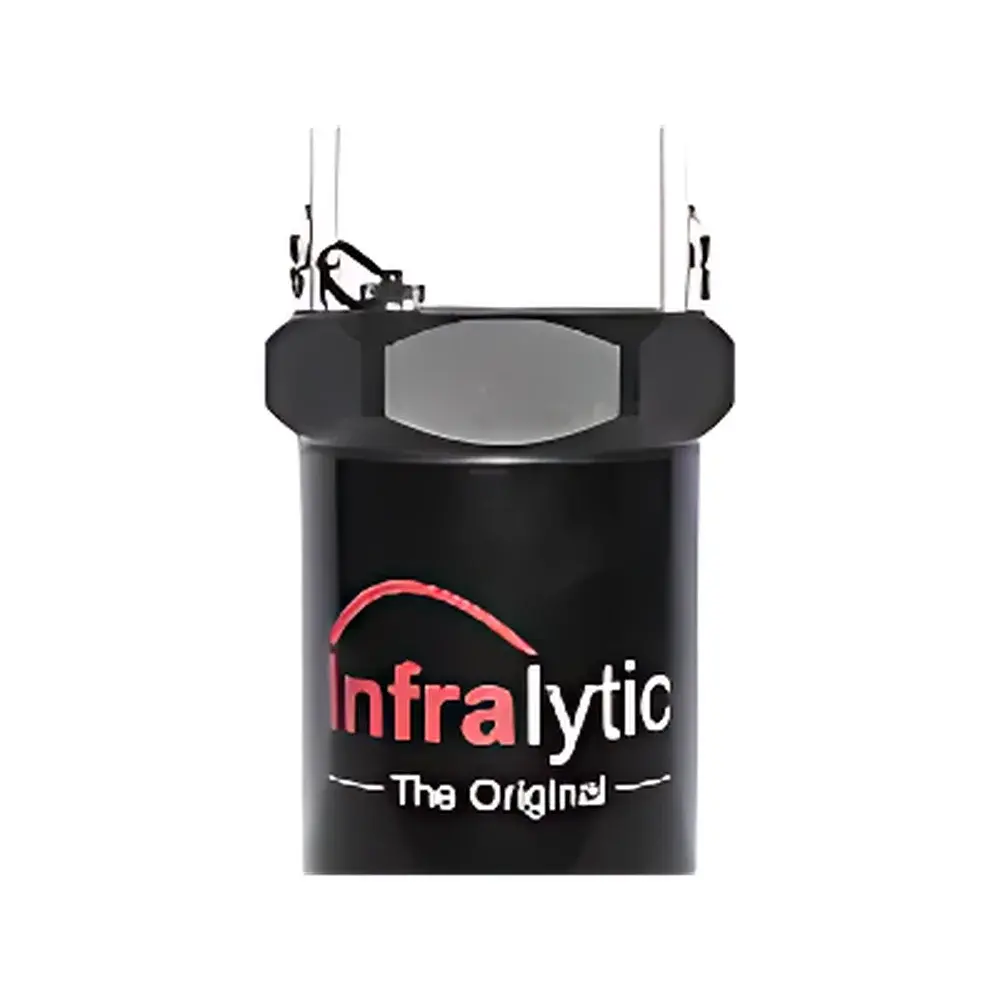
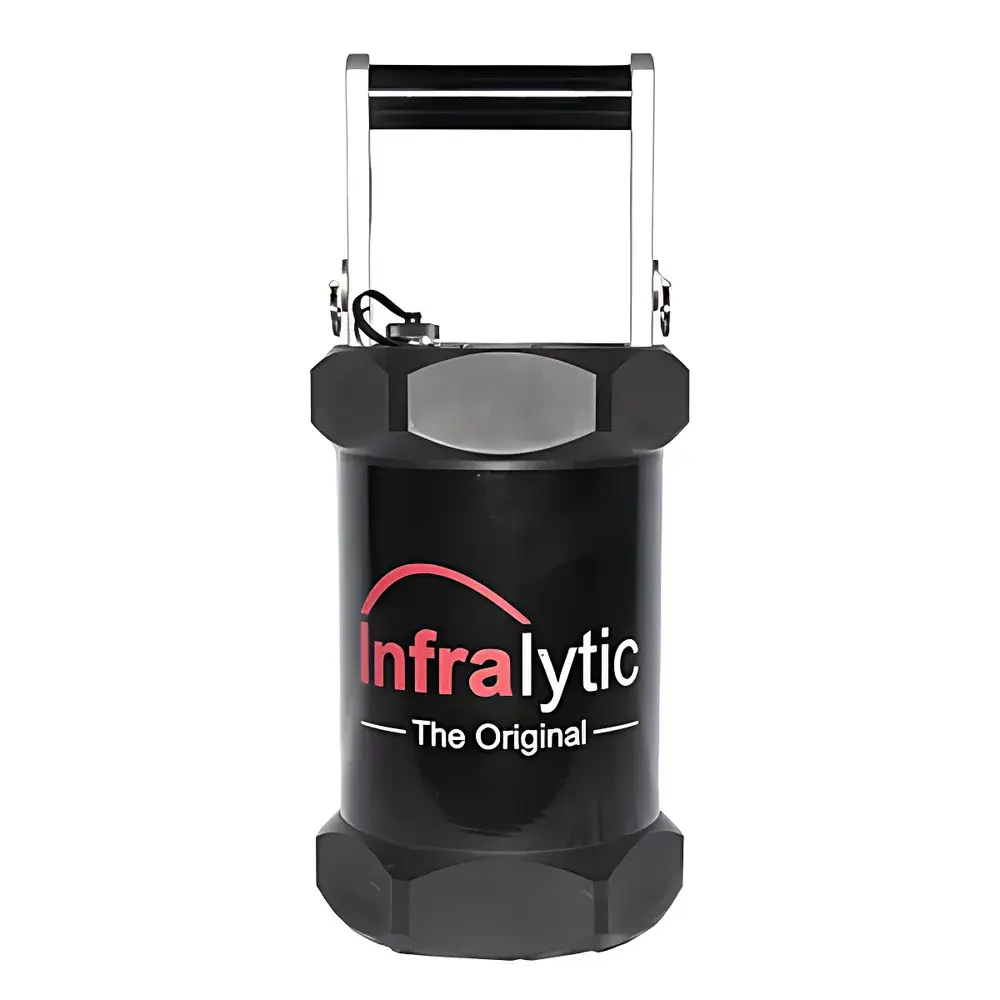
Infralytic NGO1/2/3 Non-Contact Infrared Oil Film Thickness Gauge
| Brand | Infralytic |
|---|---|
| Origin | Germany |
| Model | NGO1/2/3 |
| Measurement Principle | Infrared Spectroscopy |
| Measurement Range | 0.05–6 g/m² |
| Accuracy | ±0.015 g/m² (0.02–0.3 g/m²), ±0.2 g/m² (0.3–2 g/m²), ±10% of reading (>2 g/m²) |
| Repeatability | <0.0010 g/m² |
| Resolution | Up to 0.001 g/m² |
| Measurement Distance | 8 mm (+5/−2 mm) |
| Operating Temperature | 0°C to 45°C |
| IP Rating | IP65 |
| Substrate Compatibility | Cold-rolled steel, hot-dip galvanized, electrogalvanized, phosphated, annealed galvanized, aluminum (polished & EDT), ZnMg-coated, aluzinc |
| Lubricant Types | Mineral oils, thixotropic mineral oils, hot-melt adhesives, waxes, other organics (with custom calibration) |
| Power | Battery-operated (≥12 h runtime) |
| Compliance | Designed for GLP/GMP-aligned production environments |
Overview
The Infralytic NGO1/2/3 Non-Contact Infrared Oil Film Thickness Gauge is an industrial-grade metrology instrument engineered for precise, real-time quantification of thin lubricant layers on metallic substrates in continuous production environments. Unlike contact-based profilometers or gravimetric methods, the NGO series employs near-infrared (NIR) absorption spectroscopy—specifically calibrated to C–H bond vibrational overtones—to determine mass-based oil coverage (g/m²) without physical interaction. This optical principle ensures zero mechanical wear, no surface contamination, and immunity to substrate topography variations typical in cold-rolled, galvanized, or aluminum sheet metal. The system operates at a fixed standoff distance of 8 mm (± tolerance window), enabling integration into inline conveyor setups or handheld inspection workflows across coil coating lines, stamping plants, and automotive component manufacturing facilities.
Key Features
- Non-contact, non-destructive infrared measurement with no sample preparation required
- Automatic substrate recognition algorithm for rapid switching between cold-rolled steel, hot-dip galvanized (HDG), electrogalvanized (EG), phosphated, annealed galvanized, aluminum (polished and EDT-treated), ZnMg alloy, and aluzinc surfaces
- Integrated material feed-direction detection to align measurement geometry with rolling direction—an essential factor for anisotropic oil distribution on textured surfaces
- Smartphone-coupled documentation: On-device photo capture with timestamped metadata and embedded measurement values for traceable quality records
- Battery-powered operation with ≥12 hours of continuous runtime—enabling mobile use in remote line sections or maintenance zones without AC dependency
- IP65-rated enclosure ensuring operational reliability in high-humidity, dust-laden, or coolant-splashed industrial settings
- Factory-calibrated for standard lubricants (mineral oils, thixotropic variants, waxes, hot-melt adhesives); optional custom calibration available for proprietary formulations
Sample Compatibility & Compliance
The NGO1/2/3 is validated for quantitative analysis on industrially relevant metallic substrates including untreated cold-rolled strip, hot-dip galvanized steel (Zn-coated), electrogalvanized steel (with automatic phosphating verification capability), annealed galvanized steel, bare and pre-treated aluminum (including EDT-passivated and polished variants), and ZnMg-alloy coated sheets. It accommodates both uncoated and pre-phosphated surfaces without recalibration. While not certified to ISO/IEC 17025 as a standalone laboratory instrument, its measurement traceability aligns with internal quality system requirements under ISO 9001:2015 and automotive IATF 16949. Data integrity supports GLP/GMP-aligned documentation practices; smartphone-generated reports include operator ID, location tag, time stamp, and raw spectral snapshot—facilitating 21 CFR Part 11-compliant audit trails when integrated with validated enterprise document management systems.
Software & Data Management
The NGO platform utilizes embedded firmware with onboard spectral processing—no external PC is required for core functionality. All measurements are stored locally with full metadata (substrate type, lubricant class, ambient temperature, operator ID if entered). Export occurs via Bluetooth or USB-C to CSV or XML formats compatible with MES (Manufacturing Execution Systems) and SPC (Statistical Process Control) platforms such as Minitab, InfinityQS, or Siemens Opcenter. The companion mobile application enables real-time pass/fail threshold alerts based on user-defined specification limits (e.g., 0.8–1.4 g/m² for drawing oil on EG steel), with configurable alarms for drift detection or out-of-tolerance events. Audit logs retain all parameter changes, calibration history, and firmware revision data—critical for regulatory readiness in Tier-1 automotive or appliance OEM supply chains.
Applications
- Real-time verification of oil application uniformity post-roller coater or spray station in cold-rolled steel service centers
- Final QC checkpoint before stamping or deep-drawing to prevent galling, scratching, or die wear caused by insufficient lubrication
- Process validation during transition from one lubricant formulation to another—especially critical when switching between mineral and synthetic ester-based oils
- Monitoring lubricant degradation or migration during storage or transport of pre-oiled coils
- Supporting APQP Phase 3 (Production Part Approval Process) submissions with statistically significant thickness distribution profiles across coil width and length
- Root cause analysis of surface defects (e.g., orange peel, stretcher strain) correlated with localized oil film deviation
FAQ
Does the NGO require annual recalibration by the manufacturer?
No—field recalibration is not required under normal operating conditions. The instrument performs continuous self-validation using internal reference standards. However, users must perform daily verification checks using supplied NIST-traceable reference foils prior to shift start, per internal QA procedures.
Can it measure oil thickness on painted or lacquered substrates?
No—the NIR method relies on direct optical coupling with the metallic base layer. Paint, lacquer, or polymer coatings absorb or scatter the diagnostic wavelengths and invalidate the calibration model.
Is the measurement affected by ambient lighting or ambient IR sources?
The sensor incorporates active background compensation and narrowband spectral filtering to reject broadband interference from shop-floor lighting, welding arcs, or heating elements—ensuring stable readings even in unshielded production areas.
What is the minimum detectable oil mass on a 1 m² sample area?
The resolution limit is 0.001 g/m², corresponding to a nominal monolayer coverage of approximately 0.05 µm thickness for typical mineral oils (density ~0.85 g/cm³).
How does the system handle curved or corrugated sheet surfaces?
The 8 mm working distance and ±2 mm tolerance window accommodate minor curvature (radius > 500 mm) and standard embossing patterns. For highly contoured parts, a custom mounting jig with adjustable focus is recommended.



