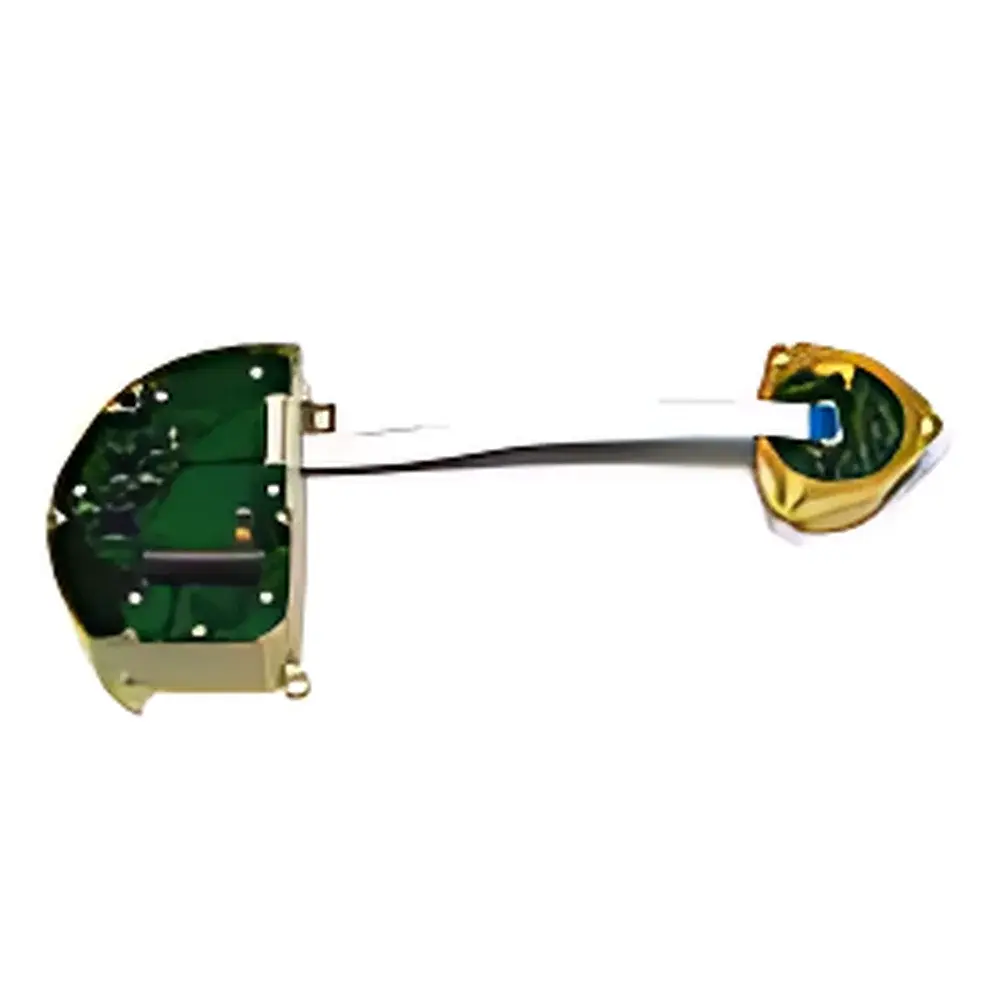
INNALABS INL-CVG-G100 Single-Axis Coriolis Vibratory Gyroscope with Analog Output
| Axis Count | 1 (X or Y) |
|---|---|
| Output Type | Analog Voltage (Differential, ±10 V Full Scale) |
| Measurement Range | ±110 °/s |
| Bandwidth | 300 Hz |
| Bias Stability (25°C, 10° averaging) | <0.1 °/hr |
| Bias Stability (Full Temperature Range −40°C to +85°C, 10° averaging) | <10 °/hr |
| Bias Repeatability (Power-On) | 0.5 °/hr |
| Angle Random Walk (ARW) | <0.008 °/√hr |
| Output Noise (0.1–100 Hz, RMS) | <0.008 °/s |
| Scale Factor Error (Full Temp Range) | <2500 ppm |
| Scale Factor Linearity | <500 ppm |
| Startup Time | <1 s |
| Bias Offset | <8 mrad |
| Temperature Compensation | Yes (Bias & Scale Factor) |
| Input Voltage | +12 to +36 VDC (MIL-STD-461/1275 compliant) |
| Power Consumption | <1.7 W |
| Operating Temperature | −40°C to +85°C |
| Vibration (Operational) | 12 g RMS, 1–2000 Hz, 10 min/axis |
| Vibration (Shipping) | 3 g RMS, 1–2000 Hz, 1 h/axis |
| Shock | 500 g, 0.5 ms half-sine |
| MTBF (MIL-HDBK-217F) | 500,000 hr |
| EMI Immunity | Unshielded operation validated |
| Lifetime | ≥17 years |
| Weight (Sensor Element) | 71 g |
| Weight (Damping Assembly) | 26 g |
| Weight (Electronics & Connector) | 73 g |
| Dimensions (Sensor Element) | 25 mm H × 29.4 mm D |
| Built-in Self-Test (BIST) | Yes |
| Origin | Germany |
| Compliance | MIL-STD-810G, MIL-STD-461F, MIL-STD-1275E |
Overview
The INNALABS INL-CVG-G100 is a high-performance single-axis Coriolis vibratory gyroscope engineered for demanding inertial sensing applications where precision, stability, and environmental resilience are critical. Based on solid-state micro-machined tuning-fork architecture, the G100 leverages the Coriolis effect to detect angular rate about a single sensitive axis (X or Y), delivering analog voltage output proportional to rotational velocity. Its design targets mission-critical systems requiring long-term bias stability, low noise floor, and wide dynamic bandwidth—attributes essential in aerospace, defense, maritime, and autonomous vehicle platforms. Unlike optical or mechanical gyroscopes, the CVG principle ensures no moving parts beyond microscopic resonating structures, eliminating wear mechanisms and enabling exceptional reliability (MTBF > 500,000 hours per MIL-HDBK-217F) and shock survivability up to 500 g (0.5 ms half-sine). The device operates across an industrial temperature range (−40°C to +85°C) and maintains calibrated performance through integrated real-time temperature compensation of both bias and scale factor.
Key Features
- Ultra-stable bias performance: <0.1 °/hr (25°C, 10° averaging), <10 °/hr over full temperature range
- Low angle random walk (ARW): <0.008 °/√hr — critical for drift-limited navigation solutions
- High-bandwidth analog output: 300 Hz small-signal bandwidth supports fast closed-loop stabilization
- Differential ±10 V analog interface with inherent common-mode noise rejection
- Integrated temperature compensation for bias and scale factor, eliminating need for external calibration tables
- Ruggedized mechanical design: qualified to MIL-STD-810G for vibration (12 g RMS, 1–2000 Hz), shock (500 g), and thermal cycling
- EMI-hardened electronics: compliant with MIL-STD-461F and MIL-STD-1275E for vehicular and airborne power bus environments
- Built-in self-test (BIST) function enables in-system verification without external stimulus
- Low power consumption (<1.7 W) and compact form factor (sensor element: 25 mm × 29.4 mm × H25 mm)
Sample Compatibility & Compliance
The INL-CVG-G100 is designed for integration into sealed, hermetically packaged inertial modules and is compatible with standard PCB mounting (through-hole or surface-mount variants available upon request). It interfaces directly with analog-to-digital converters (ADCs) featuring differential input stages and programmable gain, supporting resolution down to sub-0.001 °/s when paired with 24-bit sigma-delta converters. The device complies with key military and industrial standards including MIL-STD-810G (environmental testing), MIL-STD-461F (EMI emissions/susceptibility), and MIL-STD-1275E (vehicle power quality). While not inherently certified for aviation (DO-160) or rail (EN 50121), its robustness profile supports qualification pathways for Class 3 and Class 4 safety-critical subsystems under ISO 26262 ASIL-B or IEC 61508 SIL2 frameworks when embedded within validated system architectures.
Software & Data Management
As an analog-output sensor, the INL-CVG-G100 does not embed firmware or require host-side driver stacks. However, its deterministic transfer function (linear ±110 °/s range, <500 ppm scale factor nonlinearity) simplifies system-level calibration and data fusion workflows. When integrated into IMUs or AHRS platforms, it contributes raw angular rate data to Kalman filter implementations—compatible with open-source navigation libraries (e.g., RTIMULib, PX4 Attitude Estimator) and commercial middleware (VectorNav VN-300 SDK, SBG Systems Ellipse firmware). All calibration coefficients—including temperature-dependent bias and scale factor polynomials—are supplied in machine-readable format (CSV/JSON) for automated loading into production test systems. Traceable calibration reports (NIST-traceable reference turntables) are provided per batch, satisfying GLP/GMP documentation requirements for defense prime contractors and medical robotics OEMs.
Applications
- Inertial Measurement Units (IMUs) for UAVs, UUVs, AGVs, and ROVs requiring size, weight, and power (SWaP)-optimized angular rate sensing
- Antenna and optical payload stabilization systems, especially in gimbal assemblies subject to high-frequency jitter
- Attitude and Heading Reference Systems (AHRS) for land vehicles operating in GPS-denied environments
- Redundant channel in INS/GPS hybrid navigation systems where analog signal integrity reduces digital bus contention
- Platform stabilization for electro-optical/infrared (EO/IR) turrets, maritime radar pedestals, and satellite communication terminals
- Condition monitoring subsystems in rotating machinery where angular acceleration signatures inform predictive maintenance algorithms
FAQ
Is the INL-CVG-G100 RoHS and REACH compliant?
Yes. All materials and manufacturing processes conform to EU Directive 2011/65/EU (RoHS3) and Regulation (EC) No 1907/2006 (REACH), with full substance declarations available upon NDA.
Can the G100 be used in vacuum or high-humidity environments?
The sensor element is hermetically sealed in a metal-ceramic package rated IP67 equivalent; operation in controlled vacuum (<10⁻³ mbar) is feasible but requires thermal derating validation. Humidity exposure up to 95% RH non-condensing is fully supported.
Does INNALABS provide calibration certificates with each unit?
Batch-level NIST-traceable calibration reports are standard. Unit-level certificates are available as an optional service with additional lead time and cost.
What is the recommended ADC resolution for optimal noise performance?
A minimum of 20-bit effective resolution (ENOB) is recommended to resolve the <0.008 °/s RMS noise floor; 24-bit delta-sigma converters yield optimal dynamic range utilization.
Is there a digital-output variant of the G100?
Yes—the INL-CVG-G100-D offers SPI/I²C digital output with embedded temperature compensation and configurable filters. Contact technical sales for cross-reference specifications.