
Binsfeld TorqueTrak 10K Wireless Torque Telemetry System
| Brand | Binsfeld |
|---|---|
| Origin | USA |
| Model | TT10K |
| Transmitter Dimensions | 25 mm × 41 mm × 64 mm |
| Transmitter Weight | 85 g |
| Operating Temperature | −30 °C to +85 °C |
| Battery Life | 24 h (9 V Li battery, 350 Ω bridge, 25 °C) |
| Excitation Voltage | 2.5 VDC ±0.1% |
| Supply Voltage (Transmitter) | 7.5–18 VDC |
| Transmit Current (Active) | 40 mA typical, 50 mA max |
| Transmit Current (Standby) | 4 mA typical, 5 mA max |
| Gain Range | 500–16,000 (6 selectable steps) |
| Frequency Response | 0–500 Hz (−3 dB at 500 Hz), adjustable low-pass filtering |
| Output Delay | 4.2 ms typical (500 Hz filter setting) |
| Sampling Rate | 2400 samples/sec |
| ADC Resolution | 14-bit |
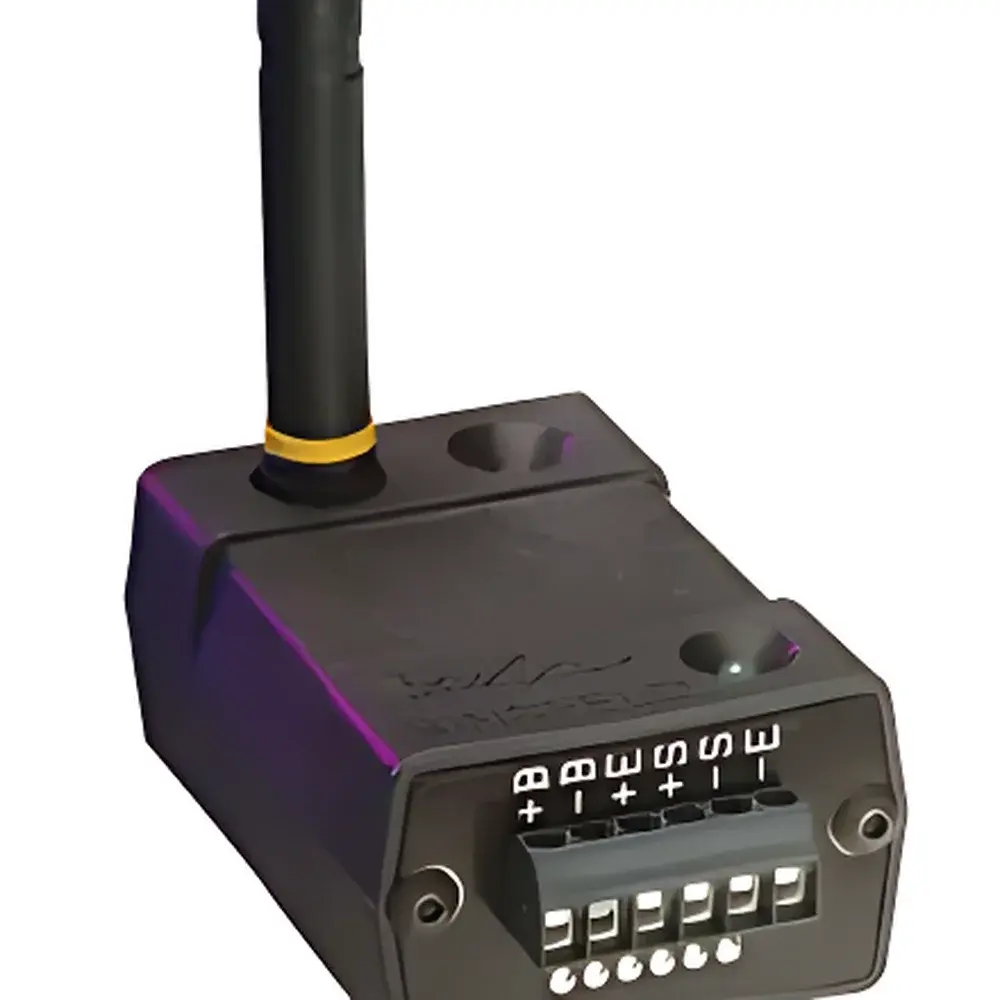
| Output Options | ±10 VDC analog (field-adjustable gain 0.25× to 4.0×), RS-232 serial (DB9) |
| Transmission Band | 902–925 MHz |
| Line-of-Sight Range | ≥6 m (20 ft) |
| Centrifugal Tolerance | 3000 g (e.g., 5700 RPM on 102 mm shaft) |
| Strain Gauge Compatibility | Full-bridge, 350 Ω standard (1000 Ω optional) |
| Bridge Excitation | 2.5 VDC |
| Bias Error | ±0.25% of reading or ±0.16% FS (at gain = 4000, 25 °C) |
| Remote Control | IR-based, up to 3 m line-of-sight, enables channel selection, gain/FS adjustment, shunt calibration, and standby activation without disassembly |
Overview
The Binsfeld TorqueTrak 10K is a high-fidelity wireless torque telemetry system engineered for real-time, non-contact measurement of dynamic torsional load on rotating shafts. Based on strain gauge transduction and digital radio-frequency (RF) telemetry, the system converts any rotating drive shaft into a calibrated torque sensor without mechanical coupling, slip rings, or structural modification. The transmitter—mounted directly onto the shaft—conditions full-bridge strain signals, digitizes them via a 14-bit analog-to-digital converter, and transmits synchronized data wirelessly in the 902–925 MHz ISM band. This architecture eliminates signal degradation associated with slip-ring wear, electromagnetic interference, or thermal drift common in legacy contact-based systems. Designed for integration into R&D test benches, powertrain validation labs, and industrial driveline diagnostics, the TorqueTrak 10K delivers metrologically traceable torque data under high-speed, high-g environments—including sustained centrifugal loads up to 3000 g.
Key Features
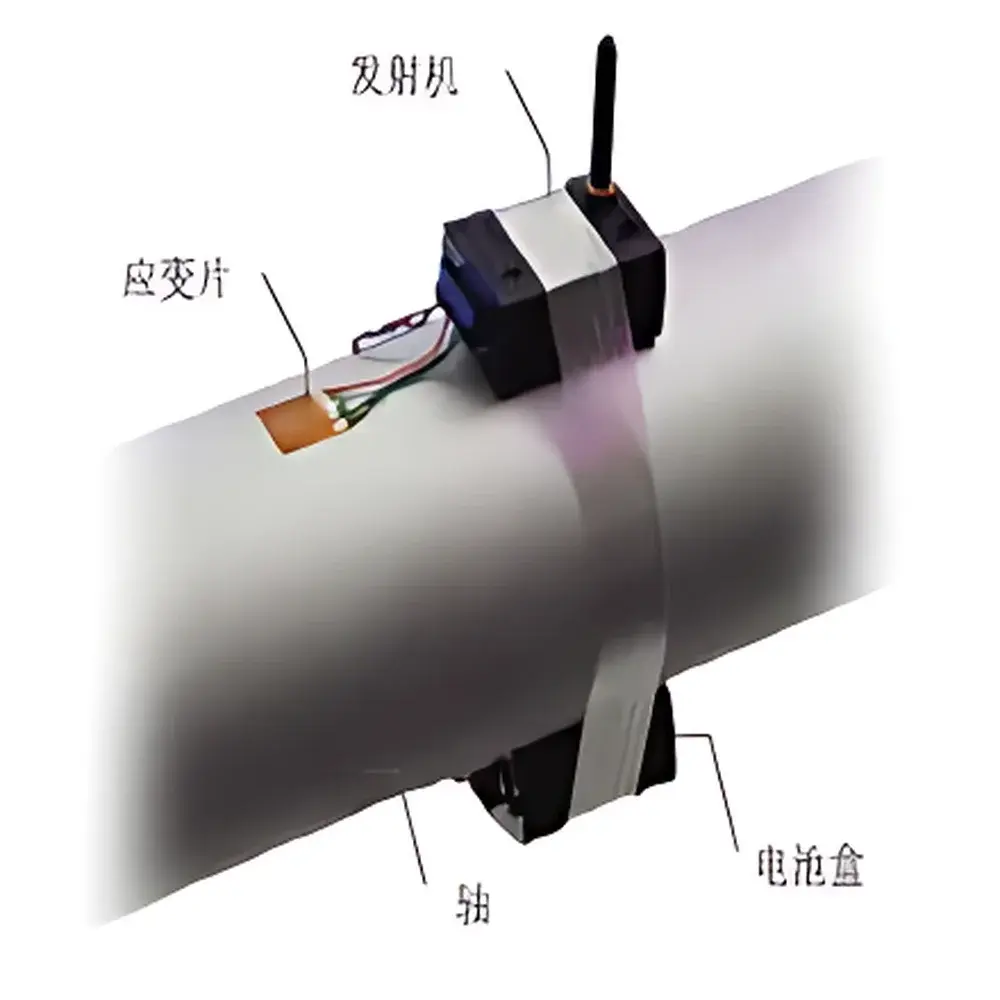
- Non-intrusive installation: No shaft machining, keyway alterations, or disassembly required; transmitter mounts via V-groove base and integrated strap channels for secure, vibration-resistant attachment.
- Infrared remote configuration: Full transmitter parameterization—including channel selection, gain scaling (500–16,000), shunt calibration initiation, and standby mode activation—performed remotely via handheld IR controller without physical access to the rotating unit.
- Dual-output interface: Simultaneous analog (±10 VDC, field-adjustable gain 0.25× to 4.0×) and digital (RS-232, DB9) outputs ensure compatibility with oscilloscopes, DAQ systems, PLCs, and custom LabVIEW or Python-based acquisition platforms.
- Low-power, long-life operation: Optimized RF electronics and intelligent power management yield 24 hours of continuous operation on a single 9 V lithium battery (350 Ω bridge, 25 °C), with standby current limited to 4 mA typical.
- High-bandwidth signal fidelity: 0–500 Hz frequency response (−3 dB point), configurable low-pass filtering, and 4.2 ms total system latency support accurate capture of transient torsional events—including gear meshing harmonics, clutch engagement spikes, and resonance modes.
- Ruggedized transmitter housing: Injection-molded thermoplastic enclosure rated for −30 °C to +85 °C ambient operation; IP54-equivalent sealing against dust and incidental moisture; optimized mass distribution for minimal rotor imbalance.
Sample Compatibility & Compliance
The TorqueTrak 10K supports full-bridge strain gauges with nominal resistances of 350 Ω (standard) or 1000 Ω (optional), excited at a tightly regulated 2.5 VDC (±0.1%). It is compatible with industry-standard foil or semiconductor gauges applied per ASTM E251 and ISO 14124 guidelines. While the system itself does not carry CE or UKCA marking, its RF emissions comply with FCC Part 15 Subpart C (902–928 MHz band) and Industry Canada RSS-247. When deployed in GLP- or GMP-regulated environments—such as automotive component validation per SAE J2320 or aerospace drivetrain qualification per AS9100—the system supports audit-ready documentation including calibration certificates (traceable to NIST), shunt calibration logs, and user-configurable metadata tagging. The RS-232 output may be integrated into 21 CFR Part 11-compliant data acquisition workflows when paired with validated software and electronic signature controls.
Software & Data Management
The TorqueTrak 10K operates as a hardware-transparent transducer: no proprietary drivers or closed firmware are required. Analog output integrates seamlessly with third-party DAQ hardware (e.g., National Instruments PXI, Keysight DAQ970A). Digital output streams ASCII-formatted torque values at 2400 samples/sec, enabling direct ingestion into MATLAB, Python (via pySerial), or time-series databases such as InfluxDB. Binsfeld provides reference configuration scripts and ASCII protocol documentation for custom integration. All remote settings—including gain, channel ID, and filter cutoff—are stored non-volatilely in the transmitter’s EEPROM. The LCD-equipped receiver includes front-panel navigation keys for local verification of signal health, battery status, and link quality—critical during commissioning or field troubleshooting where PC connectivity is unavailable.
Applications
- Powertrain development: Real-time torque profiling of electric motor/gearbox assemblies, CVT input shafts, and hybrid driveline couplings.
- Rotating machinery diagnostics: Detection of torsional resonance, misalignment-induced harmonic distortion, and bearing-induced torque ripple in pumps, compressors, and turbines.
- Academic and government research: Dynamic torsion characterization of composite drive shafts, bio-mechanical joint simulators, and wind turbine drivetrain prototypes.
- Production line verification: In-process torque validation for assembled differentials, transfer cases, and servo-coupled actuators prior to final packaging.
- Calibration lab support: Secondary reference for static and dynamic torque calibrators per ISO/IEC 17025 requirements, using shunt-calibrated traceability paths.
FAQ
Can the TT10K measure torque on hollow or non-circular shafts?
Yes—provided a full-bridge strain gauge rosette is properly mounted and temperature-compensated per ASTM E1238, the system measures surface shear strain independent of cross-sectional geometry. Calibration must account for polar moment of inertia and material modulus.
Is synchronization across multiple TT10K units supported?
No inherent master-slave timing synchronization is provided; however, all units operate at identical sampling rates (2400 S/sec) and share the same RF bandwidth. Time alignment in post-processing is achievable using embedded timestamp markers or external trigger inputs via auxiliary I/O (available on custom firmware variants).
What is the maximum recommended shaft speed for reliable telemetry?
The transmitter is validated to 5700 RPM on a 102 mm diameter shaft (3000 g). For higher speeds, centrifugal loading must be verified against the transmitter’s mechanical retention margin and RF antenna pattern stability.
Does the system support hot-swappable battery replacement during operation?
No—battery replacement requires brief interruption. However, the standby mode reduces current draw to 4 mA, permitting extended runtime between changes without full shutdown.
Can the RS-232 output be converted to USB or Ethernet for modern data acquisition?
Yes—standard FTDI-based USB-to-serial adapters or industrial RS-232-to-Ethernet gateways (e.g., Moxa NPort) maintain full protocol fidelity and are widely used in production deployments.



