
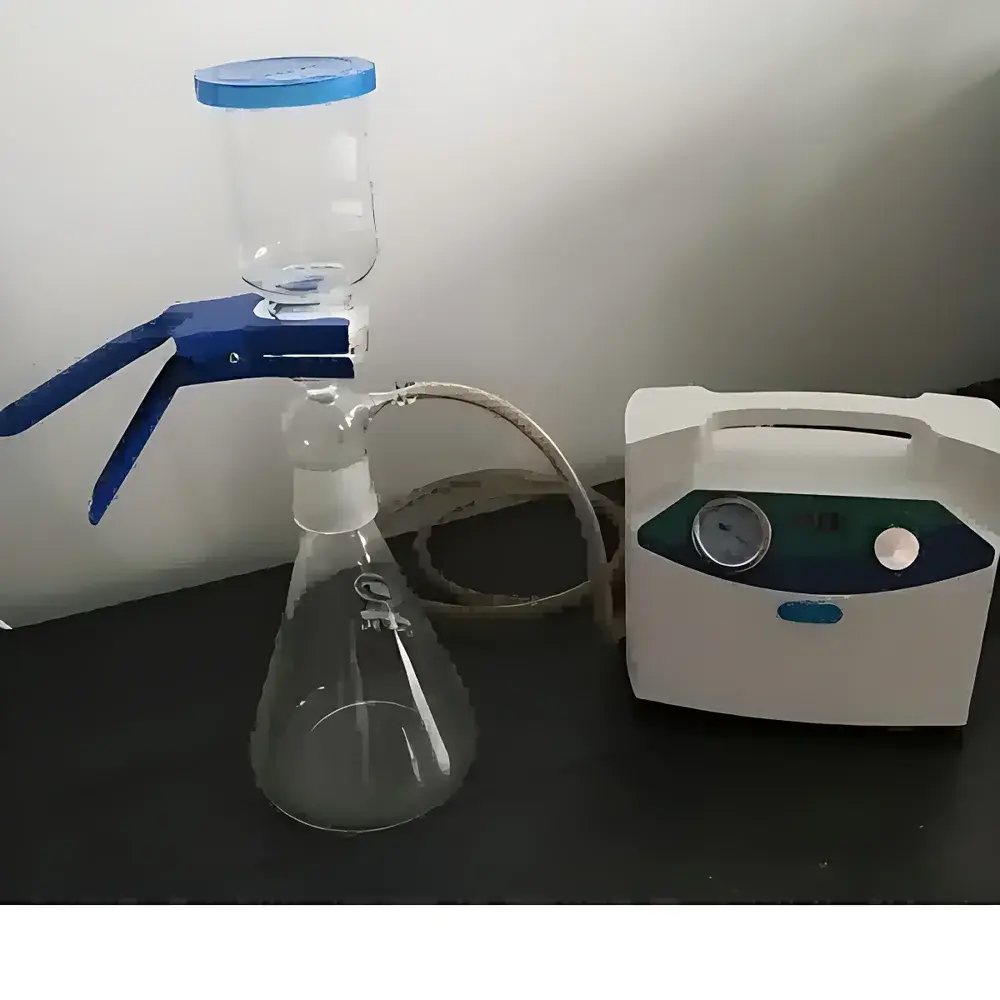
PULL PLD-11901 Laboratory Suspended Solids Analyzer
| Brand | PULL |
|---|---|
| Origin | Shaanxi, China |
| Model | PLD-11901 |
| Instrument Type | Benchtop Water Quality Analyzer |
| Detection Principle | Gravimetric Filtration (0.45 µm membrane) |
| Filter Membrane | Glass Fiber or Quantitative Filter Paper (φ50 mm or φ60 mm, pore size 0.45 µm) |
| Drying Temperature | 103–105 °C (controlled at 104 ± 1 °C) |
| Weighing Accuracy | ≥ 0.1 mg |
| Vacuum Pressure Range | 20–80 kPa |
| Maximum Vacuum Flow Rate | ≥ 20 L/min |
| Noise Level | ≤ 60 dB(A) |
| Power Supply | AC 220 V ± 10 %, 50 Hz |
| Detection Limit | 2 mg/L |
| Recommended Sample Volume | 100 mL (adjustable for 5–100 mg expected suspended solids mass) |
| Compliance Basis | Aligns with ISO 11923:1997, EPA Method 160.2, and GB/T 11901–1989 |
Overview
The PULL PLD-11901 Laboratory Suspended Solids Analyzer is a precision gravimetric instrumentation system engineered for the standardized determination of total suspended solids (TSS) in aqueous matrices. It implements the internationally recognized filtration–drying–weighing methodology defined in ISO 11923:1997 (Water quality — Determination of suspended solids — Gravimetric method), EPA Method 160.2 (Suspended Solids by Filtration), and China’s national standard GB/T 11901–1989. The instrument integrates a vacuum-assisted filtration module, thermally stable drying control interface, and ergonomic sample handling design to ensure procedural consistency across environmental monitoring laboratories. Unlike optical or turbidimetric alternatives, the PLD-11901 delivers traceable, mass-based quantification—critical for regulatory reporting, wastewater treatment process control, and compliance auditing under ISO/IEC 17025-accredited environments.
Key Features
- Integrated vacuum filtration station with adjustable negative pressure (20–80 kPa) and flow rate ≥20 L/min, enabling rapid, uniform filtration of high-turbidity samples without membrane clogging.
- Thermally stabilized drying interface calibrated to maintain 104 ± 1 °C—precisely matching the ISO-specified range of 103–105 °C for moisture removal while minimizing organic volatilization.
- Dual-format membrane compatibility: supports both glass fiber filters (standard for low-blank applications) and quantitative filter papers (φ50 mm or φ60 mm, 0.45 µm pore size), with integrated membrane positioning guides and leak-proof sealing.
- Acoustically optimized enclosure (<60 dB[A]) suitable for shared laboratory spaces; EMI-shielded power management compliant with IEC 61000-4 series standards.
- Modular hardware architecture—vacuum pump, filtration manifold, and control panel are serviceably decoupled for field-level maintenance and calibration verification.
- No embedded software or data storage: designed explicitly for GLP/GMP workflows requiring full analyst control over raw weighing records and manual chain-of-custody documentation.
Sample Compatibility & Compliance
The PLD-11901 is validated for use with surface water, groundwater, domestic wastewater, and industrial effluents—provided particulate matter is non-buoyant and fully suspended (i.e., excludes floating scum or settled sediments per ISO 11923 Clause 4.2). Sample volumes are user-selectable (typically 100 mL, scalable between 50–1000 mL) to accommodate expected TSS concentrations ranging from 2 mg/L to >1000 mg/L. All wetted components contact only Class I reagent-grade water or equivalent; no chemical reagents are consumed during analysis. The system meets essential requirements for regulatory submission under US EPA NPDES permits, EU Urban Wastewater Treatment Directive (91/271/EEC), and China’s HJ 91.1–2019 technical guidelines. While the analyzer itself does not generate electronic records, its operational parameters align with FDA 21 CFR Part 11 Annex 11 principles when paired with certified analytical balances and validated laboratory notebooks.
Software & Data Management
The PLD-11901 operates as a hardware-only platform—intentionally omitting onboard firmware, touchscreens, or automated data logging. This design reflects strict adherence to gravimetric method integrity: all mass measurements must originate from independently calibrated analytical balances (≥0.1 mg resolution), and all procedural steps—including membrane pre-weighing, post-filtration drying cycles, and final residue mass determination—are manually recorded by the analyst. Laboratories implementing this instrument retain full ownership of raw data provenance, facilitating audit-ready documentation for ISO/IEC 17025 accreditation assessments. Optional integration with LIMS systems is achieved via external balance RS-232/USB output and standardized CSV export protocols—not through proprietary drivers.
Applications
- Regulatory TSS quantification for discharge monitoring under national water quality standards (e.g., China’s GB 3838–2002, US EPA Clean Water Act Section 402).
- Performance evaluation of primary sedimentation tanks, dissolved air flotation units, and membrane bioreactors in municipal and industrial WWTPs.
- Baseline characterization of source waters prior to coagulation–flocculation trials or filter media selection studies.
- Method validation and reference material verification in metrology laboratories accredited to ISO/IEC 17025.
- Educational training in standard methods for environmental chemistry and water engineering curricula.
FAQ
What filtration membrane specifications are required?
Glass fiber filters (e.g., Whatman GF/C or equivalent) or ashless quantitative filter paper (e.g., Grade 41 or 42) with nominal pore size 0.45 µm and diameter 50 mm or 60 mm.
Can the PLD-11901 be used for saline or high-conductivity samples?
Yes—provided membranes are pre-rinsed with deionized water and samples are filtered immediately after collection; no salt precipitation artifacts are introduced under standard operating conditions.
Is calibration certification included with shipment?
No—calibration must be performed using NIST-traceable weights and verified against local metrological standards prior to first use; a calibration checklist and verification protocol are provided in the operator manual.
Does the system comply with GLP requirements?
Yes—the absence of automated data capture ensures full analyst accountability, and all procedural parameters (drying time, temperature, vacuum setpoint) are manually logged per OECD GLP Principles Section 5.2.
What maintenance intervals are recommended for the vacuum pump?
Oil-lubricated pumps require oil replacement every 500 operating hours; dry diaphragm variants require inspection every 1,000 hours—both outlined in the preventive maintenance schedule (Section 7.3 of the technical manual).







