
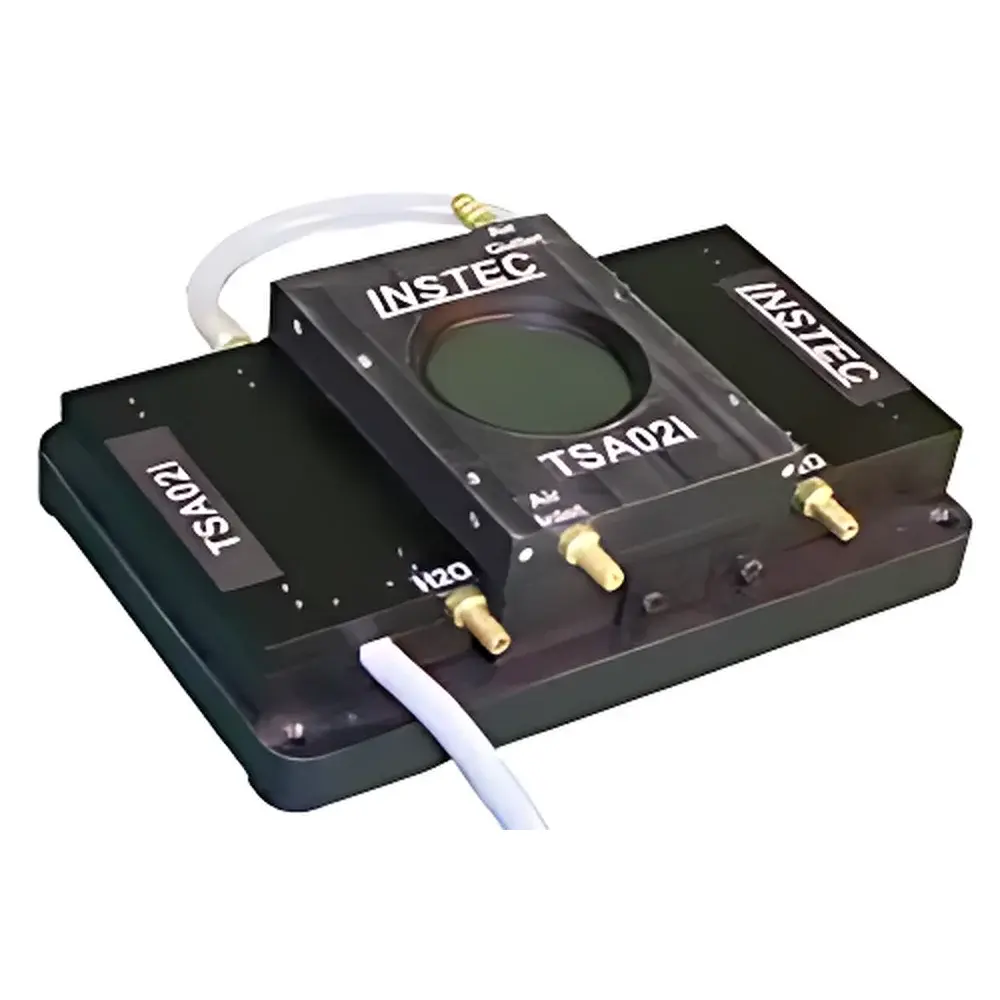
Instec TSA02i Peltier-Based Inverted Microscope Heating and Cooling Stage
| Brand | Instec |
|---|---|
| Origin | USA |
| Model | TSA02i |
| Temperature Range | –25°C to +60°C (optional extended range available) |
| Temperature Resolution | ±0.01°C at 37°C |
| Temperature Stability | ±0.1°C/hour |
| Max Heating Rate | +50°C/min at 37°C |
| Max Cooling Rate | –50°C/min at 37°C |
| Sample Area | 53 mm × 78 mm |
| Viewing Aperture | 17 mm (with sample plate), 40 mm (without sample plate) |
| Working Distance | 1.3 mm (standard), 2.8 mm (with sample plate), 14.6 mm (inner cover only) |
| Chamber Height | 12.8 mm (inner cover), 32 mm (outer cover) |
| Condenser Clearance | 35 mm (with outer cover), 14.6 mm (inner cover only) |
Overview
The Instec TSA02i is a high-precision, Peltier-based heating and cooling stage engineered specifically for integration with inverted optical microscopes. It enables real-time, in situ thermal analysis of materials under controlled temperature conditions ranging from –25°C to +60°C — with optional extended-range configurations available upon request. Based on solid-state thermoelectric (Peltier) technology, the TSA02i delivers rapid, bidirectional thermal response without mechanical refrigerants or cryogenic fluids, ensuring clean, vibration-free operation critical for high-magnification microscopy. Its design prioritizes optical accessibility and thermal uniformity: the large 53 mm × 78 mm sample chamber accommodates standard and custom substrates, while dual-glazed, defrost-capable windows minimize condensation and maximize transmission across visible and near-IR spectra. The stage supports gas-purged environments (e.g., N₂, dry air) to suppress oxidation or moisture-induced artifacts during phase transition studies — essential for polymer crystallization, liquid crystal alignment, semiconductor thin-film characterization, and biomaterial thermal stability assays.
Key Features
- Peltier-driven thermal actuation with bipolar DC control for symmetric heating and cooling profiles
- High-resolution temperature regulation: ±0.01°C resolution at 37°C; ±0.1°C/hour long-term stability
- Rapid thermal transients: up to +50°C/min heating and –50°C/min cooling rates at 37°C
- Optimized optical path: 40 mm unobstructed transmitted-light aperture (no sample plate), 1.3 mm minimum working distance
- Modular window system: removable, replaceable dual-glass windows with integrated anti-fog/defrost circuitry
- Gas-tight chamber with inlet/outlet ports for inert or dry gas purging (N₂, Ar, synthetic air)
- Flexible sample mounting: variable-height chamber (12.8–32 mm), customizable base plates, and cable feedthroughs for in-chamber electrical biasing
- Integrated 100 Ω platinum RTD sensor with direct PID feedback loop — no external calibration required
- Compatibility with standard inverted microscope nosepieces and condenser assemblies (35 mm clearance with outer cover)
Sample Compatibility & Compliance
The TSA02i supports a broad spectrum of thermally sensitive specimens, including liquid crystals, polymer melts, biological hydrogels, semiconductor wafers, fiber composites, and pharmaceutical co-crystals. Its open architecture permits simultaneous application of electric fields via embedded electrodes or external probes — enabling electro-optic studies of domain reorientation, ferroelectric switching, or electrophoretic mobility. All thermal protocols are fully traceable and reproducible, supporting GLP-compliant workflows. While the device itself is not certified to ISO/IEC 17025, its temperature control architecture aligns with ASTM E29–23 (standard practice for using significant digits in test data), ISO 11357–3 (DSC calibration), and USP environmental monitoring guidelines when deployed in controlled laboratory settings. Data logging adheres to audit-trail principles compatible with FDA 21 CFR Part 11–ready software environments (when used with validated third-party acquisition platforms).
Software & Data Management
The TSA02i operates via Instec’s TED4070 temperature controller — a dedicated hardware interface featuring front-panel navigation, real-time graphing, and programmable ramp/soak sequences. Communication occurs over RS-232 or USB to host PCs running Instec’s proprietary control software (Windows-compatible). The software allows full scripting of multi-step thermal profiles, synchronized image capture triggers (via TTL output), and export of time-stamped temperature logs in CSV format. Users may annotate experiments with metadata (operator ID, sample ID, ambient RH/T), overlay temperature curves on microscope video streams, and generate PDF reports compliant with internal lab documentation standards. No configuration parameters affecting hardware safety margins (e.g., current limits, sensor gain) are exposed in the GUI — these remain locked per factory calibration to ensure measurement integrity and regulatory defensibility.
Applications
- In situ observation of polymer melting/crystallization kinetics and lamellar morphology evolution
- Phase transition mapping of lyotropic and thermotropic liquid crystals under thermal and electric field gradients
- Thermal stress testing of microelectronic packaging interfaces and solder joint reliability
- Hydration/dehydration dynamics in biopolymer films and hydrogel networks
- Crystal nucleation and growth studies in small-molecule pharmaceuticals and co-crystal screening
- Thermally induced conformational changes in protein-lipid bilayers and membrane mimetics
- Calibration and validation of infrared thermal imaging systems using traceable reference samples
FAQ
What is the minimum working distance when using the TSA02i with a high-NA objective?
The minimum working distance is 1.3 mm with the standard configuration. With the outer window removed and no sample plate installed, the working distance increases to 2.8 mm — accommodating longer-working-distance objectives while preserving thermal isolation.
Can the chamber be evacuated?
No — the TSA02i is designed for positive-pressure gas purging only. Vacuum operation is not supported due to structural and sealing constraints inherent to its Peltier-cooled architecture.
Is the TED4070 controller compatible with LabVIEW or Python?
Yes — Instec provides documented SCPI-style command sets and DLL libraries for integration into LabVIEW, MATLAB, Python (pySerial), and other automation frameworks. Custom drivers are available under NDA for OEM deployment.
How often does the recirculating chiller require maintenance?
The external chiller (required for heat rejection) must maintain coolant temperature ≥5°C below the lowest setpoint. Annual inspection of pump seals, fluid level, and filter integrity is recommended. Deionized water with biocide additive should be replaced every 12 months to prevent microbial growth and corrosion.
Does the TSA02i support humidity control?
Not natively — relative humidity is managed externally via pre-conditioned purge gas. For RH-controlled experiments, users integrate the TSA02i into a larger environmental enclosure equipped with calibrated humidity sensors and vapor delivery modules.



