
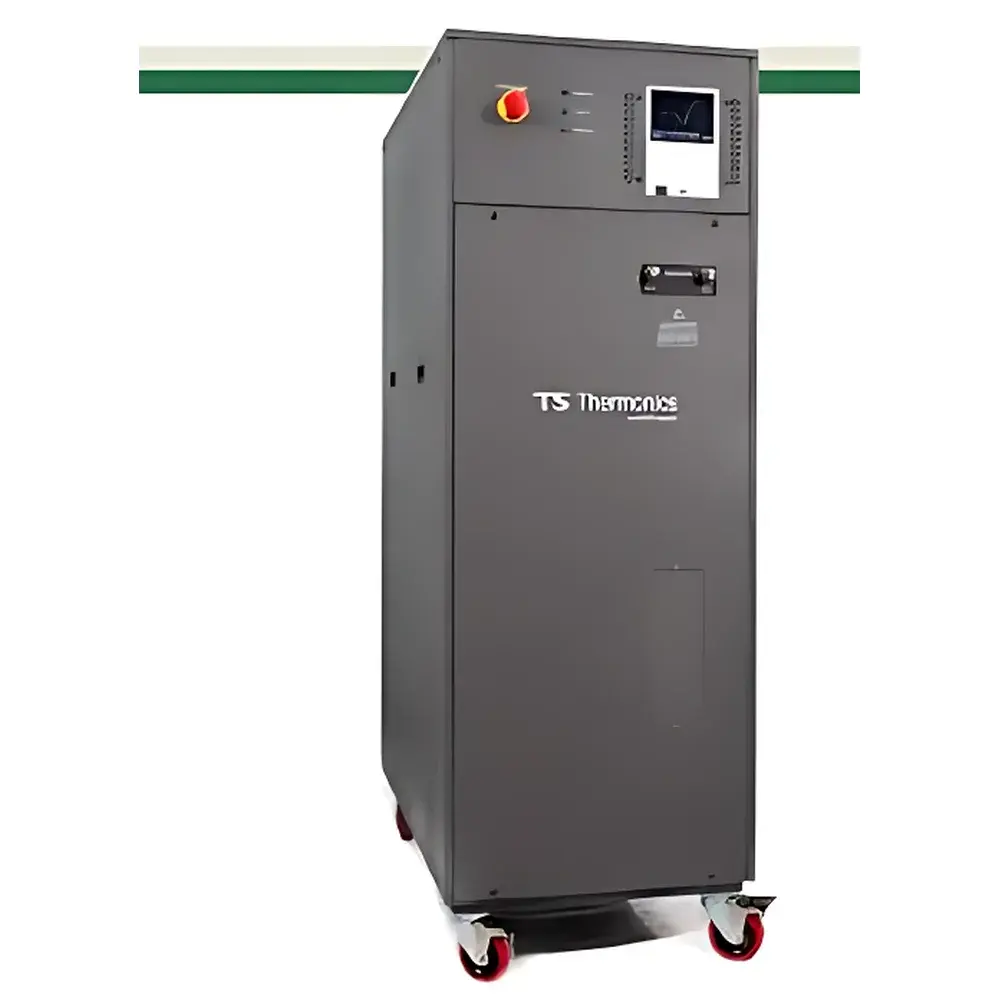
inTEST-Thermonics T-Series Ultra-Low Temperature Circulating Chiller
| Brand | inTEST-Thermonics |
|---|---|
| Origin | USA |
| Type | Integrated Circulating Chiller |
| Cooling Method | Water-Cooled |
| Temperature Range | –80 °C to +200 °C |
| Temperature Stability | ±0.1 °C |
| Refrigeration Capacity | Up to 15 kW @ 20 °C |
| Circulating Pump Pressure | 2 bar (max 50 PSIG) |
| Flow Rate | 38 L/min |
| Reservoir Volume | Not specified |
| Compatible Heat Transfer Fluids | Syltherm XLT (for –40/–60 °C), HFE-7100 (for –80 °C), HFE-7500, KRYO 60, PEG-based glycols |
| Certifications | ISO 9001, ITAR |
Overview
The inTEST-Thermonics T-Series Ultra-Low Temperature Circulating Chiller is an engineered thermal management system designed for precision temperature control in demanding industrial and research applications requiring stable, reproducible cooling at cryogenic and elevated temperatures. Based on dual-stage or single-stage vapor-compression refrigeration architecture with cascade or natural-standby staging, the T-Series delivers high-fidelity thermal regulation across a broad operational envelope—from –80 °C to +200 °C—using compatible heat transfer fluids (HTFs) such as Syltherm XLT, HFE-7100, HFE-7500, and KRYO 60. Unlike conventional chillers optimized only for ambient-range operation, this system integrates advanced compressor sequencing, fluid-phase monitoring, and pressure-regulated flow control to maintain thermodynamic stability under dynamic load conditions typical of semiconductor process tools, fuel cell test benches, and high-pressure material testing cells. Its modular construction supports both water-cooled and air-cooled configurations, enabling deployment in controlled cleanroom environments or rugged industrial settings where utility infrastructure varies.
Key Features
- Wide operational temperature range: –80 °C to +200 °C, with model-specific calibration and fluid compatibility validation
- Precision temperature stability of ±0.1 °C (typical) over extended dwell periods, verified per ASTM E220 and ISO/IEC 17025 traceable procedures
- High-capacity circulating pump delivering up to 38 L/min at 2 bar maximum discharge pressure, with adjustable flow setpoints and real-time flow monitoring
- Touchscreen HMI with programmable ramp-soak profiles, alarm logging, and self-diagnostics—including refrigerant pressure, HTF level, filter differential, and compressor status
- Remote communication interface supporting Modbus TCP/IP and optional Ethernet/IP for integration into SCADA or MES platforms compliant with ISA-88 and ISA-95 frameworks
- ITAR-controlled design and ISO 9001-certified manufacturing—ensuring compliance with export control requirements and quality management standards applicable to defense, aerospace, and semiconductor supply chains
- Fluid compatibility database pre-validated for common HTFs including synthetic hydrofluoroethers (HFEs), silicone oils, and polyglycol-water mixtures
Sample Compatibility & Compliance
The T-Series chiller is not sample-contacting equipment; it serves as a closed-loop thermal energy transfer medium for external process systems—including wafer chucks, electrochemical cells, pressure vessels, and gas conditioning manifolds. It complies with key regulatory and industry standards governing laboratory and production-grade thermal instrumentation: ISO 9001:2015 for quality management, ITAR (International Traffic in Arms Regulations) for controlled technology export, and UL 61010-1 / IEC 61010-1 for electrical safety in measurement and control equipment. While not directly subject to FDA 21 CFR Part 11, its audit-trail-capable software architecture supports ALCOA+ data integrity principles when integrated with validated laboratory information management systems (LIMS) or electronic lab notebooks (ELN). Fluid selection must conform to material compatibility guidelines published by Dow (Syltherm), 3M (HFE series), and Chemours (KRYO formulations), with documented verification of thermal conductivity, viscosity, and chemical inertness at target operating temperatures.
Software & Data Management
Embedded firmware provides full-cycle thermal program execution—including multi-segment ramps, isothermal holds, and derivative-based event triggers—with timestamped logging of all critical parameters: HTF inlet/outlet temperature, pressure differential, flow rate, compressor run time, and refrigerant saturation points. Data export is supported via USB mass storage or network transfer in CSV format, compatible with MATLAB, Python pandas, and LabVIEW for post-processing. Optional firmware upgrades enable enhanced cybersecurity features—including TLS 1.2 encryption for remote access, role-based user authentication, and configurable audit trail retention (minimum 18 months). The system maintains full GLP/GMP alignment through immutable log entries, electronic signatures for parameter changes, and automated backup of configuration files prior to firmware updates.
Applications
- Semiconductor front-end: Thermal stabilization of ion implantation stages, cryo-probing stations, and wafer-level reliability testers requiring sub-–60 °C chuck temperatures
- Fuel cell R&D: Condensation and CO₂ separation from exhaust streams via precisely controlled low-temperature heat exchangers
- Materials science: In-situ thermal cycling of metallic and ceramic specimens inside high-pressure autoclaves or vacuum chambers
- Automotive battery testing: Simulating extreme ambient thermal loads during EV battery pack validation per ISO 12405 and UN GTR 20 protocols
- Defense electronics: Environmental stress screening of phased-array radar modules using rapid thermal transients between –80 °C and +150 °C
- Chemical process development: Exothermic reaction quenching and catalyst bed temperature profiling in continuous-flow microreactors
FAQ
What heat transfer fluids are certified for use at –80 °C?
HFE-7100 is the primary fluid qualified for sustained operation at –80 °C; its low vapor pressure, non-toxicity, and thermal stability meet ASTM D6987 specifications for low-temperature dielectric coolants.
Is remote monitoring supported out-of-the-box?
Yes—the standard Ethernet port enables Modbus TCP/IP communication; optional firmware enables secure HTTPS-based web interface access with TLS 1.2 encryption.
Can the chiller be integrated into a GMP-compliant manufacturing line?
While the chiller itself is not a GMP device, its data logging, audit trail, and electronic signature capabilities support qualification under Annex 11 and 21 CFR Part 11 when deployed within a validated thermal control subsystem.
What is the maximum allowable backpressure at the outlet port?
The system is rated for continuous operation at ≤50 PSIG (3.4 bar) static backpressure; higher values require custom pump head configuration and fluid compatibility reassessment.
Does the unit include predictive maintenance diagnostics?
Yes—embedded algorithms monitor compressor current draw, refrigerant superheat, and HTF viscosity drift trends to flag potential degradation before failure, generating actionable alerts via email or SNMP trap.



