
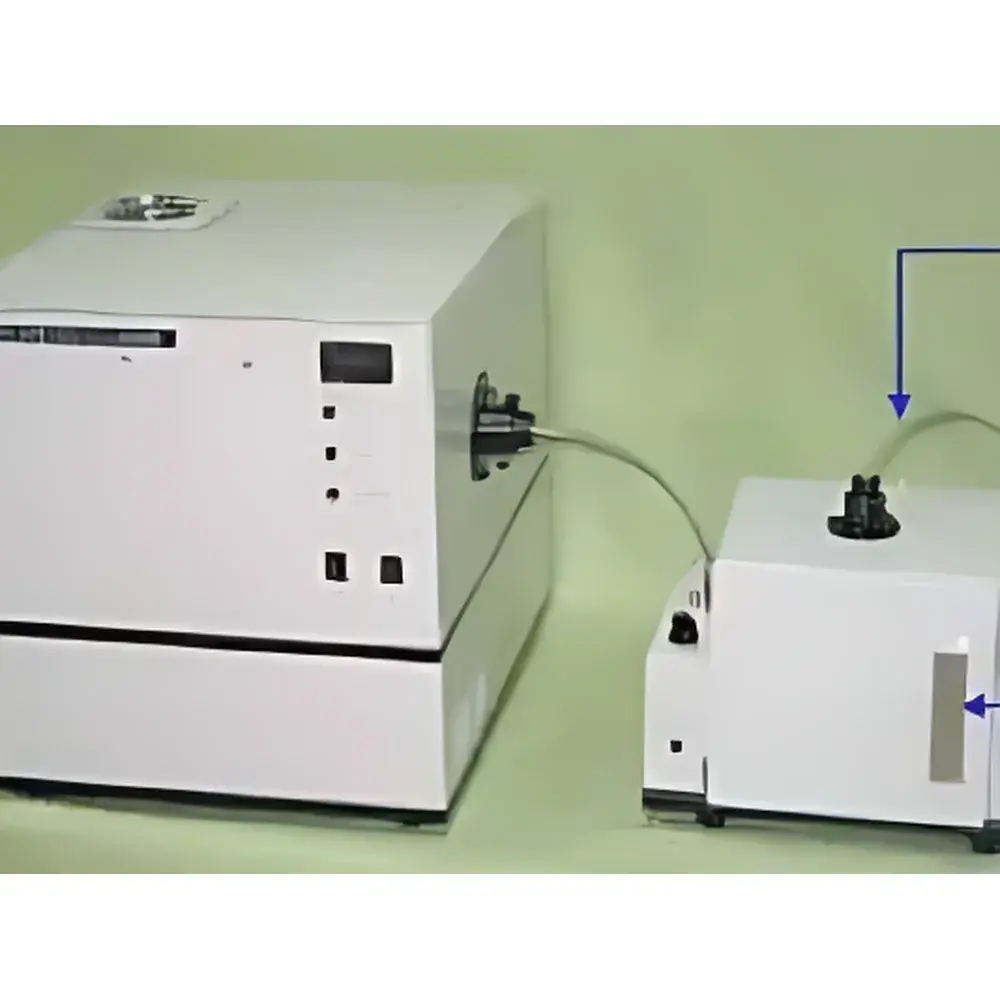
IPCE Solar Cell Quantum Efficiency Measurement System
| Origin | Germany |
|---|---|
| Manufacturer Type | Distributor |
| Origin Category | Imported |
| Model | IPCE |
| Price | €40,000 |
| Measurement Mode | AC |
Overview
The IPCE Solar Cell Quantum Efficiency Measurement System is a precision optical-electronic instrumentation platform engineered for the quantitative characterization of incident photon-to-current conversion efficiency (IPCE) in photovoltaic devices and photoactive materials. Based on the fundamental principle of monochromatic photocurrent spectroscopy, the system illuminates a sample with spectrally resolved, intensity-stabilized light and measures the resulting photocurrent under controlled bias and illumination conditions. This enables direct calculation of wavelength-resolved external quantum efficiency (EQE), a critical parameter for evaluating spectral response, charge carrier generation, and interfacial recombination losses in solar cells—including perovskite, organic, dye-sensitized (DSSC), and silicon-based architectures. Designed for research-grade reproducibility and traceable calibration, the system supports both steady-state and modulated (AC) measurement protocols to suppress noise and enhance signal-to-noise ratio in low-current regimes.
Key Features
- Stabilized 150 W xenon arc lamp with dedicated constant-current power supply, delivering high-intensity, broadband output suitable for spectral scanning from UV to NIR.
- High-throughput monochromator with 10 cm focal length, F/3.0 optical design, and ≤2 nm optical resolution—ensuring precise spectral isolation and minimal stray light.
- Wavelength coverage standard from 400–800 nm; optional extension to 300–1000 nm to accommodate wide-bandgap and NIR-absorbing materials.
- Calibrated irradiance of 2 mW/cm² at 480 nm, delivered via fused silica optical fiber with 3 mm diameter spot size—enabling uniform, localized excitation without thermal artifacts.
- Adjustable sample stage with vertical height control for optimal alignment between fiber output, sample surface, and reference detector.
- AC lock-in detection architecture synchronized with modulated light source, providing enhanced sensitivity for sub-nA photocurrent measurements and effective rejection of 1/f and environmental noise.
Sample Compatibility & Compliance
The system accommodates standard solar cell geometries including rigid substrates (glass/FTO, Si wafers), flexible films, and lab-scale coated electrodes (e.g., spin-coated perovskite layers). Sample holders are electrically isolated and compatible with four-terminal sensing configurations for accurate series resistance compensation. All optical components comply with ISO 9022-3 (optical instrument environmental testing) and meet CE marking requirements for electromagnetic compatibility (EMC Directive 2014/30/EU) and low-voltage safety (LVD Directive 2014/35/EU). The measurement methodology aligns with ASTM E1021–22 “Standard Test Methods for Spectral Responsivity Measurements of Photovoltaic Devices” and supports traceability to NIST-traceable silicon photodiode standards.
Software & Data Management
Control and data acquisition are managed through a dedicated Windows-based application via USB 2.0 interface. The software provides real-time spectral scanning, automatic wavelength calibration using built-in reference lines, and simultaneous acquisition of photocurrent, bias voltage, and reference detector signal. Raw data are exported in CSV and HDF5 formats for post-processing in MATLAB, Python (NumPy/Pandas), or Origin. Audit trails, user access levels, and timestamped metadata are recorded per measurement session—supporting GLP-compliant documentation and facilitating FDA 21 CFR Part 11 readiness when deployed in regulated R&D environments.
Applications
- Wavelength-resolved EQE mapping of emerging photovoltaic absorbers (e.g., CsPbBr₃, Sn-Pb perovskites, non-fullerene acceptors).
- Interface engineering validation—quantifying charge extraction efficiency at electron/hole transport layer junctions.
- Light-soaking and bias-dependent EQE analysis to probe metastable defect states and ion migration effects.
- Calibration of reference solar cells used in outdoor PV performance monitoring and spectral mismatch correction.
- Correlation of EQE spectra with absorption, PL quantum yield, and transient photocurrent data for mechanistic photophysics studies.
FAQ
What is the difference between IPCE and EQE?
IPCE (Incident Photon-to-Current Efficiency) is numerically identical to External Quantum Efficiency (EQE); both express the ratio of collected electrons per incident photon as a function of wavelength. The term IPCE is historically common in solar cell literature, while EQE is the standardized IEC/ASTM designation.
Can the system measure under bias or illumination bias?
Yes—the software supports programmable DC bias application (±10 V range) and simultaneous white-light bias illumination (via optional LED array) to simulate operating conditions and assess voltage-dependent spectral response.
Is spectral calibration performed automatically?
Yes—built-in mercury-argon emission lines enable automated wavelength calibration prior to each scan sequence, ensuring long-term repeatability across instrument lifetime.
Does the system support integration with potentiostats?
The system includes analog voltage/current I/O ports compatible with third-party potentiostats (e.g., BioLogic SP-300, CH Instruments) for advanced electrochemical photocurrent spectroscopy (ECS) configurations.
What maintenance is required for the xenon lamp and monochromator?
Xenon lamps require replacement every ~1,000 hours of operation; monochromator gratings and mirrors are sealed and maintenance-free under normal laboratory conditions—no user-accessible optical alignment is needed.





