
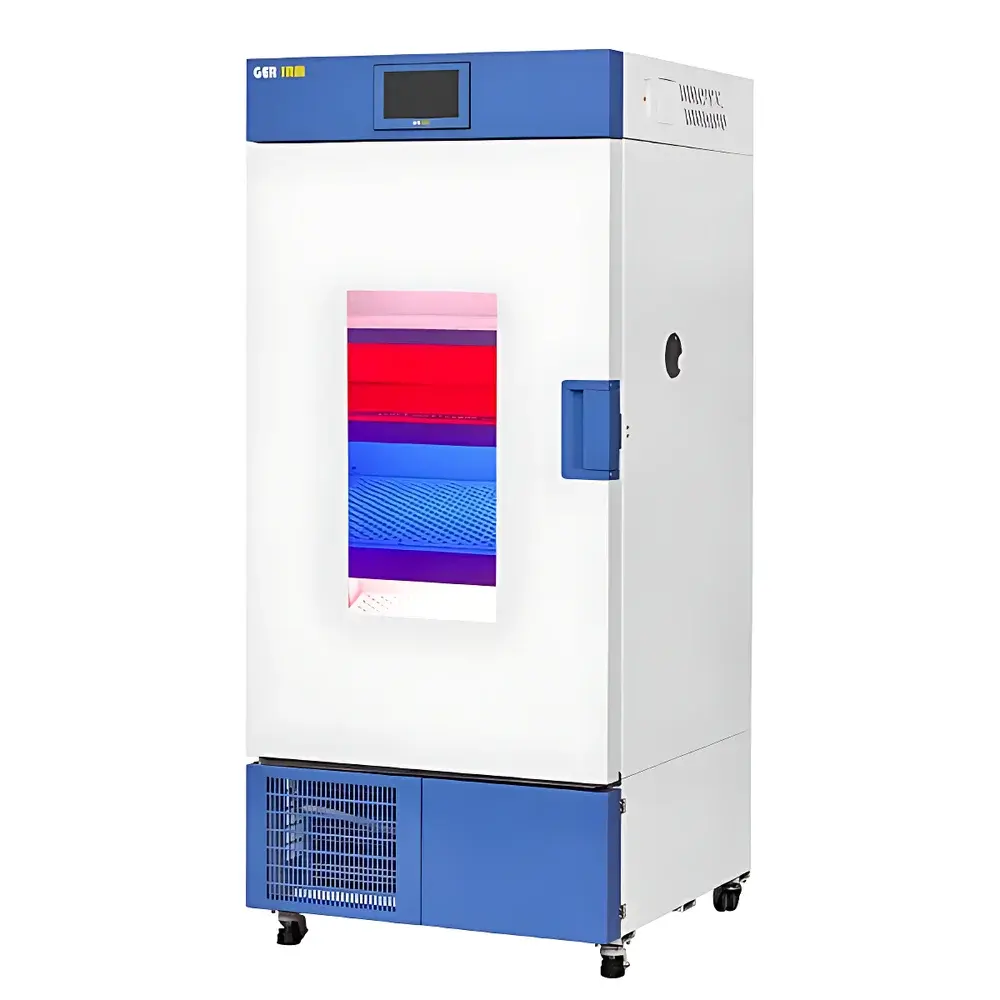
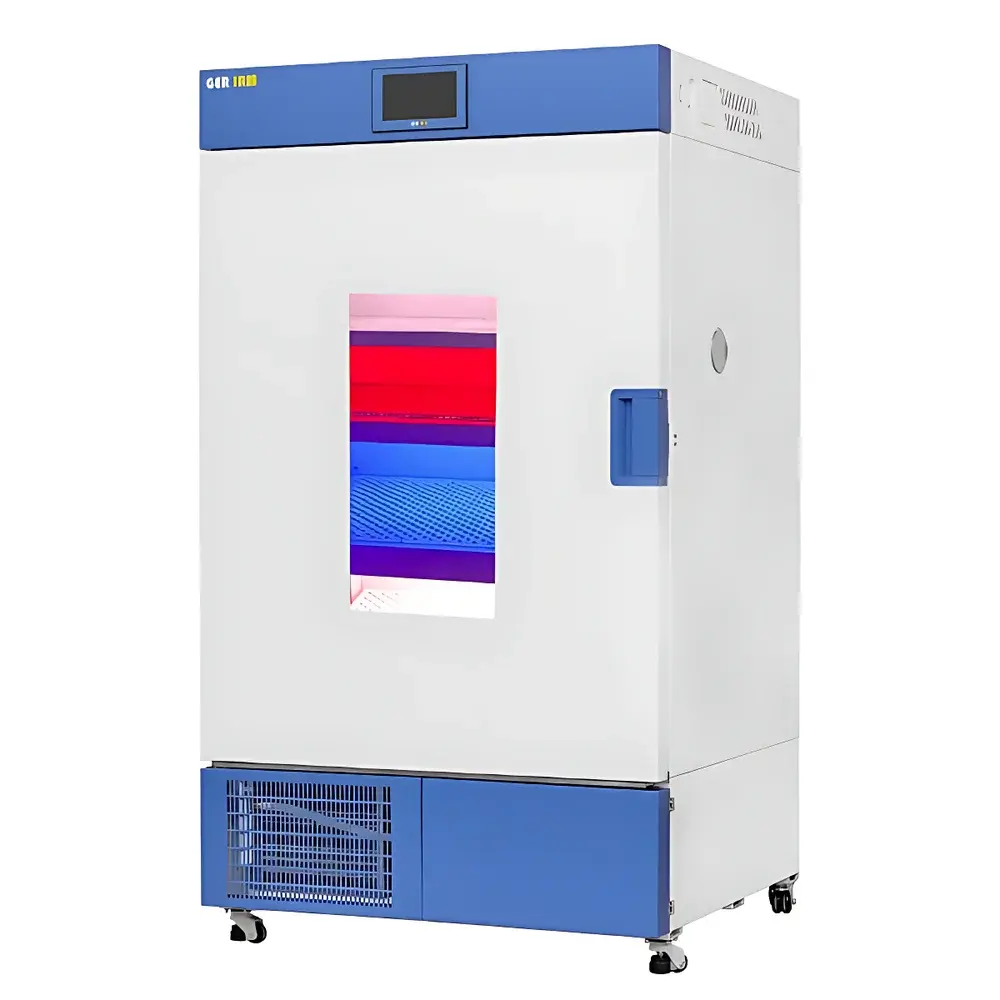

IRM IP260 Advanced Plant Growth Chamber
| Brand | IRM |
|---|---|
| Origin | Beijing, China |
| Manufacturer Type | Direct Manufacturer |
| Model | IP260 |
| Illumination Method | Shelf-Integrated LED Lighting |
| Light Source | High-Efficiency White LED |
| Spectral Range | Visible Spectrum (400–700 nm) |
| Temperature Range | 10–65°C (with illumination), 0–65°C (without illumination) |
| Temperature Fluctuation | ±0.3°C |
| Temperature Uniformity | ±1.0°C (at 20°C, same shelf) |
| Humidity Range | 30–95% RH |
| Photosynthetic Photon Flux Density (PPFD) | 0–500 µmol/m²/s |
| Chamber Volume | 305 L |
| External Dimensions (W×D×H) | 780 × 790 × 1600 mm |
Overview
The IRM IP260 Advanced Plant Growth Chamber is a fully integrated, research-grade environmental control system engineered for reproducible plant phenotyping, seed germination studies, photobiology experiments, and controlled-environment agriculture (CEA) research. It operates on a dual-mode thermal management architecture—combining high-efficiency variable-frequency refrigeration with precision PID-driven heating—to maintain stable setpoints across wide operational ranges. Unlike conventional incubators, the IP260 implements IRM’s proprietary iHACC (intelligent Hybrid Air Conditioning & Control) technology, enabling continuous frost-free operation above 20°C while minimizing thermal gradients and condensation risks. Its forced-air convection system ensures uniform distribution of temperature, humidity, and light across the entire growth volume, critical for longitudinal studies requiring inter-replicate comparability. The chamber supports simultaneous, independent regulation of temperature, photosynthetic irradiance, relative humidity (optional), and CO₂ concentration (optional add-on), making it compliant with experimental protocols defined in ASTM E1822, ISO 21748, and FAO/IAEA guidelines for controlled-environment plant trials.
Key Features
- 7-inch industrial-grade capacitive touchscreen interface with multi-level user authentication (Level 1–3), audit-trail-enabled event logging, and real-time graphical display of all environmental parameters
- Variable-speed centrifugal fan system with adjustable airflow profiles to prevent desiccation of delicate seedlings or tissue cultures
- Integrated water reservoir with auto-refill function, overflow protection, and wastewater recirculation design—reducing manual maintenance intervals by up to 70% compared to standard humidification systems
- Shelf-integrated LED lighting array delivering uniform PPFD (0–500 µmol/m²/s) across the full growth plane; spectral output optimized for PAR (Photosynthetically Active Radiation) without UV or far-red leakage
- Dual independent safety architecture: hardware-level redundant overtemperature cutoff (separate from main controller), leak-proof water path monitoring, compressor overpressure protection, and door-open alarm with thermal hold logic
- Two 50-mm-diameter pass-through ports (left/right), each fitted with silicone grommets and vacuum-compatible sealing caps for sensor integration or gas line routing
- Heavy-duty locking casters (load capacity ≥120 kg) enabling safe relocation within laboratory corridors or greenhouse staging areas
Sample Compatibility & Compliance
The IP260 accommodates standard growth containers—including Petri dishes, Magenta boxes, hydroponic rafts, and 10-cm pots—within its 305-L internal volume and 200–1000 mm adjustable vertical clearance. Its ±1.0°C temperature uniformity (measured per ISO 15272 Annex B at 20°C) and ≤±2% RH stability (IPH/IPHC variants) meet GLP requirements for long-term botanical assays. All firmware and data handling modules comply with FDA 21 CFR Part 11 principles: electronic signatures, immutable audit trails, and role-based access control are embedded at the OS level. Optional 4G LTE connectivity enables remote validation of environmental logs against ISO/IEC 17025 traceability standards.
Software & Data Management
Data acquisition occurs at 1-second resolution across all active sensors (PT100 temperature, capacitive RH, quantum sensor, optional NDIR CO₂). Measurements are timestamped, stored locally on encrypted internal flash memory, and exportable via USB 2.0 to CSV or Excel-compatible formats. The embedded operating system supports up to 30 programmable ramp-hold cycles with slope-defined transitions, scheduled start/stop triggers, and power-failure recovery with state retention. Optional cloud gateway firmware enables TLS-secured MQTT transmission to third-party LIMS or ELN platforms, supporting automated report generation aligned with ISO 9001 documentation workflows.
Applications
- Photoperiod-dependent flowering time assays in Arabidopsis thaliana and Brassica species
- Stress physiology studies (drought, heat, or combined abiotic stress) under precisely defined VPD (Vapor Pressure Deficit) conditions
- Micropropagation protocol optimization for orchids and medicinal herbs requiring strict light quality control
- Pre-commercial testing of LED lighting spectra for vertical farming crop yield enhancement
- Regulatory submission support for EPA, EFSA, or PMRA phytotoxicity dossiers requiring documented environmental fidelity
FAQ
Does the IP260 support GLP-compliant data integrity requirements?
Yes—its embedded audit trail records all parameter changes, user logins, alarm events, and calibration actions with tamper-proof timestamps. Exported data files include digital signatures verifiable via SHA-256 hash.
Can the lighting spectrum be customized beyond white LEDs?
Yes—optional monochromatic (e.g., 450 nm blue, 660 nm red) or tunable RGB+FR modules are available as factory-installed configurations, with spectral output certified per CIE S 026/E:2019.
Is remote monitoring possible without local IT infrastructure?
Yes—the optional 4G LTE module operates independently of LAN/WiFi, transmitting real-time status and alerts directly to iOS/Android apps or web dashboards via secure HTTPS endpoints.
What is the maximum allowable ambient temperature for continuous operation?
The unit is rated for ambient temperatures up to 35°C (non-condensing) when operating at 25°C setpoint with 60% RH and full illumination load.
Are validation documents (IQ/OQ/PQ protocols) provided?
IRM supplies standardized qualification templates compliant with Annex 15 of the EU GMP Guide, including sensor calibration certificates traceable to NIST standards. Custom PQ execution support is available under service agreement.




