
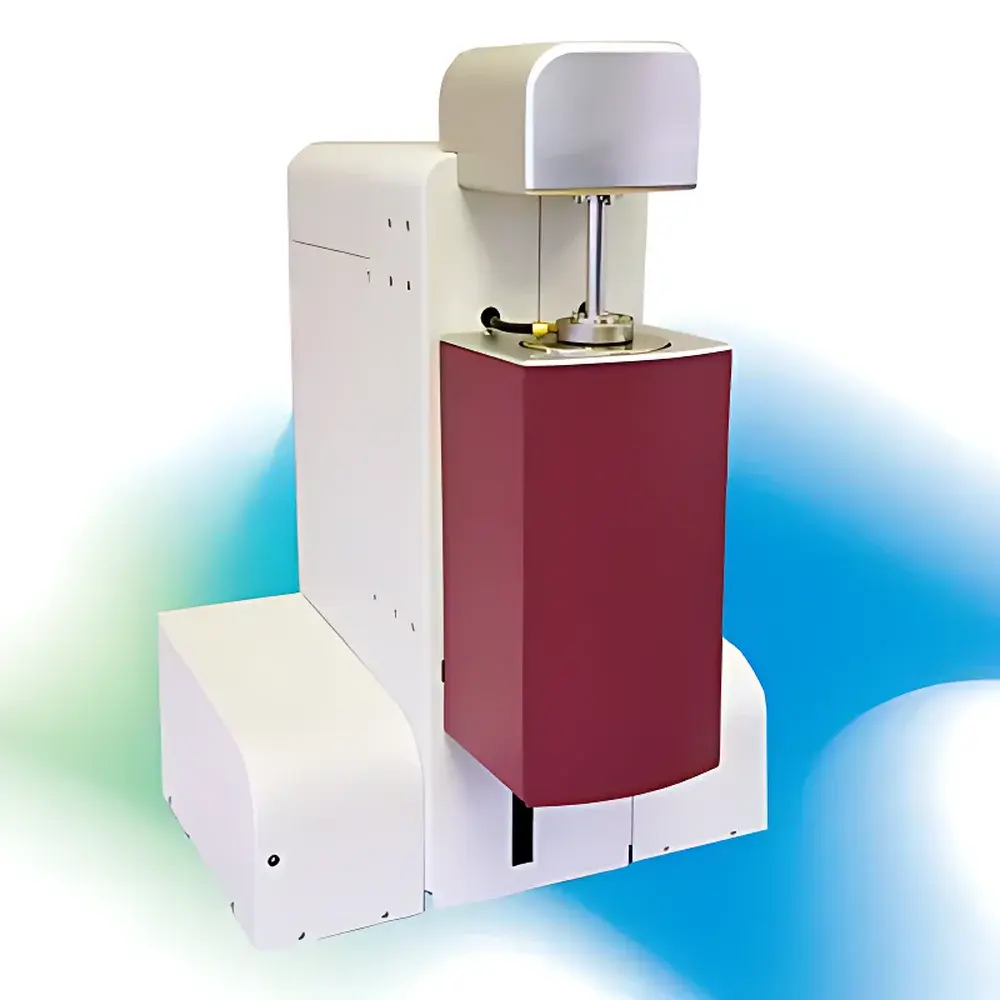
ISI STA 1200 Simultaneous Thermal Analyzer
| Temperature Range | -125–1200°C |
|---|---|
| Heating Rate | 0.1–40°C/min |
| Max Sample Mass | 0.4 g |
| Balance Resolution | 0.1 µg |
Overview
The ISI STA 1200 Simultaneous Thermal Analyzer is an engineered platform for high-precision, real-time coupling of thermogravimetric analysis (TGA) and differential scanning calorimetry (DSC) or differential thermal analysis (DTA). Based on the principle of simultaneous mass and heat flow measurement under controlled temperature programs, the instrument delivers synchronized, time-aligned data streams—enabling unambiguous correlation between endothermic/exothermic events and mass loss/gain phenomena. Its vertical suspension microbalance architecture minimizes buoyancy artifacts and mechanical drift, while the integrated furnace design ensures exceptional thermal homogeneity and reproducibility across the full operating range of –125°C to 1200°C. The system is optimized for applications requiring detection of sub-microgram mass changes (0.1 µg resolution) alongside µW-level thermal signal fidelity—critical for decomposition kinetics, polymorph transitions, oxidative stability assessment, and reaction enthalpy quantification.
Key Features
- Vertical microbalance with 0.1 µg resolution and active drift compensation, enabling detection of minute mass changes during low-mass or slow-decomposition processes
- Modular furnace options: standard 1200°C resistive heating unit; optional LN₂-cooled cryo-furnace for low-temperature studies down to –125°C; high-temperature upgrade path to 1500°C
- Dual independent gas purge system (two mass flow controllers) supporting inert, oxidative, reducing, or reactive atmospheres; configurable for evolved gas analysis (EGA) coupling with FTIR or MS
- Expandable to quad-gas manifold for dynamic atmosphere switching within a single run (e.g., N₂ → air → CO₂ sequence)
- Interchangeable sensor modules: calibrated DSC sensors for quantitative heat capacity and enthalpy measurement; DTA sensors for high-sensitivity qualitative thermal event detection
- Compact purge volume design (< 5 mL) reduces gas consumption and improves response time during atmosphere transitions
- Water-cooled furnace housing maintains external surface temperature below 40°C during extended high-temperature operation
Sample Compatibility & Compliance
The STA 1200 accommodates solid, powder, fiber, thin-film, and small-volume liquid samples (in hermetic pans) with maximum mass loading of 400 mg. Sample containment options include alumina, platinum, gold, and sealed stainless-steel crucibles—compatible with corrosive, volatile, or reactive chemistries. The system complies with ASTM E1131 (standard test method for compositional analysis by TGA), ASTM E1269 (heat capacity by DSC), ISO 11357 series (plastics—DSC), and USP (thermal analysis in pharmaceutical development). Data acquisition and software workflows support 21 CFR Part 11 compliance when configured with electronic signatures, audit trails, and user access controls—meeting GLP and GMP documentation requirements for regulated laboratories.
Software & Data Management
Controlled exclusively by Infinity Pro—a native Windows-based application—the STA 1200 provides intuitive method setup, real-time multi-channel visualization, and advanced post-run analysis. The software includes baseline correction algorithms (tangent, linear, polynomial), peak deconvolution (Gaussian/Lorentzian fitting), kinetic modeling (Friedman, Ozawa-Flynn-Wall, Kissinger-Akahira-Sunose), and automatic onset/melting/peak temperature identification. All raw and processed data are stored in vendor-neutral ASCII formats (.txt, .csv) alongside metadata-rich .isd project files. Export modules integrate directly with MATLAB, OriginLab, and Python-based analysis pipelines via documented APIs. Audit trail logs record operator ID, timestamp, parameter changes, calibration events, and data export actions—fully traceable for internal QA review or regulatory inspection.
Applications
The STA 1200 serves as a core characterization tool across R&D and QC environments. In polymer science, it quantifies degradation onset, filler content, and residual solvent. For pharmaceuticals, it validates polymorphic purity, hydrate/dehydrate transitions, and excipient compatibility. Ceramic and metallurgical labs use it to map phase transformations, sintering behavior, and oxidation kinetics. Energy materials researchers apply it to battery cathode thermal runaway profiling, coal combustion staging, and catalyst deactivation mechanisms. Additional validated use cases include nuclear fuel stability screening, food matrix water-binding analysis, explosive sensitivity assessment, and high-temperature superconductor transition characterization—all leveraging the instrument’s ability to resolve coupled thermal–mass events with temporal precision better than ±0.1 s.
FAQ
What is the difference between DSC and DTA modes on the STA 1200?
DSC mode delivers quantitative heat flow data (mW) referenced to known standards, enabling enthalpy calculation; DTA mode measures temperature difference (°C) between sample and reference, offering higher sensitivity for detecting subtle thermal events without absolute calibration.
Can the STA 1200 be used under vacuum conditions?
Yes—the dual-gas system supports vacuum purging via continuous sweep; optional vacuum-compatible furnace seals and pressure-rated viewports enable operation down to 10⁻² mbar when paired with external vacuum pumps.
Is calibration traceable to NIST standards?
All temperature, mass, and enthalpy calibrations use NIST-traceable reference materials (e.g., indium, zinc, nickel, calcium oxalate monohydrate), with certificate documentation provided per installation and annual verification.
How does the system handle moisture-sensitive samples?
The integrated glove-box interface option allows direct sample loading under argon or nitrogen atmosphere; additionally, hermetically sealed crucibles with laser-welded lids prevent ambient moisture ingress during analysis.
Does Infinity Pro support automated reporting for ISO/IEC 17025 accreditation?
Yes—customizable report templates include instrument ID, calibration status, analyst signature fields, uncertainty statements, and raw data embedding, fully compliant with ISO/IEC 17025 clause 7.8 requirements for result reporting.



