
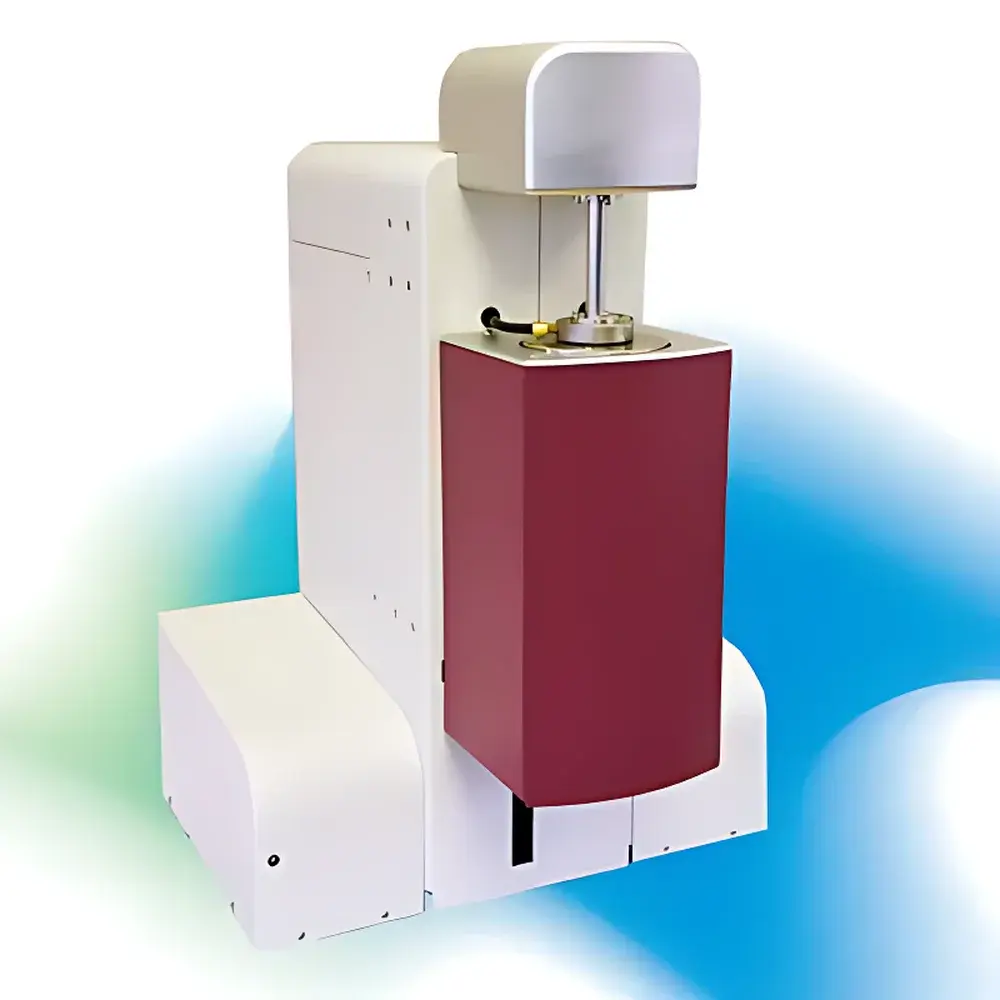
ISI STA 650 Simultaneous Thermal Analyzer
| Brand | ISI |
|---|---|
| Origin | USA |
| Model | STA 650 |
| Temperature Range | –125 to 650 °C |
| Heating Rate | 0.1–100 °C/min |
| Maximum Sample Mass | 400 mg |
| Balance Resolution | 0.1 µg |
| Software | Infinity Pro Thermal Analysis Suite |
Overview
The ISI STA 650 Simultaneous Thermal Analyzer is an engineered platform for high-precision, real-time concurrent measurement of thermal transitions and mass changes under controlled atmospheric conditions. Based on the principle of simultaneous differential scanning calorimetry (DSC) or differential thermal analysis (DTA) coupled with thermogravimetric analysis (TGA), the instrument delivers synchronized, time-aligned data streams—enabling unambiguous correlation between enthalpic events (e.g., melting, crystallization, decomposition) and mass-loss/gain phenomena (e.g., dehydration, oxidation, volatilization). Its vertical suspension microbalance architecture minimizes buoyancy artifacts and mechanical drift, while the optimized furnace geometry ensures exceptional temperature homogeneity and rapid thermal response. Designed for laboratories requiring trace-level sensitivity and reproducible baseline stability, the STA 650 supports both ambient and cryogenic operation (down to –125 °C using liquid nitrogen cooling) and integrates seamlessly with evolved gas analysis (EGA) systems via standardized quadrupole mass spectrometer (QMS) or Fourier-transform infrared (FTIR) interfaces.
Key Features
- Vertical microbalance with 0.1 µg resolution and <0.5 µg baseline repeatability over 24 h
- Three interchangeable furnace options: 650 °C standard (STA 650), 1200 °C (STA 1200), and 1500 °C (STA 1500) — all compatible with a single instrument frame
- Selectable DSC or DTA sensor modules, each calibrated per ASTM E1269 and ISO 11357 standards
- Low-volume dual-gas purge system (two independent mass flow controllers) with optional four-channel upgrade for complex gas switching protocols (e.g., O2 → N2 → Ar → synthetic air)
- Cryogenic capability via LN2-cooled furnace assembly, enabling sub-ambient studies down to –125 °C
- Water-cooled furnace housing for extended high-temperature stability and reduced thermal lag
- Modular design supporting future upgrades including humidity control, UV exposure, or magnetic field integration
Sample Compatibility & Compliance
The STA 650 accommodates solid, powder, fiber, thin-film, and pelletized samples up to 400 mg in standard crucibles (alumina, platinum, gold-plated, or sealed stainless steel). Its low thermal inertia and symmetric sample/reference geometry ensure minimal thermal lag and high signal-to-noise ratio across diverse material classes—including polymers with low Tg, hygroscopic pharmaceuticals, refractory ceramics, and energetic materials. The system complies with key regulatory frameworks for analytical instrumentation: data integrity features in Infinity Pro software support audit trails, electronic signatures, and user-access controls aligned with FDA 21 CFR Part 11 requirements; calibration procedures follow ISO/IEC 17025 guidelines; and thermal performance validation adheres to ASTM E1131 (TGA), ASTM E1269 (DSC), and USP <1225> for method verification in GMP environments.
Software & Data Management
Controlled exclusively by Infinity Pro Thermal Analysis Software—a native Windows application built on a modular, object-oriented architecture—the STA 650 enables fully automated method development, real-time data visualization, and advanced post-processing. The interface provides intuitive drag-and-drop protocol building, multi-step temperature programming (including isothermal holds, ramp/hold cycles, and modulation), and synchronized overlay of DSC/DTA, TGA, and derivative (DTG) curves. Built-in algorithms support peak deconvolution, kinetic modeling (e.g., Kissinger, Ozawa-Flynn-Wall), residue quantification, and baseline correction using polynomial or spline fitting. All raw and processed data are stored in vendor-neutral HDF5 format with embedded metadata (instrument ID, operator, calibration history, gas composition), ensuring long-term archival compliance and third-party interoperability.
Applications
The STA 650 serves as a foundational tool in R&D, quality control, and failure analysis across regulated and industrial sectors. Typical use cases include: determination of polymer degradation onset and activation energy in aerospace composites; quantification of bound water and carbonate content in pharmaceutical hydrates per ICH Q5C; assessment of coal rank and ash fusion behavior in energy research; characterization of phase transitions in high-entropy alloys; evaluation of catalyst deactivation mechanisms via coke burn-off profiling; and thermal safety screening of battery cathode materials under inert and oxidative atmospheres. Its ability to resolve overlapping endothermic/exothermic events with concurrent mass loss makes it indispensable for multistep decomposition studies—such as calcium oxalate monohydrate (CaC2O4·H2O), where three distinct weight-loss steps correlate precisely with sequential DSC peaks representing dehydration, decarboxylation, and oxide formation.
FAQ
What is the difference between DSC and DTA modes on the STA 650?
DSC mode measures heat flow difference between sample and reference to quantify enthalpy changes (e.g., ΔHfus), while DTA records temperature difference and is preferred for high-temperature applications above 1000 °C or when absolute enthalpy values are not required.
Can the STA 650 be used for dynamic vapor sorption (DVS) studies?
No—DVS requires continuous humidity control and gravimetric monitoring at constant temperature; however, the STA 650 supports discrete humidity-controlled TGA experiments using optional vapor generators.
Is GLP-compliant calibration documentation provided?
Yes—each instrument ships with a factory-issued calibration certificate traceable to NIST standards, including balance linearity, temperature accuracy (±0.5 °C), and Curie point verification (Ni, Fe, In, Sn, Zn).
Does the Infinity Pro software support automated reporting for regulatory submissions?
Yes—it generates PDF reports with configurable templates, embedded chromatograms (for EGA-coupled runs), statistical summaries, and full audit logs compliant with ALCOA+ principles.
What maintenance intervals are recommended for optimal performance?
Quarterly balance recalibration and annual furnace thermocouple verification are advised; the vacuum-sealed sensor module requires no routine servicing beyond periodic purge gas filter replacement.
Related Products



