
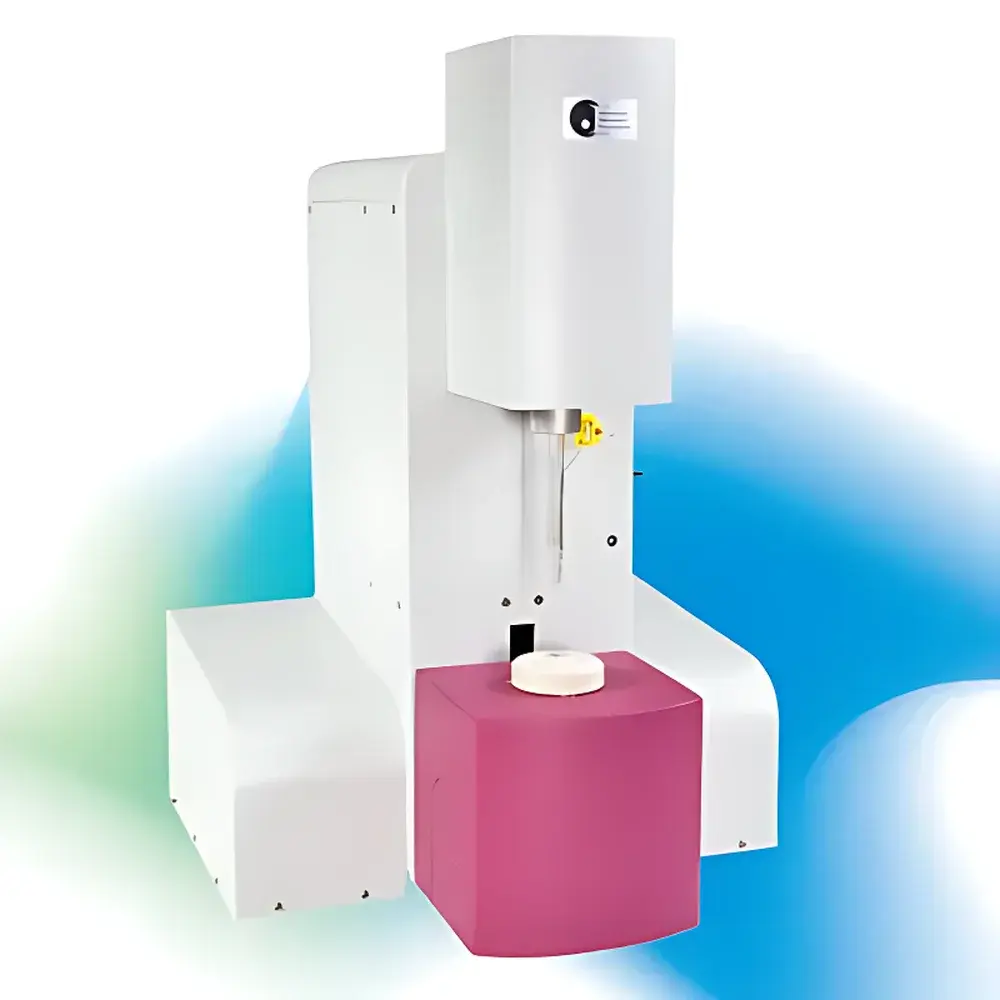
ISI TMA 800 Thermomechanical Analyzer
| Brand | ISI |
|---|---|
| Origin | USA |
| Model | TMA 800 |
| Temperature Range | -90°C to 800°C |
| Temperature Accuracy | ±1°C |
| Temperature Precision | ±1°C |
| Cooling Options | Mechanical refrigeration, water cooling |
| Test Modes | Expansion, Compression, Tension, Penetration, 3-Point Bending |
| Maximum Load Force | 2 N |
| Displacement Sensor | High-sensitivity LVDT |
| Furnace Design | All-metal, vertical inline architecture with Archimedes suspension system |
| Sample Height Range | Micrometer-scale to >10 mm |
| Uniform Temperature Zone Height | 40 mm |
Overview
The ISI TMA 800 Thermomechanical Analyzer is a precision-engineered instrument designed for quantitative measurement of dimensional changes in solid materials as a function of temperature and applied force. Operating on the principle of controlled-force thermomechanical displacement sensing, the TMA 800 employs a vertical inline probe geometry—distinct from conventional U-frame architectures—to eliminate mechanical hysteresis, friction-induced artifacts, and lateral loading errors. Its core measurement capability centers on linear thermal expansion coefficient (CTE), glass transition temperature (Tg), softening point, stress relaxation onset, and delamination threshold identification—critical parameters for reliability assessment in microelectronics packaging, PCB substrate development, aerospace composites, and high-performance polymer formulation. The instrument’s all-metal furnace, rated for continuous operation from –90°C to 800°C, integrates active thermal mass stabilization and a motorized lift mechanism with positional feedback, ensuring repeatable probe-sample contact across extreme thermal gradients.
Key Features
- Archimedes suspension system: Fully supports probe assembly and force coil mass, decoupling environmental vibration and eliminating parasitic load drift—enabling true net-force application during softening transitions.
- Vertical inline architecture: Eliminates bending moments and lateral compliance inherent in U-frame designs, delivering superior baseline stability and long-term reproducibility (RSD < 0.5% over 100-cycle validation).
- High-fidelity LVDT displacement sensor: Resolves sub-nanometer changes while maintaining linearity over full-scale travel (up to 10 mm), calibrated traceably to NIST standards.
- Uniform temperature zone: 40 mm axial homogeneity region certified per ASTM E220, ensuring spatially consistent thermal exposure for heterogeneous or layered samples.
- Modular probe interface: Interchangeable probe types—including expansion rods, three-point bending fixtures, penetration tips, and tension clamps—comply with ISO 11359-2, ASTM E831, and IPC-TM-650 2.4.24.
- Cooling versatility: Dual-path thermal management supports mechanical refrigeration (–90°C endpoint) or recirculating water cooling (–40°C endpoint), enabling rapid thermal cycling without liquid nitrogen dependency.
Sample Compatibility & Compliance
The TMA 800 accommodates geometrically diverse specimens—from thin films (<5 µm) and fine fibers to bulk ceramics and multilayer laminates up to 10 mm in height. Its high-aspect-ratio probe column ensures unobstructed access for edge-sensitive substrates such as FR-4, polyimide flex circuits, and wafer-level underfill materials. All test protocols adhere to internationally recognized standards including ISO 11359-2 (thermomechanical analysis of polymers), ASTM E831 (linear thermal expansion of solids), and IPC-TM-650 Method 2.4.24 (CTE measurement for printed board materials). The system architecture supports GLP/GMP workflows via optional audit-trail-enabled software modules compliant with FDA 21 CFR Part 11 requirements for electronic records and signatures.
Software & Data Management
The TMA 800 operates under a dedicated Windows-based control suite featuring real-time displacement/temperature overlay, automated zero-point correction at user-defined intervals, and dynamic sample height calibration prior to each run. Data acquisition includes synchronized time-stamped logging of force, displacement, temperature, and furnace power—all exportable in ASCII or CSV format for third-party statistical analysis. Advanced post-processing tools enable CTE calculation across user-selectable temperature windows, derivative peak detection for Tg identification, multi-curve overlay with RMS deviation metrics, and programmable method archiving with version-controlled templates. Software validation documentation (IQ/OQ/PQ protocols) is available upon request for regulated laboratory environments.
Applications
- Electronic packaging: Quantification of coefficient of thermal expansion mismatch between die attach, mold compound, and leadframe to predict warpage and interfacial delamination.
- Aerospace composites: Characterization of out-of-plane expansion behavior in carbon-fiber-reinforced polymer laminates under simulated service thermal profiles.
- Pharmaceutical excipients: Detection of moisture-induced dimensional instability and glass transition shifts in amorphous solid dispersions.
- Advanced ceramics: Evaluation of sintering shrinkage kinetics and residual stress evolution during controlled cooldown cycles.
- Automotive elastomers: Measurement of compression set resistance and viscoelastic recovery under cyclic thermal-mechanical loading.
FAQ
What distinguishes the Archimedes suspension system from conventional force-generation mechanisms?
It mechanically isolates the probe and force coil mass from the applied measurement load, allowing only the programmed net force to act on the sample—eliminating preload drift and noise coupling from electromagnetic or thermal sources.
Can the TMA 800 perform tests under inert or controlled-atmosphere conditions?
Yes—optional quartz or alumina furnace tubes with gas inlet/outlet ports support nitrogen, argon, or forming gas purging per ASTM D3418 requirements.
Is the displacement sensor calibrated traceably to national standards?
Yes—the LVDT is factory-calibrated against NIST-traceable interferometric references; certificate of calibration is included with each instrument shipment.
How does the system ensure thermal uniformity during rapid heating or cooling ramps?
The 40 mm uniform zone is validated at multiple ramp rates (0.1–20°C/min); active furnace wall temperature monitoring and adaptive PID tuning maintain axial gradient ≤ ±0.5°C across the working zone.
Are software updates and firmware patches provided post-purchase?
Yes—ISI offers free lifetime software maintenance with documented release notes, security patches, and backward-compatible data file handling.



