
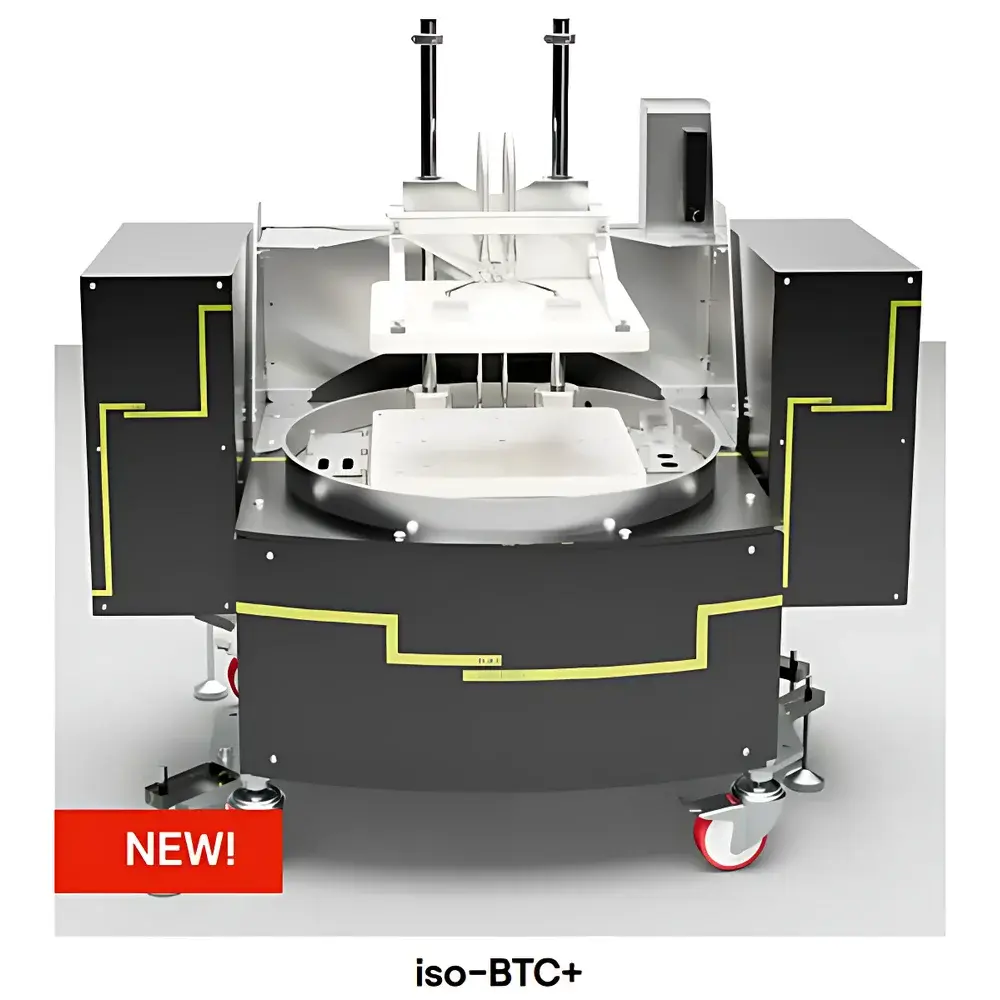
H.E.L iso-BTC+ Isothermal Battery Calorimeter
| Brand | H.E.L |
|---|---|
| Origin | United Kingdom |
| Model | iso-BTC+ |
| Measurement Mode | Isothermal Calorimetry |
| Instrument Type | Accelerating Rate Calorimeter (ARC-compatible architecture) |
| Temperature Range | −60 °C to +100 °C |
| Temperature Resolution | 0.001 °C |
| Temperature Precision | ±0.01 °C |
| Single-Sample Test Duration | up to 1000 min |
| Heat Capacity | 10,000 J/K |
| Outer Bath Volume | 1000 mL |
| Inner Bath Volume | 1000 mL |
| Sample Chamber Dimensions | 350 × 350 mm (W × D) |
| Maximum Compensation Power | 200 W |
| Minimum Detectable Heat Flow | 5 mW |
Overview
The H.E.L iso-BTC+ Isothermal Battery Calorimeter is a high-precision, fully automated thermal analysis system engineered for quantitative, real-time measurement of heat generation and absorption during electrochemical cycling of lithium-ion and next-generation battery cells. Operating on the principle of active isothermal compensation calorimetry, the iso-BTC+ maintains the cell at a user-defined constant temperature using a dual-bath (inner/outer) liquid-circulated thermal control architecture coupled with high-bandwidth PID-regulated power compensation. Unlike adiabatic or differential scanning approaches, this method directly quantifies net heat flow (in mW) as the electrical power required to offset exothermic or endothermic reactions—enabling trace-level detection (≥5 mW) and sub-millikelvin thermal stability (±0.01 °C over 1000 min). Designed in compliance with ISO 12185 (battery safety testing), ASTM D3350 (plastics calorimetry), and aligned with IEC 62660-2 thermal abuse test protocols, the iso-BTC+ delivers metrologically traceable data essential for thermal runaway modeling, TMS design validation, and DOE-compliant cell qualification.
Key Features
- True isothermal operation across −60 °C to +100 °C, enabled by independent inner/outer bath circulation (1000 mL each) and 200 W dynamic compensation heating/cooling
- Sub-millikelvin temperature resolution (0.001 °C) and long-term stability (±0.01 °C over multi-hour tests)
- Modular sample interface: standardized 350 × 350 mm chamber accommodates prismatic, pouch, and cylindrical cells; custom adapters available for large-format (e.g., >50 Ah) modules
- Multi-point temperature monitoring support: optional embedded thermocouples and auxiliary heater controllers for spatial thermal profiling
- Integrated power synchronization: simultaneous acquisition of voltage, current, surface temperature, and real-time heat flow—time-aligned to <10 ms resolution
- Rugged, EMI-shielded enclosure compliant with CE, UKCA, and IEC 61000-6-3 emission standards
Sample Compatibility & Compliance
The iso-BTC+ supports single-cell to module-level testing under controlled environmental conditions, including variable SOC, C-rate (0.1C–5C), charge/discharge protocols (CC/CV, pulse, hybrid), and multi-step thermal ramps. It meets functional requirements for UN 38.3 thermal test sequences and provides raw data suitable for input into thermal simulation tools (e.g., ANSYS Fluent, COMSOL Multiphysics). All thermal output data include full audit trails, timestamped metadata, and calibration certificate references—ensuring compliance with GLP, GMP, and FDA 21 CFR Part 11 electronic record integrity requirements when paired with H.E.L’s validated software suite.
Software & Data Management
Control and analysis are performed via H.E.L’s BTC Software v4.x—a Windows-based platform supporting IEC 61508 SIL2-certified operation. The software enables script-driven test sequencing, real-time heat flow visualization (including derivative dQ/dt and cumulative Q), automatic baseline correction, and export to CSV, HDF5, or MATLAB .mat formats. Built-in reporting modules generate ISO/IEC 17025-compliant test summaries with uncertainty budgets per NIST SP 960-12 guidelines. Data encryption, role-based access control, and electronic signature workflows satisfy regulatory submission requirements for automotive OEMs and cell manufacturers undergoing VDA 6.3 or AIAG CQI-17 audits.
Applications
- Quantification of enthalpic contributions to heat generation during lithiation/delithiation (e.g., distinguishing ohmic, polarization, and reaction enthalpy components)
- Temperature-dependent capacity fade analysis across −20 °C to +60 °C, correlating reversible/irreversible heat flows with SEI growth kinetics
- High-fidelity mapping of heat flow fine structure during discharge—resolving transient endothermic steps (e.g., Li-plating onset) amid dominant exothermic processes
- Thermal management system (TMS) co-simulation: generating boundary-condition datasets for cold plate, PCM, or direct-coolant system modeling
- Safety margin assessment: determining onset temperatures for self-heating under low-C-rate storage or high-temperature float charging
- Cell-to-cell thermal uniformity evaluation in parallel/series configurations using synchronized multi-channel compensation
FAQ
How does the iso-BTC+ differ from conventional ARC or DSC systems?
Unlike accelerating rate calorimeters (ARC), which operate adiabatically to detect self-heating onset, or DSC, which measures relative heat flow against a reference, the iso-BTC+ enforces strict isothermal conditions and reports absolute heat flow (mW) via active power compensation—yielding higher accuracy for low-power, long-duration electrochemical processes.
Can it measure both exothermic and endothermic events during cycling?
Yes. The bidirectional 200 W compensation system detects heat absorption (e.g., during low-rate charging or solid-electrolyte interphase formation) with the same sensitivity (5 mW) as exothermic events.
Is calibration traceable to national standards?
All temperature sensors are NIST-traceable; heat flow calibration is performed using certified Joule heaters with ±0.2% uncertainty, documented per ISO/IEC 17025.
What level of software validation is provided for regulated environments?
BTC Software v4.x includes full 21 CFR Part 11 validation documentation (IQ/OQ/PQ protocols, change control logs, and electronic signature implementation), available upon request for pharmaceutical or medical device battery applications.
Does the system support automated testing across multiple temperature setpoints?
Yes. The software supports nested temperature sweeps—e.g., executing full charge/discharge cycles at −20 °C, 25 °C, and 60 °C without manual intervention—while preserving full metadata linkage across conditions.



