
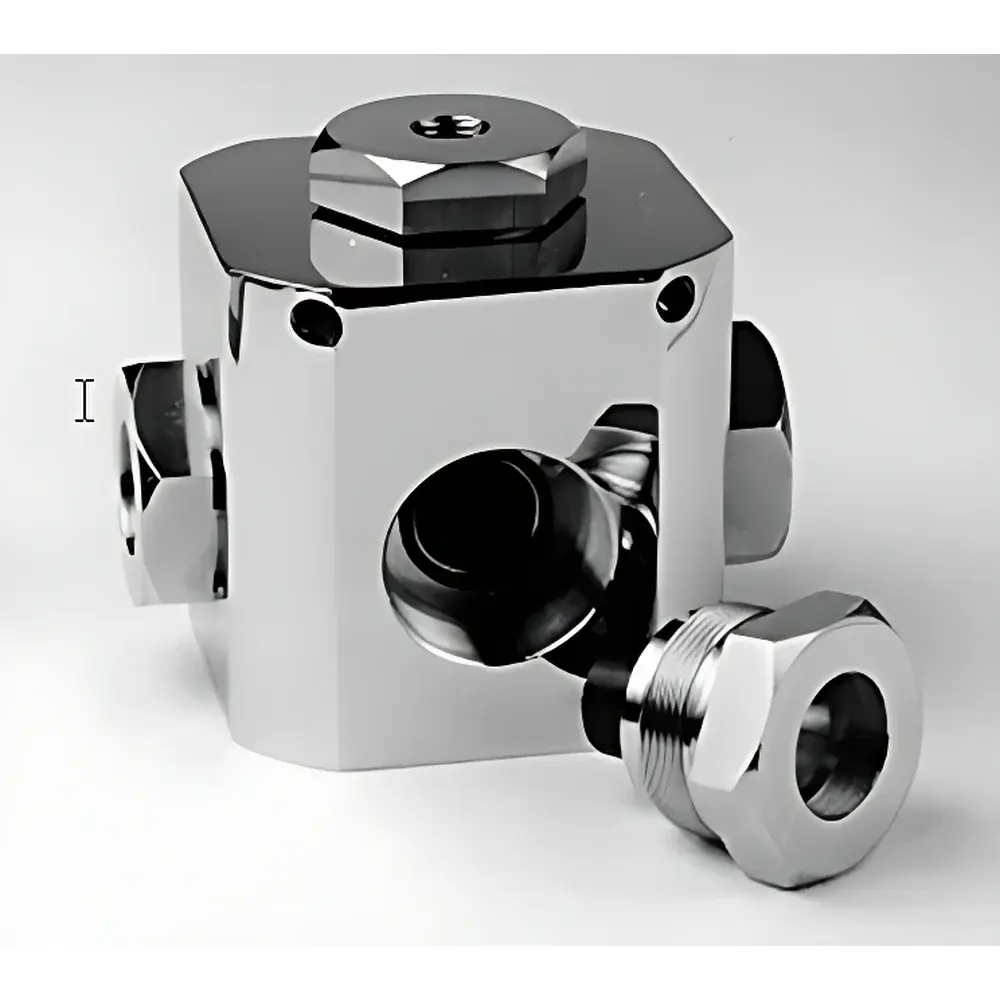
ISS Hpcell-00 High-Pressure Liquid Cell for Spectroscopic Measurements
| Brand | ISS |
|---|---|
| Origin | USA |
| Manufacturer Type | Authorized Distributor |
| Origin Category | Imported |
| Model | Hpcell-00 |
| Price Range | USD 2,800 – 7,000 |
| Maximum Pressure | 400 MPa (4 kbar / 43,500 psi) |
| Optical Windows | Three 10 mm diameter fused silica windows, 90° angular distribution |
| Optional Window Material | Sapphire |
| Configurable Window Count | 3 or 4 |
| Compatible With | Fluorescence spectroscopy, time-resolved fluorescence, UV-Vis absorption spectroscopy |
| Integration Method | Direct mounting on optical tables or fiber-coupled interface with commercial spectrometers |
Overview
The ISS Hpcell-00 High-Pressure Liquid Cell is an engineered optical pressure vessel designed for in situ spectroscopic characterization of materials under extreme hydrostatic compression—up to 400 MPa (4 kbar). It operates on the principle of static high-pressure generation via external hydraulic actuation, enabling controlled, stable, and reproducible pressure environments for spectral interrogation. Unlike dynamic or shock-compression methods, this cell supports continuous, real-time acquisition of fluorescence emission spectra, fluorescence lifetime decays (via TCSPC or time-gated detection), and UV-Vis absorption profiles under thermally stabilized conditions. Its modular architecture allows integration into both benchtop fluorimeters and custom-built multi-modal spectroscopy platforms, including those equipped with pulsed lasers, streak cameras, or broadband detectors. The cell’s core function is to preserve optical access while maintaining mechanical integrity and minimal signal distortion—critical for quantitative spectral analysis under pressure-induced electronic and conformational changes.
Key Features
- Rated pressure capacity of 400 MPa (4 kbar), validated per ASME B31.3 process piping standards for high-pressure instrumentation
- Three symmetrically arranged 10 mm diameter fused silica optical windows, positioned at 90° intervals to support orthogonal excitation/emission geometries (L-type and T-type configurations)
- Optional fourth window for simultaneous dual-mode acquisition—e.g., concurrent fluorescence intensity and transmission absorbance measurement
- Interchangeable window material options: high-transmission fused silica (185–2500 nm) or single-crystal sapphire (150–5500 nm), selected based on spectral range and mechanical load requirements
- Integrated thermal base plate with precision-machined mounting interface for Peltier or liquid-circulation temperature control (operating range: −20 °C to +80 °C, ±0.1 °C stability)
- Modular coupling design compatible with standard C-mount, SM1-threaded, or kinematic optical rails; also supports fiber-optic interfacing via SMA905 or FC/PC connectors
Sample Compatibility & Compliance
The Hpcell-00 accommodates both liquid-phase samples (e.g., aqueous solutions, organic solvents, ionic liquids) and thin solid films or microcrystalline powders suspended in pressure-transmitting media (e.g., silicone oil, methanol–ethanol mixture, or neon gas). Sample volume ranges from 20 µL to 120 µL depending on internal geometry and window spacing. All wetted components—including the body, piston, and O-rings—are constructed from precipitation-hardened stainless steel (ASTM A276 UNS S17400) and chemically resistant elastomers compliant with USP Class VI and FDA 21 CFR 177.2600. The system meets ISO/IEC 17025 calibration traceability requirements when paired with NIST-traceable pressure transducers and certified reference materials. It is routinely deployed in laboratories adhering to GLP protocols for structure–property relationship studies under pressure.
Software & Data Management
While the Hpcell-00 is a hardware-only subsystem, it interfaces seamlessly with industry-standard spectroscopy control software—including Horiba LabSpec, Edinburgh Instruments FLS1000 Instrument Manager, and Ocean Insight OceanView—via TTL-triggered pressure synchronization and analog voltage feedback. When used with ISS’s own VistaVision TCSPC platform, the cell supports automated pressure-step acquisition sequences with timestamped metadata logging (pressure, temperature, delay time, detector gain). All raw spectral datasets retain embedded EXIF-style headers compliant with Andor SDK and HDF5 v1.12 schemas, ensuring interoperability with Python-based analysis pipelines (e.g., SciPy, LMFIT, PyMCA) and long-term archival in FAIR-compliant repositories.
Applications
- Pressure-dependent fluorescence quantum yield and nonradiative decay pathway analysis in molecular probes and quantum dots
- High-pressure UV-Vis absorption edge shifts in semiconductors, metal–organic frameworks (MOFs), and hydrogen-bonded systems
- In situ monitoring of protein folding/unfolding transitions and ligand-binding thermodynamics under compression
- Phase behavior mapping of supercritical fluids and deep eutectic solvents via absorption band broadening and peak splitting
- Calibration of Raman shift–pressure relationships using diamond anvil cell cross-validation
- Time-resolved studies of excited-state proton transfer kinetics under variable dielectric confinement
FAQ
What pressure-transmitting media are recommended for optical clarity and chemical inertness?
Methanol–ethanol (4:1 v/v) and neon gas are preferred for UV-Vis–NIR work; silicone oil is suitable for visible-range measurements where thermal stability >60 °C is required.
Can the Hpcell-00 be used with synchrotron radiation sources?
Yes—its low-Z construction and window alignment tolerance (<5 arcsec) support beamline integration; users must specify vacuum-compatible sealing upgrades for UHV environments.
Is remote pressure ramping supported?
When coupled with ISS-certified ultra-high-pressure pumps (e.g., Haskel QX series), programmable pressure ramps (0.1–10 MPa/s) are achievable via RS485 or Ethernet/IP communication.
Does the cell include pressure calibration documentation?
Each unit ships with a factory calibration certificate traceable to NIST Standard Reference Material 2827 (quartz pressure gauge), valid for 12 months from date of shipment.
What maintenance intervals are recommended for long-term reliability?
O-ring replacement every 200 pressure cycles or annually (whichever occurs first); window cleaning with spectroscopic-grade acetone followed by nitrogen purge prior to each use.
Related Products






