
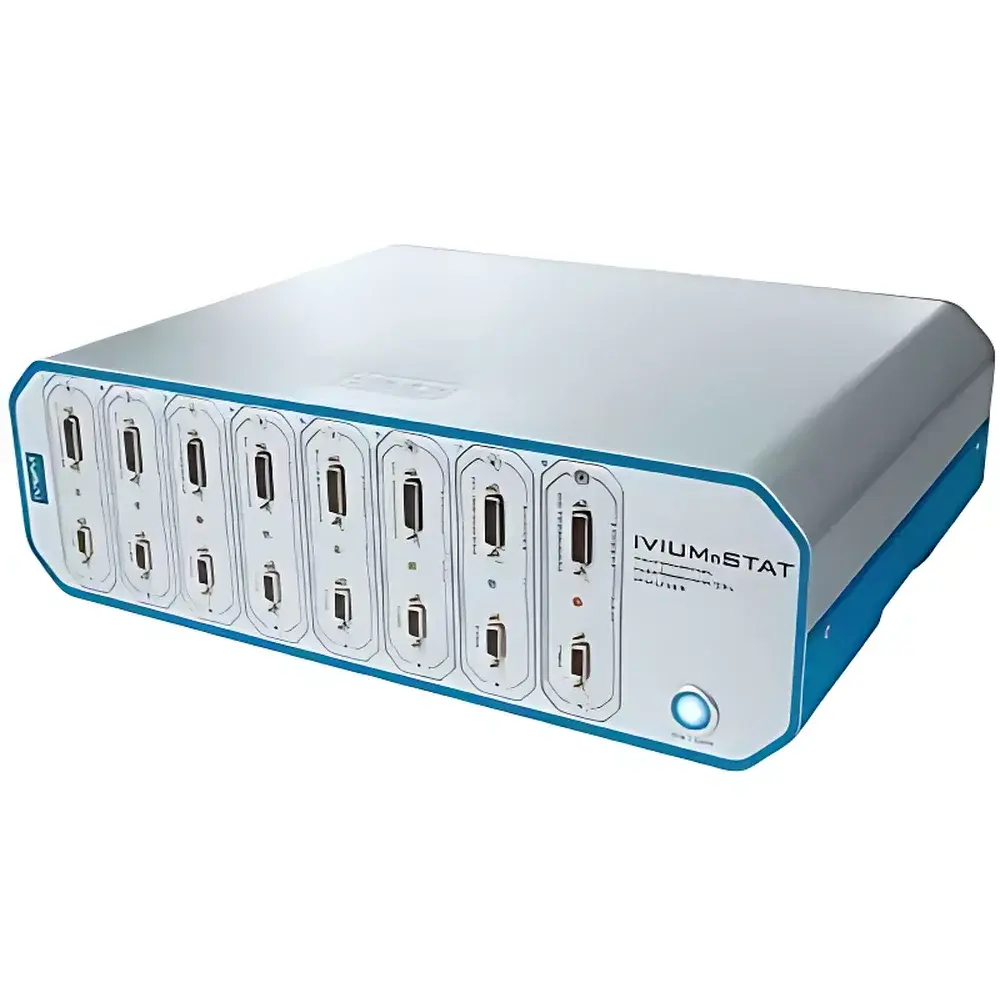
Ivium-n-Stat Multi-Channel Electrochemical Workstation
| Brand | Ivium |
|---|---|
| Origin | Netherlands |
| Model | Ivium-n-Stat |
| Instrument Type | Electrochemical Workstation |
| Channel Count | Up to 256 (via modular stacking) |
| Current Range | Standard: ±10 nA to ±10 A (10 decades) |
| Extended | ±10 pA to ±10 A (13 decades) |
| Current Resolution | Down to 1 fA (in 10 pA range) |
| Current Accuracy | ±0.015% of full scale per range |
| Potential Accuracy | ±0.2% or ±2 mV |
| Potentiostatic Range | −10 V to +10 V (extendable to ±20 V, ±40 V, ±100 V with auxiliary modules) |
| EIS Frequency Range | 10 µHz – 250 kHz (extendable to 1 MHz) |
| Data Acquisition Rate | Up to 100 kHz |
| Integrated Impedance Analyzer per Channel | Yes |
| Analog I/O Interfaces | Multiple isolated analog inputs/outputs for external device synchronization |
Overview
The Ivium-n-Stat Multi-Channel Electrochemical Workstation is a modular, high-precision potentiostat/galvanostat system engineered for advanced electrochemical research and industrial quality control. Designed and manufactured by Ivium Technologies BV in the Netherlands, the system operates on bipotentiostatic principles with independent current and potential control per channel, enabling true parallel experimentation under identical environmental conditions. Each channel implements a fully digital, real-time feedback architecture with hardware-based PID regulation—ensuring stability during fast transient measurements and low-noise performance across ultra-low-current regimes (down to femtoampere resolution). The workstation supports both conventional DC techniques (cyclic voltammetry, chronoamperometry, chronopotentiometry) and dynamic AC methods including electrochemical impedance spectroscopy (EIS), with frequency sweep capabilities from microhertz to megahertz. Its distributed architecture eliminates cross-talk between channels, making it suitable for comparative studies across electrode materials, electrolyte formulations, or sensor configurations without sequential measurement bias.
Key Features
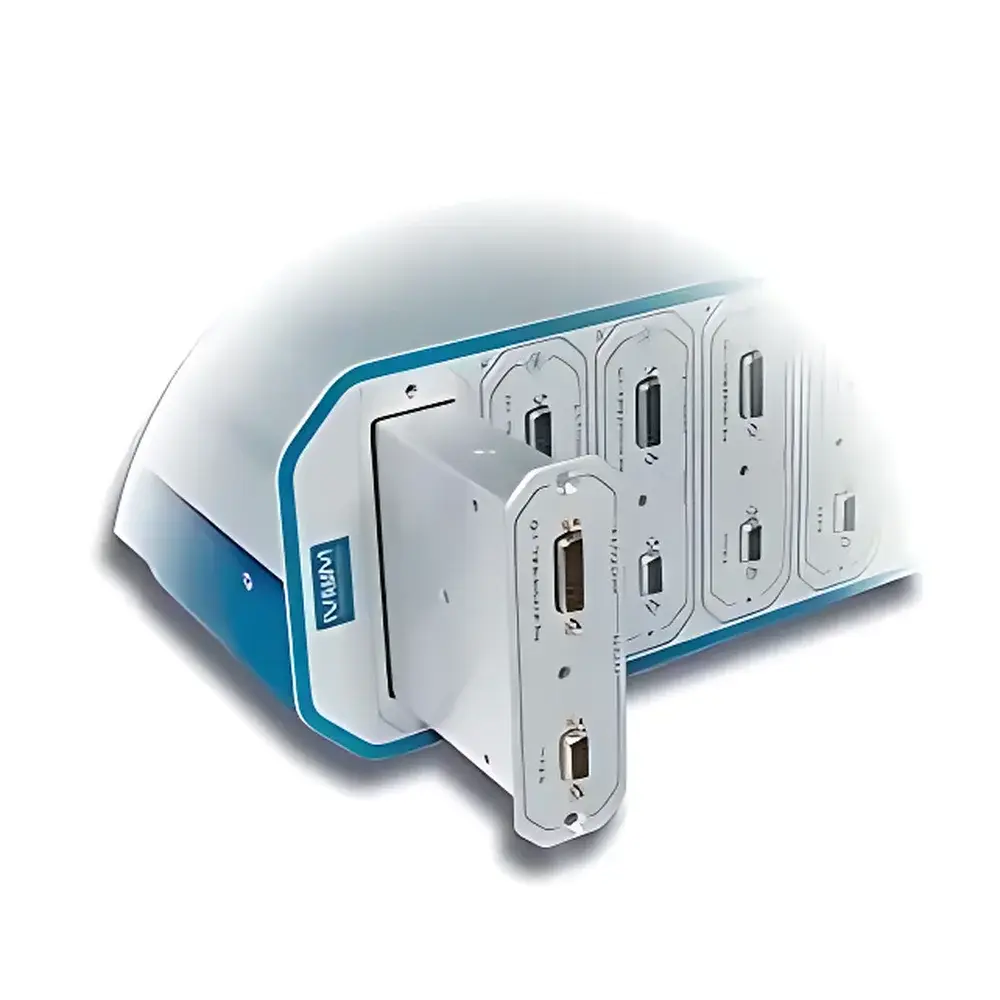
- Modular scalability: Configurable from 1 to 32 channels per unit; up to 256 channels via synchronized stacking of eight Ivium-n-Stat units using deterministic Ethernet-based timing.
- Dedicated impedance analyzer per channel: No shared oscillator or multiplexing—enabling simultaneous EIS acquisition on all active channels at user-defined frequencies and amplitudes.
- Ultra-low-current capability: Extended current range down to ±10 pA with 1 fA resolution in that range, validated per ASTM E2913-13 for trace-level redox detection.
- High-voltage and high-current options: Standard ±10 V compliance; optional modules support ±20 V, ±40 V, ±100 V, and current outputs up to 100 A (e.g., for battery formation cycling or corrosion testing under load).
- Real-time data streaming: 100 kHz sampling rate per channel with onboard 16-bit ADCs and ring-buffer memory—minimizing latency during rapid scan protocols.
- Isolated analog I/O: Eight programmable analog inputs and four analog outputs per unit, galvanically isolated to prevent ground loops when interfacing with furnaces, flow cells, or environmental chambers.
Sample Compatibility & Compliance
The Ivium-n-Stat accommodates standard three-electrode electrochemical cells (working, reference, counter), rotating disk electrodes (RDE), and custom multi-electrode arrays. It complies with ISO 17025 requirements for measurement traceability when operated with calibrated reference electrodes (e.g., Ag/AgCl, SCE) and certified shunt resistors. Firmware and software adhere to FDA 21 CFR Part 11 guidelines for electronic records and signatures, supporting audit trails, user access levels, and electronic signature workflows required in GLP and GMP environments. All EIS measurements are compatible with Kramers–Kronig validation routines to verify linearity, causality, and stability—essential for publication-grade data in journals such as Journal of The Electrochemical Society and Electrochimica Acta.
Software & Data Management
Control and analysis are performed via IviumSoft, a native Windows application built on .NET Framework with Python API (ivium-python) for automation and integration into LabVIEW, MATLAB, or custom CI/CD pipelines. IviumSoft provides preconfigured method templates aligned with ASTM G102 (corrosion rate calculation), ASTM D6319 (battery impedance profiling), and ISO 12944-6 (coating degradation monitoring). Raw data is stored in HDF5 format with embedded metadata (timestamp, instrument ID, calibration history, environmental logs), ensuring FAIR (Findable, Accessible, Interoperable, Reusable) compliance. Batch processing tools enable automated baseline correction, equivalent circuit fitting (using ZView-compatible models), and statistical comparison across channel groups.
Applications
- Battery R&D: Parallel cycling of Li-ion, solid-state, and Na-ion half-cells to accelerate formulation screening and lifetime prediction.
- Corrosion science: Multi-site monitoring of localized corrosion under varying pH, chloride concentration, or applied potential gradients.
- Sensor development: High-throughput evaluation of enzymatic, immunosensing, or DNA hybridization platforms with integrated temperature and flow control.
- Electrocatalysis: Simultaneous polarization curve acquisition across catalyst libraries (e.g., Pt alloys, MOFs, single-atom sites) under identical mass transport conditions.
- Coating and surface treatment: In-situ EIS tracking of coating delamination, blistering, or inhibitor release kinetics over extended durations (weeks to months).
FAQ
Can the Ivium-n-Stat perform true simultaneous EIS on all channels?
Yes—each channel contains an independent direct digital synthesizer (DDS) and lock-in amplifier, eliminating time-sharing limitations inherent in multiplexed systems.
Is firmware upgrade supported remotely?
Yes, secure over-the-air updates are available via Ivium’s authenticated firmware portal, with version rollback and SHA-256 integrity verification.
What level of electromagnetic compatibility (EMC) does the system meet?
The Ivium-n-Stat complies with EN 61326-1:2013 for laboratory equipment, including radiated emissions (Class B) and immunity to electrostatic discharge (IEC 61000-4-2, ±8 kV contact).
How is channel synchronization accuracy verified?
Inter-channel timing jitter is measured at ≤10 ns RMS using high-speed oscilloscope cross-correlation, documented in the factory calibration report shipped with each unit.
Are third-party electrode cables and connectors supported?
Yes—the system uses standard BNC and LEMO 00 interfaces; Ivium provides pinout specifications and termination guidelines for custom cable assemblies compliant with IEC 61000-4-6.
Related Products






