
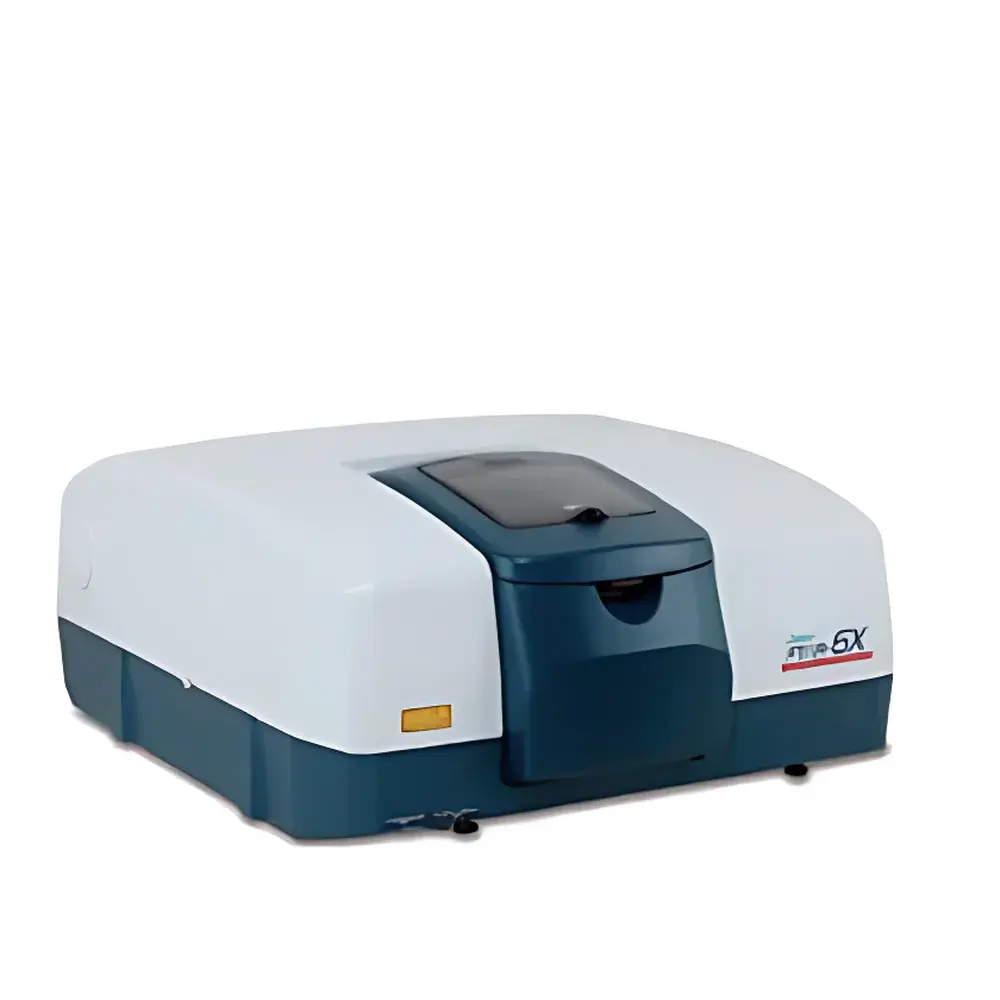
JASCO FT/IR-6X and FT/IR-8X Fourier Transform Infrared Spectrometers
| Brand | JASCO |
|---|---|
| Origin | Japan |
| Model | FT/IR-6X / FT/IR-8X |
| Instrument Type | Laboratory Benchtop FTIR Spectrometer |
| Spectral Range | 25,000–20 cm⁻¹ |
| Spectral Resolution | 0.07 cm⁻¹ |
| Signal-to-Noise Ratio (S/N) | 55,000:1 (at 4 cm⁻¹, 1 min scan, MCT detector, peak-to-peak) |
| Interferometer | 28° Michelson with Corner Cube Retroreflectors |
| Light Source | High-intensity Ceramic Source |
| Detector | Temperature-Controlled DLATGS or Optional MCT |
| Beam Splitter Exchange | Automated Beam Splitter (BS) Switching Unit |
| Software | Spectrum Manager™ Ver. 2.5 |
| Compliance | Fully Compatible with ASTM E1421, ISO 18382, USP <1119>, GLP/GMP Data Integrity Requirements (21 CFR Part 11 Ready) |
Overview
The JASCO FT/IR-6X and FT/IR-8X are high-performance, research-grade Fourier Transform Infrared (FTIR) spectrometers engineered for precision molecular spectroscopy in academic, pharmaceutical, materials science, and quality control laboratories. Based on the interferometric principle of the Michelson configuration, these instruments utilize a dynamically controlled moving mirror and permanently aligned corner-cube retroreflectors to generate stable, high-fidelity interferograms. The optical architecture is optimized for maximum throughput and phase stability—critical for quantitative spectral reproducibility across extended acquisition times and variable environmental conditions. Designed and manufactured in Japan by JASCO Inc.—a pioneer in optical instrumentation since its founding in 1958—the FT/IR-6X/8X series represents over six decades of continuous innovation in infrared spectroscopy, building upon JASCO’s legacy of the DS-101, Japan’s first commercial IR spectrometer.
Key Features
- Ultra-high spectral resolution of 0.07 cm⁻¹, enabling fine structural discrimination in complex organic and inorganic samples.
- Exceptional signal-to-noise ratio up to 55,000:1 (peak-to-peak, 4 cm⁻¹ resolution, 1-minute scan, MCT detector), ensuring reliable detection of low-concentration analytes and weak absorption bands.
- Extended spectral coverage from 25,000 cm⁻¹ (UV-NIR edge) to 20 cm⁻¹ (far-IR region), supported by automated beam splitter exchange and interchangeable sources/detectors.
- 28° incident-angle Michelson interferometer with high-rigidity cast-aluminum optical baseplate and threaded mechanical structure—designed to suppress vibration-induced phase errors and thermal drift.
- Hermetically sealed interferometer housing protecting internal optics from humidity and particulate contamination; integrated KRS-5 windows for far-IR transmission and moisture resistance.
- Thermally stabilized DLATGS detector and long-life ceramic broadband source ensure baseline stability and measurement consistency over multi-hour experimental sessions.
- Digital signal processing (DSP)-driven mirror velocity control guarantees precise retardation sampling and zero-path-difference (ZPD) accuracy—essential for phase-corrected spectra and advanced processing routines such as deconvolution and derivative analysis.
Sample Compatibility & Compliance
The FT/IR-6X/8X accommodates a wide range of sample forms—including transmission cells (KBr, CaF₂, polyethylene), ATR accessories (diamond, ZnSe, Ge), diffuse reflectance (DRIFTS), gas cells (with pathlengths up to 10 m), and microsampling stages. Optional vacuum operation enables suppression of atmospheric water vapor and CO₂ interference—critical for high-sensitivity far-IR and low-frequency vibrational studies. The system complies with international analytical standards including ASTM E1421 (Standard Guide for Describing and Measuring Performance of FTIR Spectrometers), ISO 18382 (Molecular spectroscopy — Vocabulary), and USP (Infrared Absorption Spectrophotometry). When configured with audit-trail-enabled Spectrum Manager™ Ver. 2.5, the instrument supports full 21 CFR Part 11 compliance for regulated environments, including electronic signatures, user access controls, and immutable data archiving.
Software & Data Management
Spectrum Manager™ Ver. 2.5 provides an integrated platform for instrument control, real-time spectral acquisition, multivariate analysis (PCA, PLS), spectral library searching (including Sadtler, Aldrich, and custom databases), and report generation. Its guided workflow interface allows novice users to configure acquisition parameters—such as resolution, scan number, apodization function, and phase correction method—via contextual navigation prompts without requiring prior spectroscopic expertise. All raw interferograms and processed spectra are stored in vendor-neutral, metadata-rich formats (e.g., JCAMP-DX compliant files), facilitating interoperability with third-party chemometric tools. Data integrity features include timestamped operator logs, version-controlled method templates, and automatic backup to network drives or cloud repositories.
Applications
These spectrometers serve diverse applications across R&D and QA/QC workflows: polymer crystallinity and degradation analysis; pharmaceutical polymorph identification and API-excipient compatibility screening; catalytic surface reaction monitoring via in situ DRIFTS; forensic fiber and paint chip differentiation; semiconductor thin-film thickness and composition verification; and biomolecular secondary structure quantification (e.g., α-helix/β-sheet ratios in proteins via amide I band deconvolution). The optional VCD (Vibrational Circular Dichroism) and Raman coupling modules extend functionality into chiral analysis and complementary vibrational fingerprinting—enabling correlative spectroscopic studies within a single platform.
FAQ
What is the difference between the FT/IR-6X and FT/IR-8X models?
The FT/IR-8X includes enhanced hardware options—such as an integrated vacuum pump interface, expanded far-IR capability down to 20 cm⁻¹ with dedicated optics, and factory-optimized alignment for ultra-high-resolution measurements—while the FT/IR-6X delivers identical core performance for standard mid-IR applications.
Can the system operate under vacuum, and what benefits does this provide?
Yes—vacuum operation eliminates atmospheric H₂O and CO₂ absorption lines, improving sensitivity in the 2000–600 cm⁻¹ region and enabling accurate far-IR characterization below 400 cm⁻¹.
Is the software validated for GxP environments?
Spectrum Manager™ Ver. 2.5 supports 21 CFR Part 11 compliance when deployed with appropriate IT infrastructure, role-based permissions, and electronic signature configuration—validated per internal IQ/OQ protocols.
What detector options are available beyond DLATGS?
Optional liquid-nitrogen-cooled MCT (HgCdTe) detectors are available for increased sensitivity in the mid-IR, while bolometer-based detectors support far-IR extension to 20 cm⁻¹.
How is beam splitter exchange performed during operation?
The automated Beam Splitter (BS) Switching Unit enables seamless, software-triggered exchange between KBr, CsI, and Mylar beam splitters—without breaking vacuum or manual intervention—ensuring measurement continuity across broad spectral ranges.





