
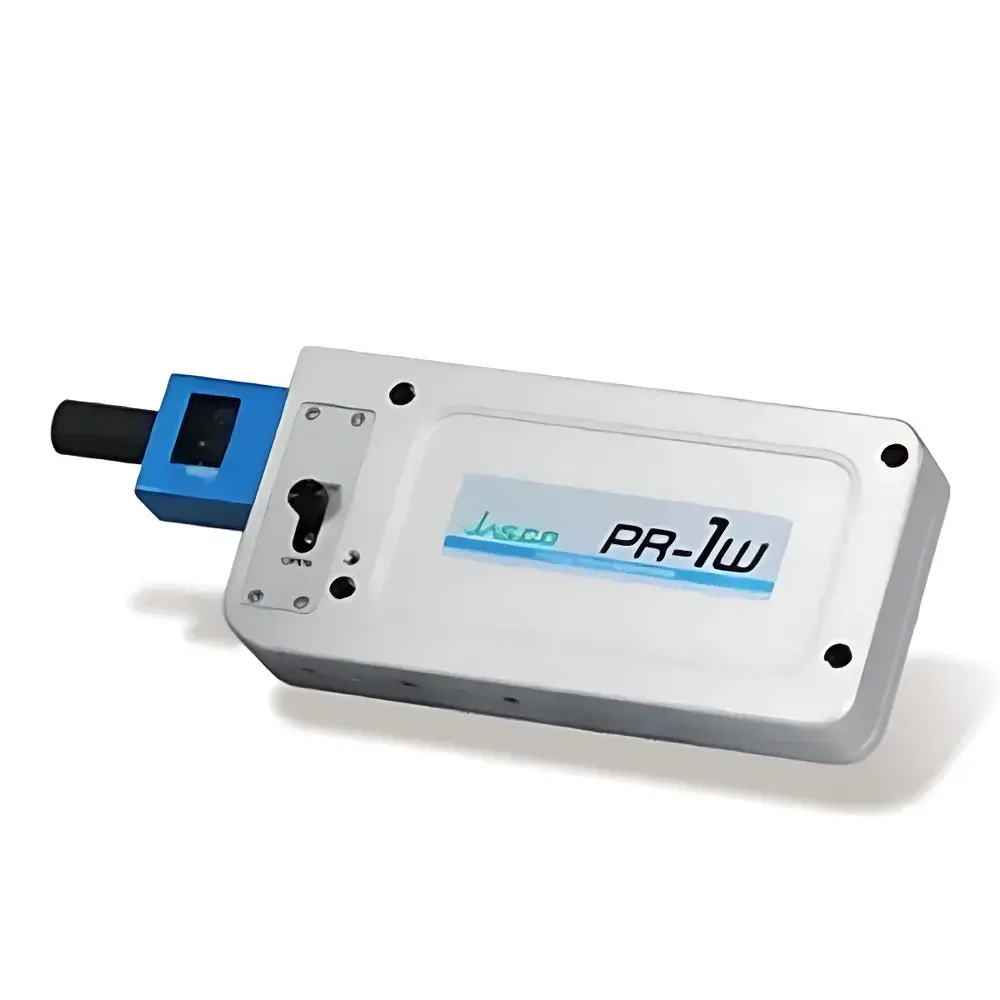
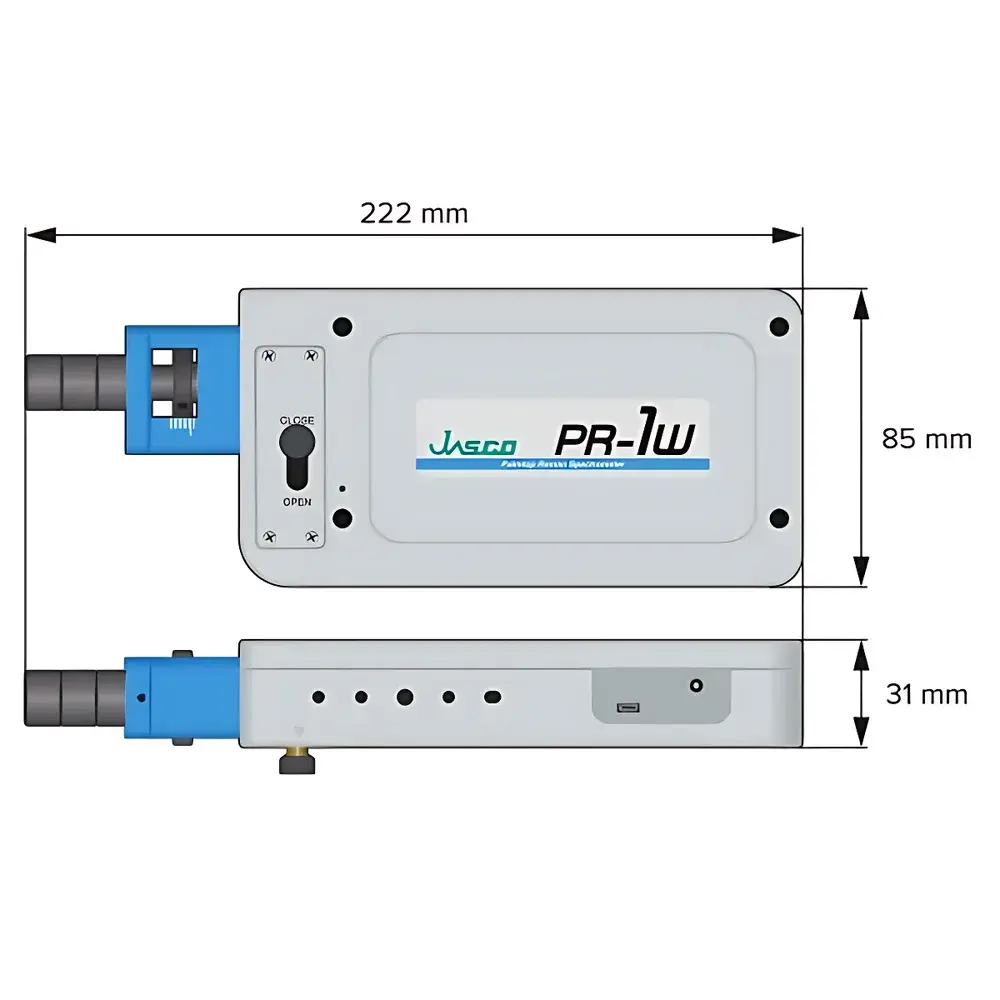
JASCO PR-1w Portable Handheld Raman Spectrometer
| Brand | JASCO |
|---|---|
| Origin | Japan |
| Manufacturer Type | Authorized Distributor |
| Product Origin | Imported |
| Model | PR-1w |
| Instrument Type | Portable/Handheld Raman Spectrometer |
| Spectral Range | 3000–200 cm⁻¹ |
| Spectral Resolution | 3 cm⁻¹ per pixel |
| Laser Excitation Wavelength | 785 nm |
| Detector | Uncooled CMOS |
| Interface | USB 2.0 for PC connectivity |
| Measurement Time | ~2–3 minutes per sample |
| Sample Compatibility | Solids, powders, liquids (including through transparent packaging) |
Overview
The JASCO PR-1w is a compact, handheld Raman spectrometer engineered for rapid, non-destructive molecular characterization in field and laboratory environments. Operating on the principle of inelastic light scattering—where monochromatic 785 nm laser excitation induces vibrational mode shifts in chemical bonds—the PR-1w captures Raman-shifted photons to generate fingerprint-like spectral signatures between 3000 cm⁻¹ and 200 cm⁻¹. Its design prioritizes operational simplicity without compromising spectroscopic fidelity: all optical components—including collimating optics, notch filters, diffraction grating, and an uncooled CMOS detector—are integrated into a single robust housing. Unlike benchtop systems requiring cryogenic cooling or complex alignment, the PR-1w delivers reproducible spectra with 3 cm⁻¹ spectral resolution per pixel, making it suitable for routine identification and comparative analysis where portability and speed are critical.
Key Features
- Integrated 785 nm diode laser source optimized for reduced fluorescence interference in organic and pharmaceutical samples.
- Uncooled CMOS linear array detector enabling stable performance across ambient temperature ranges (10–35 °C) without thermoelectric cooling hardware.
- Dial-type manual focusing mechanism for precise optical alignment on heterogeneous or irregular surfaces—no software autofocus required.
- USB 2.0 interface for direct connection to Windows-based PCs; no external power supply needed—operates solely via bus power.
- Compact form factor (185 × 85 × 45 mm) and lightweight construction (<450 g) support extended handheld use and integration into mobile QA/QC workflows.
- Optical path fully sealed against dust and moisture, conforming to IP52 ingress protection standards for field-deployable reliability.
Sample Compatibility & Compliance
The PR-1w supports non-contact, non-destructive analysis of solids, powders, gels, and liquid samples—including measurements through common transparent barriers such as polyethylene bags, glass vials, and PET containers. This capability enables compliance with ASTM E1840-22 (Standard Guide for Raman Spectroscopy Sampling Techniques) and facilitates adherence to GLP and GMP documentation requirements when paired with validated acquisition protocols. While the instrument itself does not carry FDA 21 CFR Part 11 certification, its data export functionality (ASCII, CSV, JCAMP-DX) supports traceable integration into LIMS or ELN platforms compliant with regulatory audit trails. No sample preparation is required for most routine identifications, reducing analytical turnaround time and minimizing operator-induced variability.
Software & Data Management
The PR-1w operates natively with JASCO’s Spectra Manager™ II software suite—a unified platform supporting FTIR, Raman, UV-Vis, and fluorescence data processing. Spectra Manager provides baseline correction, peak deconvolution, spectral subtraction, and library search functions compliant with ASTM E1421-20 (Standard Practice for Describing and Measuring Performance of Raman Spectrometers). Optional modules include Imaging Model Analysis (for spatial mapping of multi-component samples) and Advanced Spectral Search (enabling similarity matching against user-defined or commercial spectral libraries such as SDBS or KnowItAll®). All acquired spectra retain embedded metadata (date/time, laser power, integration time, sample ID), ensuring full traceability for internal quality records or external audits.
Applications
The PR-1w is routinely deployed in pharmaceutical raw material verification (e.g., polymorph screening of APIs), counterfeit detection in consumer goods (e.g., identification of illicit dyes in textiles or adulterants in nutraceuticals), forensic evidence triage (e.g., rapid classification of unknown white powders at crime scenes), and polymer identification in recycling sorting lines. Its compatibility with FTIR data allows complementary vibrational analysis—Raman excels in symmetric vibrations and low-frequency modes (e.g., S–S, C–S stretches), while FTIR detects asymmetric and polar bond vibrations—thereby expanding molecular insight beyond single-technique limitations. Academic labs also utilize the PR-1w for undergraduate spectroscopy instruction due to its intuitive interface and real-time spectral feedback.
FAQ
What laser safety class does the PR-1w comply with?
The PR-1w is classified as Class 3R under IEC 60825-1:2014, with maximum accessible emission limit (AEL) below 5 mW at 785 nm—requiring no interlocks but recommending controlled access during operation.
Can the PR-1w perform quantitative analysis?
Yes—when used with calibrated reference standards and consistent measurement geometry, it supports semi-quantitative concentration estimation via peak intensity ratios or multivariate regression models (e.g., PLS) implemented in Spectra Manager.
Is spectral calibration traceable to NIST standards?
Factory calibration uses polystyrene and silicon reference standards; users may perform wavelength and intensity recalibration using optional NIST-traceable calibration kits (e.g., SRM 2241).
Does the PR-1w support battery operation?
No—it draws power exclusively via USB 2.0 from the host PC; external portable power banks with sufficient USB output stability (≥5 V / 1.5 A) may be used in field settings.
How is data integrity ensured during transfer?
Spectra Manager implements checksum validation for all exported files and logs acquisition parameters in human-readable headers—supporting ALCOA+ principles (Attributable, Legible, Contemporaneous, Original, Accurate, Complete, Consistent, Enduring, Available) for regulated environments.






