
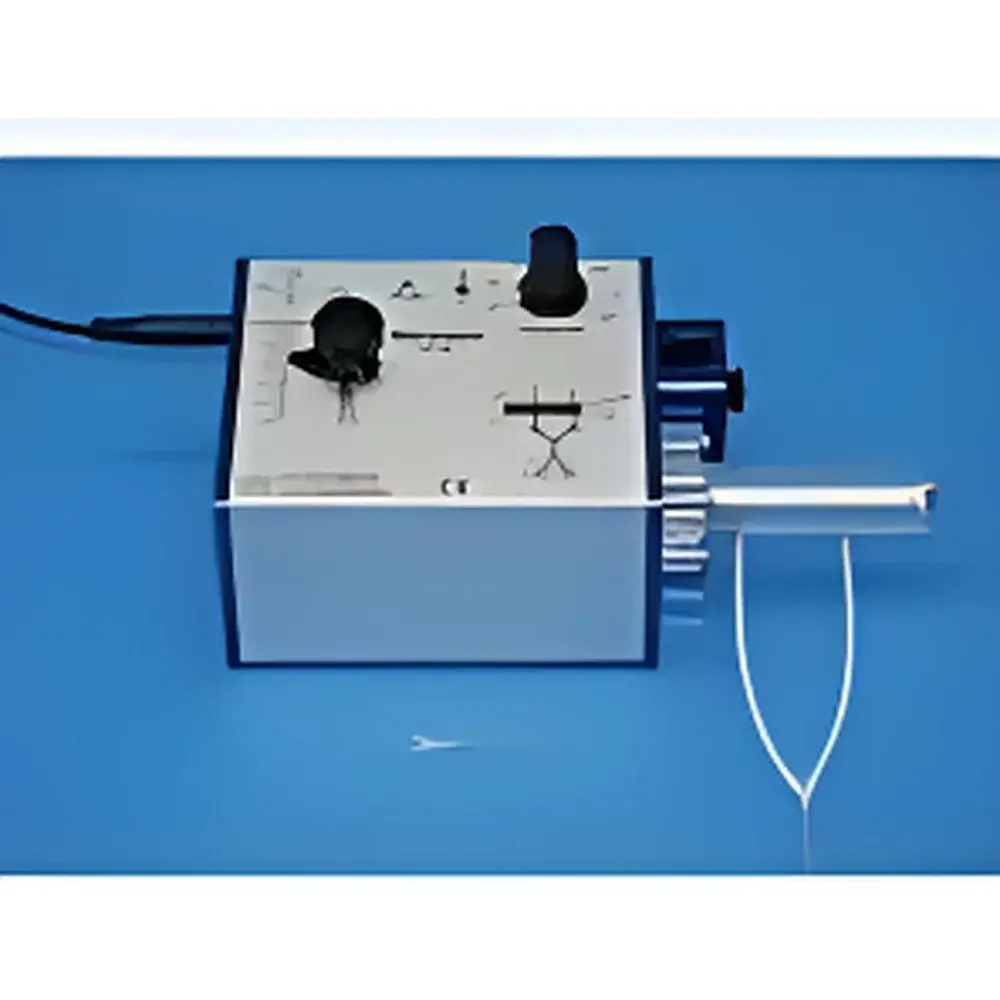
Harvard Apparatus Micro Vent Neonatal Mouse Ventilator
| Brand | Harvard Apparatus |
|---|---|
| Origin | USA |
| Manufacturer Type | Authorized Distributor |
| Origin Category | Imported |
| Model | Micro Vent |
| Tidal Volume | 0–130 µL (continuously adjustable) |
| Respiratory Rate | 60–400 breaths/min (continuously adjustable) |
| Power Supply | 12 V DC, 0.5 A via external AC adapter |
| Dimensions (H×L×W) | 8 × 10 × 20 cm |
| Weight | 1.0 kg (unit), 0.3 kg (AC adapter) |
Overview
The Harvard Apparatus Micro Vent Neonatal Mouse Ventilator is a precision-engineered, compact mechanical ventilator designed specifically for controlled respiratory support in neonatal and juvenile rodent models—primarily mice weighing less than 18 g—and small avian subjects. Operating on the principle of pressure-controlled, time-cycled ventilation, the Micro Vent delivers highly reproducible tidal volumes with minimal dead space and low intrinsic resistance, enabling stable gas exchange during acute physiological studies, surgical interventions, or pharmacological challenge experiments. Its ultra-low tidal volume range (0–130 µL) and high-frequency capability (60–400 bpm) align closely with the respiratory physiology of neonatal mice, whose minute ventilation typically falls between 10–40 mL/kg/min and whose inspiratory time is markedly shortened compared to adults. The device integrates seamlessly into stereotaxic setups, thermoregulated chambers, and electrophysiology rigs, supporting longitudinal monitoring without compromising animal welfare or experimental fidelity.
Key Features
- Ultra-low tidal volume delivery (0–130 µL) with linear, continuous adjustment via calibrated front-panel dial—optimized for subjects with minute lung capacities and high metabolic rates.
- Wide respiratory rate range (60–400 breaths per minute), enabling precise emulation of developmental respiratory patterns—from postnatal day 0 (P0) through weaning age (P21).
- Integrated cardiac motion compensation mode: allows real-time manual override of inspiratory volume during spontaneous cardiac pulsation, minimizing ventilator-induced artifact in concurrent ECG or neural recording paradigms.
- Acoustically damped housing and vibration-isolated internal actuation mechanism reduce operational noise to <35 dB(A) at 10 cm—critical for minimizing stress responses and preserving baseline autonomic tone.
- Compact footprint (8 × 10 × 20 cm) and lightweight design (1.0 kg) facilitate integration into confined spaces such as MRI-compatible animal beds, laminar flow hoods, or multi-sensor physiological monitoring stations.
- DC-powered architecture (12 V, 0.5 A) ensures electrical isolation from mains supply—supporting compliance with IEC 61000-4-5 surge immunity standards and reducing electromagnetic interference in sensitive recording environments.
Sample Compatibility & Compliance
The Micro Vent is validated for use with C57BL/6, CD-1, and BALB/c neonatal mice (P0–P14), as well as zebra finch hatchlings and other altricial avian species. Its low-compliance breathing circuit (standard 1.5 mm ID tubing) minimizes compressible volume and ensures accurate delivery across the full tidal range. The system conforms to ISO 13485:2016 requirements for medical device distributors and supports GLP-compliant documentation workflows when paired with Harvard Apparatus’ certified calibration logs and traceable service records. While not classified as a human-use medical device, its performance parameters meet or exceed the functional benchmarks referenced in NIH Guide Notice NOT-OD-15-102 for preclinical ventilatory support instrumentation.
Software & Data Management
The Micro Vent operates as a standalone analog-controlled ventilator with no embedded firmware or digital interface. All parameter adjustments are performed manually via front-panel controls, ensuring deterministic timing behavior and eliminating latency associated with serial communication protocols. For synchronized data acquisition, users may integrate the unit’s TTL-compatible trigger output (rising edge on inspiration onset) with commercial DAQ systems (e.g., National Instruments USB-6211, Tucker-Davis Technologies RZ5) to timestamp ventilatory events within electrophysiological or optical imaging datasets. Harvard Apparatus provides NIST-traceable calibration certificates upon request, and all service documentation adheres to FDA 21 CFR Part 11 audit-trail requirements when maintained through authorized distributor portals.
Applications
- Respiratory neurophysiology: mapping central pattern generator activity in brainstem slices or in vivo preparations under controlled ventilation.
- Developmental hypoxia modeling: delivering precise FiO₂ mixtures via inline gas blending modules during normobaric or hypobaric chamber studies.
- Cardiopulmonary coupling analysis: simultaneous measurement of arterial pressure, ECG, and diaphragm EMG during ventilator-synchronized acquisition.
- Pharmacokinetic-pharmacodynamic (PK-PD) assessment of respiratory depressants (e.g., opioids, GABAergics) in neonatal models.
- Preclinical validation of non-invasive respiratory monitoring technologies (e.g., whole-body plethysmography, laser Doppler flowmetry).
FAQ
Is the Micro Vent compatible with anesthesia delivery systems?
Yes—the unit features a standardized 1/8″ Swagelok inlet port that accepts standard vaporizer-outlet tubing and supports inline mixing with isoflurane or sevoflurane carrier gases.
Can tidal volume be verified in real time during an experiment?
While the Micro Vent does not include built-in flow sensing, Harvard Apparatus recommends pairing it with the HSE-HA Flow Sensor FS-1 (0–200 µL/min range) for closed-loop verification; calibration curves are provided in the technical supplement.
What maintenance intervals are recommended for long-term reliability?
Annual recalibration and diaphragm inspection are advised; consumable parts (silicone diaphragm, O-rings) are available under part number MV-SPK-01 and have a documented shelf life of 24 months under ambient storage.
Does the device support pressure-controlled ventilation modes?
No—the Micro Vent operates exclusively in volume-controlled, time-cycled mode; pressure-limiting functionality is not implemented to preserve temporal precision in high-frequency applications.
Is regulatory documentation available for institutional IACUC submissions?
Yes—Harvard Apparatus provides a full Technical Dossier including risk analysis (ISO 14971), biocompatibility summary (ISO 10993-1), and veterinary clinical validation reports upon request through authorized distributors.




