
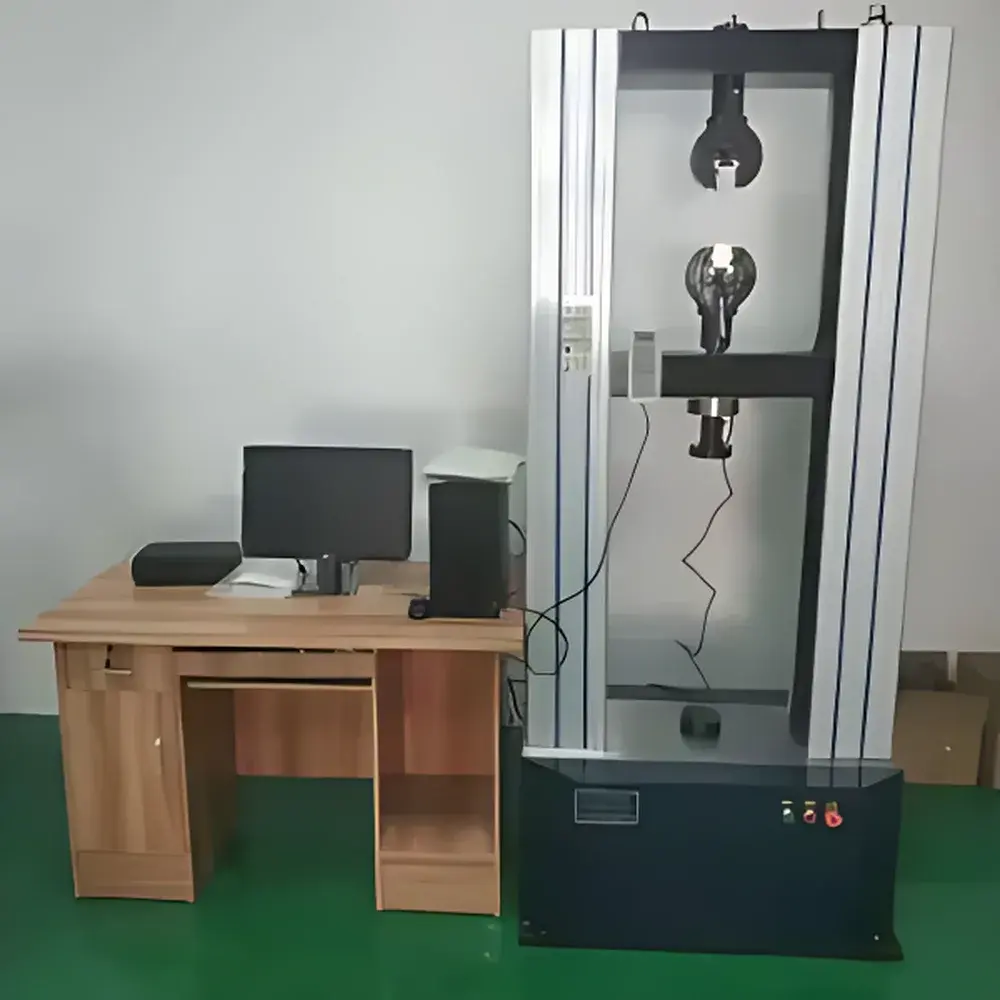
JB-Brookfield JB-126 Welding Peel Strength Testing Machine
| Brand | JB-Brookfield |
|---|---|
| Origin | Shanghai, China |
| Model | JB-126 |
| Type | Electromechanical Universal Testing Machine |
| Load Capacity Options | 5 kN, 10 kN, 20 kN, 50 kN |
| Force Measurement Accuracy | ±1% FS (±0.5% optional) |
| Displacement Resolution | 0.001 mm |
| Crosshead Speed Range | 0.001–500 mm/min |
| Max Travel | 600–1200 mm (customizable) |
| Safety Protections | Mechanical limit switches, overload cutoff, overcurrent/overvoltage protection, emergency stop |
Overview
The JB-Brookfield JB-126 Welding Peel Strength Testing Machine is a precision-engineered electromechanical universal testing system designed for quantitative mechanical evaluation of interfacial adhesion integrity in welded and bonded assemblies. It operates on the principle of controlled uniaxial force application—applying tensile, peel, or shear loads at defined rates and geometries—to measure critical failure thresholds including peel strength (90° and 180°), roller peel resistance, tensile bond strength, and interlaminar shear. The system conforms to standardized test methodologies used in automotive weld validation, battery tab bonding verification, medical device hermetic seal assessment, and aerospace composite joining qualification. Its modular architecture supports both static and quasi-static loading regimes, with real-time acquisition of force-displacement data synchronized to ASTM D903, ISO 8510-2, GB/T 2790, GB/T 2791, and EN 14410 protocols.
Key Features
- High-fidelity electromechanical actuation using a digitally controlled AC servo motor (0.75 kW) and precision ball-screw transmission, ensuring stable crosshead motion across the full speed range (0.001–500 mm/min).
- Triple-mode closed-loop control: selectable stress, strain, or displacement regulation with seamless transition between modes during a single test sequence.
- Full-scale force transduction with dual-range capability: calibrated load cells (5, 10, 20, or 50 kN nominal capacity) delivering ≤±1% FS accuracy (≤±0.5% optional for metrology-grade validation).
- Sub-micron displacement resolution (0.001 mm) and deformation measurement accuracy ≤±1% of reading across 2–100% strain range.
- Integrated safety architecture including hardware-based mechanical end stops, programmable overload cutoff, real-time current/voltage monitoring, and a certified emergency stop circuit compliant with IEC 60204-1.
- Modular fixture interface supporting rapid interchange of peel jigs (90°/180°/roller), tensile grips, compression platens, bend fixtures, and custom-designed tooling for specialized joint geometries.
Sample Compatibility & Compliance
The JB-126 accommodates specimens ranging from thin metallic foils (<0.05 mm) and polymer films to structural steel plates (up to 25 mm thick) and reinforced composites. Standard configurations support specimen widths up to 100 mm and lengths accommodating peel arm extensions ≥300 mm. All test methods align with international regulatory expectations: force and displacement data traceability meets ISO/IEC 17025 requirements; audit-ready reporting satisfies GLP and GMP documentation standards; software-generated records comply with FDA 21 CFR Part 11 electronic signature and audit trail provisions when paired with validated firmware. Test execution adheres to ASTM D1876 (T-peel), ASTM D3167 (floating roller peel), ISO 11339 (adhesive peel), and GB/T 7124 (structural adhesive shear strength).
Software & Data Management
The embedded Windows-based control and analysis suite provides real-time visualization of force–displacement, stress–strain, and peel load–distance curves. Automated test sequencing enables multi-step protocols (e.g., pre-load → dwell → ramp → hold → unload). Raw data exports in CSV and XML formats preserve metadata including operator ID, calibration timestamp, environmental conditions (optional sensor integration), and instrument configuration. Report generation follows customizable templates aligned with internal QA workflows or external submission requirements (e.g., AIAG CQI-17, IATF 16949 PPAP). Optional networked deployment supports centralized data archiving via SQL Server or cloud-synced NAS environments with role-based access control.
Applications
- Quantification of peel resistance in resistance spot-welded aluminum battery enclosures and copper-aluminum busbar joints.
- Evaluation of ultrasonic weld integrity in medical tubing assemblies and filter housing seams.
- Validation of laser-welded stainless steel sensor housings under thermal cycling preconditioning.
- Interfacial strength assessment of dissimilar metal welds (e.g., Al–steel, Cu–Ni) used in power electronics packaging.
- Quality conformance testing of seam-welded flexible printed circuits (FPCs) and EMI shielding laminates.
- R&D-level characterization of novel brazing alloys and transient liquid phase (TLP) diffusion bonds.
FAQ
What peel geometries does the JB-126 support?
The system natively executes 90° peel, 180° peel, and roller peel per ISO 8510-2 and ASTM D903, with optional fixtures for T-peel and climbing drum configurations.
Can the machine perform tests beyond peel strength?
Yes—it functions as a full-capability universal testing machine, supporting tensile, compression, flexural, shear, and tear testing per ASTM E8, ISO 6892-1, ASTM D695, and ISO 14125.
Is calibration certification included?
Each unit ships with NIST-traceable factory calibration documentation; ISO/IEC 17025 accredited field recalibration services are available upon request.
How is data integrity ensured for regulated industries?
Firmware implements electronic signatures, immutable audit trails, and user-access logging meeting FDA 21 CFR Part 11 and EU Annex 11 requirements.
Are custom fixtures available for non-standard joint configurations?
JB-Brookfield offers engineering consultation and CNC-manufactured fixture design for proprietary weld geometries, including contoured peel mandrels and multi-axis alignment jigs.



