
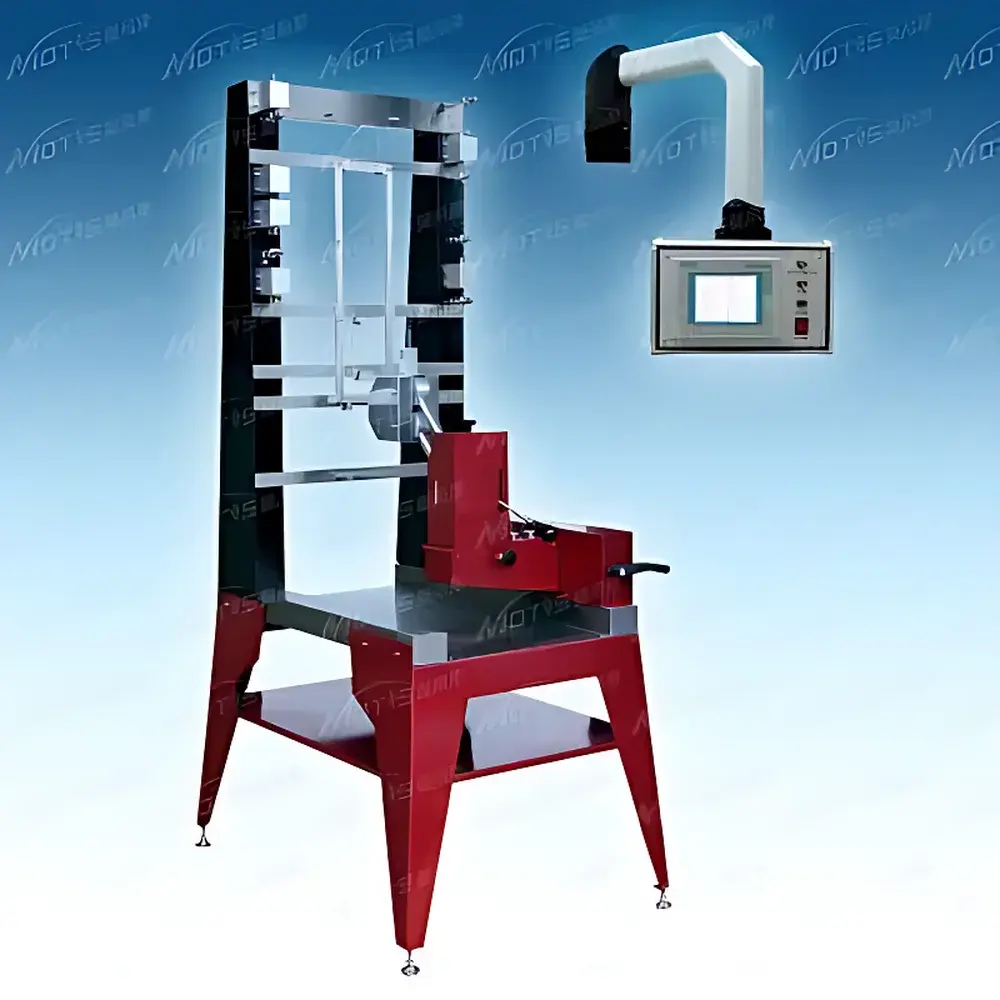
Relia-Burn Multi-Function Combustion Test Chamber
| Origin | Shanghai, China |
|---|---|
| Manufacturer Type | Authorized Distributor |
| Origin Category | Domestic (PRC) |
| Model | Relia-Burn |
| Pricing | Available Upon Request |
Overview
The Relia-Burn Multi-Function Combustion Test Chamber is an engineered platform for standardized flammability assessment of textile materials and assemblies under controlled vertical ignition conditions. It operates on the principle of regulated flame impingement—applying a defined propane or butane flame to specified specimen edges or bottom edges for prescribed durations—and quantifies critical fire response parameters including afterflame time, afterglow time, char length, and flame spread rate. Designed for compliance-driven laboratories in textile R&D, quality assurance, and regulatory testing, the system supports full-cycle evaluation of flame resistance across apparel, home furnishings, protective workwear, and children’s sleepwear. Its architecture adheres to the fundamental test geometries and thermal boundary conditions required by international vertical flame test protocols, ensuring measurement traceability to national metrology institutes and interlaboratory reproducibility per ISO/IEC 17025 requirements.
Key Features
- Floor-standing structural design eliminates dependency on laboratory benchtops, enhancing spatial flexibility and ergonomic access.
- Modular combustion frame accommodates seven standardized test frames—including BS 5438, ISO 6941, ISO 15025, and GB/T 8745 configurations—alongside one set of stainless-steel specimen clamps.
- Precision linear actuation via ball-screw drive enables repeatable horizontal positioning of the burner relative to the specimen, with fine-tuned height adjustment via calibrated rotary knob.
- Integrated spark ignition system delivers consistent, operator-independent flame initiation without manual pilot lighting.
- Automated dual-gas switching between propane and butane allows seamless transition between standards requiring different heat flux profiles (e.g., ISO 6940 vs. BS 5438:1989).
- Digital touch interface with embedded PLC control hosts preloaded test methods, eliminating manual parameter entry and reducing procedural deviation.
- Onboard flame-height gauge and angular indicator disc ensure accurate alignment of flame vector relative to specimen plane (±0.18° angular resolution).
- Stepper-motor-driven burner translation provides programmable dwell times and dynamic flame exposure sequences per ASTM D6413 or ISO 15025 Annex A.
- Rotatable support arm with adjustable control panel mounting improves line-of-sight visibility and operator reach during setup and observation phases.
Sample Compatibility & Compliance
The Relia-Burn chamber accepts flat textile specimens up to 500 mm × 150 mm (L × W), including single-layer fabrics, laminated composites, coated substrates, and stitched assemblies. It supports conditioned specimens per ISO 139 (20 ± 2°C, 65 ± 5% RH) and accommodates both rigid and flexible mounting fixtures. The system is validated for conformance with over 15 internationally recognized standards, including ISO 6940:2004 (vertical flame propagation), ISO 6941:2003 (flame spread distance), ISO 15025:2012 (protective clothing—limited flame spread), BS EN 13772:2003 (curtains and drapes), GB/T 5456–2021 (textile flammability), and AS/NZS 2755.2:2000 (children’s nightwear). All test modes comply with GLP documentation requirements and support audit-ready data logging for FDA 21 CFR Part 11–aligned environments when integrated with optional secure software modules.
Software & Data Management
The embedded HMI runs deterministic real-time firmware that records timestamped event logs—including ignition confirmation, flame onset, self-extinguishment, and char length measurement—with millisecond resolution. Test reports export in PDF and CSV formats, preserving metadata such as ambient temperature/humidity, gas type, flow rate, burner position, and operator ID. Optional PC-based software extends functionality with trend analysis, comparative benchmarking across material lots, and automated pass/fail classification against threshold criteria defined in ISO 10047 or BS 5722. Audit trails include electronic signatures, change history, and calibration status flags—fully compliant with ISO/IEC 17025 clause 7.7 and EU Annex 11 expectations for computerized systems in regulated settings.
Applications
- Flame resistance validation of flame-retardant treated cotton, polyester, aramid, and modacrylic fabrics used in industrial PPE.
- Regulatory submission testing for CPSC 16 CFR Part 1615/1616 (children’s sleepwear) and NFPA 2112 (flash fire protection).
- Pre-certification screening of curtain linings, upholstery textiles, and bedding components per BS 5852 and EN 1021.
- Material development feedback loop for textile chemists optimizing FR additive dispersion and polymer backbone modification.
- Third-party certification lab workflows requiring multi-standard capability within a single footprint and minimal reconfiguration downtime.
FAQ
Does the Relia-Burn meet ISO/IEC 17025 accreditation requirements for accredited testing labs?
Yes—the system’s mechanical repeatability, gas flow calibration traceability, and digital record integrity support scope-specific accreditation when operated within documented SOPs and maintained per manufacturer-recommended intervals.
Can test method updates be loaded remotely via USB or network interface?
Firmware and method libraries are updated via encrypted USB key; network connectivity is not enabled by default to preserve data integrity and cybersecurity compliance.
Is external fume extraction mandatory during operation?
Yes—operation requires connection to a certified laboratory exhaust system meeting local occupational exposure limits (e.g., OSHA PEL for CO and NOx) and complying with EN 14175-3 for ducted hood performance.
What calibration certificates are supplied with initial delivery?
Each unit ships with NIST-traceable calibration reports for burner positioning encoder, flame height scale, and gas mass flow controller, valid for 12 months from commissioning.
How is operator safety enforced during flame exposure cycles?
The chamber incorporates interlocked viewing window shutters, automatic flame cutoff upon door opening, and emergency stop circuitry integrated into the PLC—meeting IEC 61508 SIL1 functional safety requirements.



