
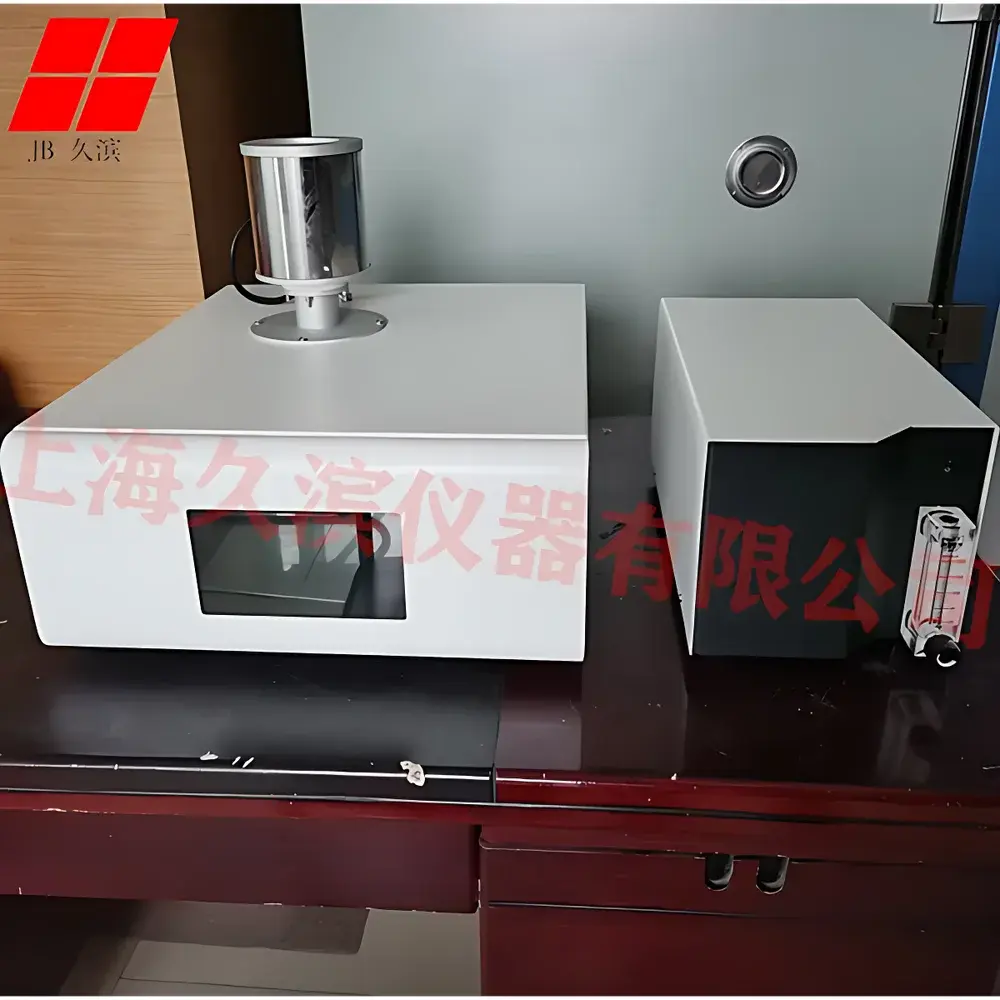
JB-TGA-1550 High-Temperature Thermogravimetric Analyzer (TGA) by JByq
| Brand | JByq |
|---|---|
| Origin | Shanghai, China |
| Model | JB-TGA-1550 |
| Temperature Range | Ambient to 1550 °C |
| Balance Sensitivity | 0.01 µg |
| Heating/Cooling Rate | 0.1–80 K/min |
| Atmosphere | Ambient pressure, dual-gas control (N₂/O₂) |
| Sample Capacity | Single sample, 0.1 mg–2 g (expandable to 50 g) |
| Temperature Stability | ±0.1 °C |
| Temperature Resolution | 0.01 °C |
| Isothermal Duration | 0–300 min adjustable |
| Cooling Time (1000 °C → 100 °C) | ≤15 min |
| Data Interface | USB |
| Software | Proprietary TGA analysis suite with TG/DTG overlay, % mass conversion, Excel export, and report generation |
Overview
The JB-TGA-1550 is a high-temperature thermogravimetric analyzer engineered for precise, reproducible mass-change measurement under controlled thermal and atmospheric conditions. It operates on the fundamental principle of thermogravimetry—monitoring real-time sample mass variation as a function of temperature or time during programmed heating, cooling, or isothermal holds. Designed for rigorous materials characterization in R&D laboratories and quality control environments, the instrument supports quantitative decomposition profiling, thermal stability assessment, and compositional analysis across ceramics, metals, polymers, pharmaceuticals, catalysts, and energy materials. Its extended operational range up to 1550 °C enables investigation of refractory oxides, sintering behavior, high-temperature oxidation kinetics, and phase transformation sequences where conventional TGA systems reach functional limits.
Key Features
- High-temperature furnace architecture with optimized thermal uniformity and rapid response PID temperature control, supporting heating rates from 0.1 to 80 K/min with resolution of 0.01 °C and stability within ±0.1 °C.
- Ultra-sensitive microbalance system with 0.01 µg detection limit and dynamic range spanning 0.1 mg to 2 g (extendable to 50 g), calibrated traceably to NIST-traceable standards.
- Dual independent gas inlet system with mass flow controllers for precise switching and blending of inert (N₂) and reactive (O₂) atmospheres—fully programmable per segment in multi-step temperature ramps.
- Integrated active cooling module enabling rapid cooldown from 1000 °C to 100 °C in ≤15 minutes, minimizing turnaround time between high-temperature runs without compromising sensor longevity.
- Large-character backlit LCD display with intuitive menu navigation; all critical parameters—including current temperature, mass signal, gas flow status, and ramp profile—are visible without software dependency.
- Robust mechanical design with ceramic crucible holder, quartz sensor housing, and electromagnetic shielding to ensure long-term baseline stability and resistance to thermal drift.
Sample Compatibility & Compliance
The JB-TGA-1550 accommodates solid, powdered, granular, viscous liquid, and paste-like samples—excluding gaseous specimens—in standard alumina, platinum, or graphite crucibles (compatible with optional high-purity silica or tungsten carbide variants). Sample containment is fully compatible with ASTM E1131 (Standard Test Method for Compositional Analysis by Thermogravimetry), ISO 11358 (Plastics — Thermogravimetry of polymers), and USP residual solvent testing protocols when operated under validated conditions. The system supports GLP-compliant operation via audit-trail-enabled software logging (including user ID, timestamp, method version, and raw data checksums), aligning with FDA 21 CFR Part 11 requirements for electronic records and signatures when deployed with appropriate IT infrastructure controls.
Software & Data Management
The proprietary TGA analysis software provides full instrument control, real-time visualization of TG and derivative (DTG) curves, and post-run processing capabilities including baseline correction, peak integration, mass loss step assignment, and kinetic modeling (e.g., Kissinger, Ozawa-Flynn-Wall). Users may toggle between absolute mass (mg), normalized mass (%), and derivative (mg/min) axes; overlay multiple runs for comparative analysis; and export tabulated data directly to CSV or Microsoft Excel formats. Reports are customizable with institutional headers, metadata fields (operator, date, sample ID, method), and embedded graphical outputs. Software updates are distributed free-of-charge and include backward-compatible data file handling and enhanced compliance features such as electronic signature prompts and configuration change logs.
Applications
- Quantification of filler content, moisture, volatiles, and ash residue in polymer composites and rubber formulations.
- Thermal degradation kinetics and activation energy determination for flame-retardant additives and bio-based resins.
- Oxidation onset temperature and weight gain profiles in high-performance alloys and Ni-based superalloys.
- Decomposition stoichiometry and intermediate phase identification in battery cathode materials (e.g., NMC, LFP) under controlled O₂ partial pressures.
- Calcination behavior and carbonate decomposition in cementitious systems and geological samples.
- Stability screening of active pharmaceutical ingredients (APIs) and excipients under ICH Q1A(R3) recommended storage condition simulations.
FAQ
What crucible materials are supported at 1550 °C?
Alumina (Al₂O₃), platinum (Pt), and high-purity graphite crucibles are certified for continuous use up to 1550 °C; silica crucibles are limited to ≤1200 °C.
Can the system perform simultaneous TGA-DTA or TGA-DSC?
No—the JB-TGA-1550 is a dedicated thermogravimetric platform. For coupled thermal analysis, a separate DTA/DSC module or hybrid instrument is required.
Is calibration traceable to international standards?
Yes—mass calibration uses certified reference weights traceable to NIST; temperature calibration employs high-purity metal standards (In, Sn, Zn, Al, Ag) per ASTM E967 and ISO 11357.
How is gas flow accuracy maintained during rapid heating?
Each gas line incorporates a thermal mass flow controller (MFC) with closed-loop feedback, maintaining setpoint accuracy within ±1% FS across the full 0–500 mL/min range, independent of temperature-induced viscosity changes.
Does the software support automated method validation per pharmacopeial guidelines?
The software includes templates aligned with USP and EP 2.2.44, but full method validation (precision, accuracy, robustness) requires user-defined protocol execution and documentation outside the software interface.



