
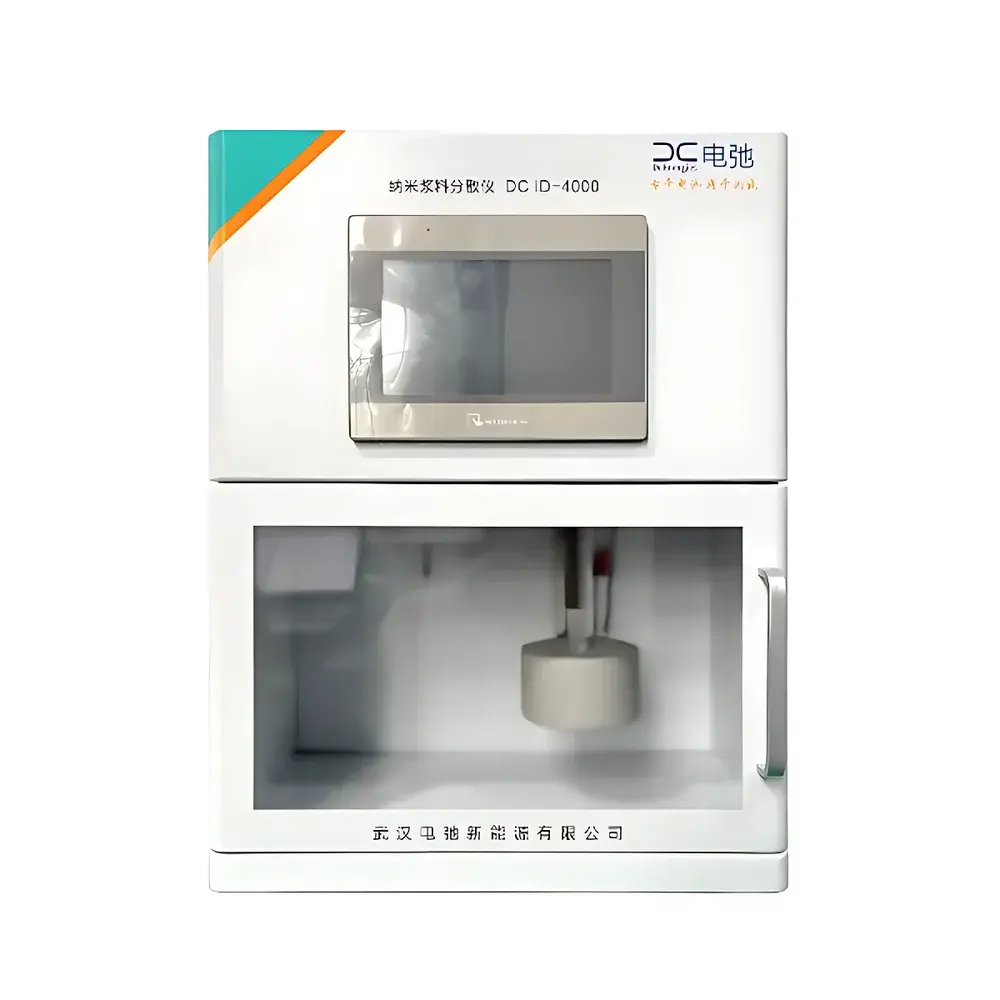
DC ID-4000 Ink Disperser for Catalyst Slurry Preparation
| Brand | DC-Energies |
|---|---|
| Model | DC ID-4000 |
| Dispersion Capacity | ≤4000 µL |
| Ultrasonic Frequency | 30 kHz |
| Ultrasonic Duration | 0–1000 s |
| Ultrasonic Interval | 10–100 s |
| Shear Speed | 0–8000 rpm |
| Shear Duration | 0–1000 s |
| Shear Interval | 10–100 s |
| Cycles | 1–100 |
| Vacuum Level | −0.1 MPa |
| Power Consumption | <500 W |
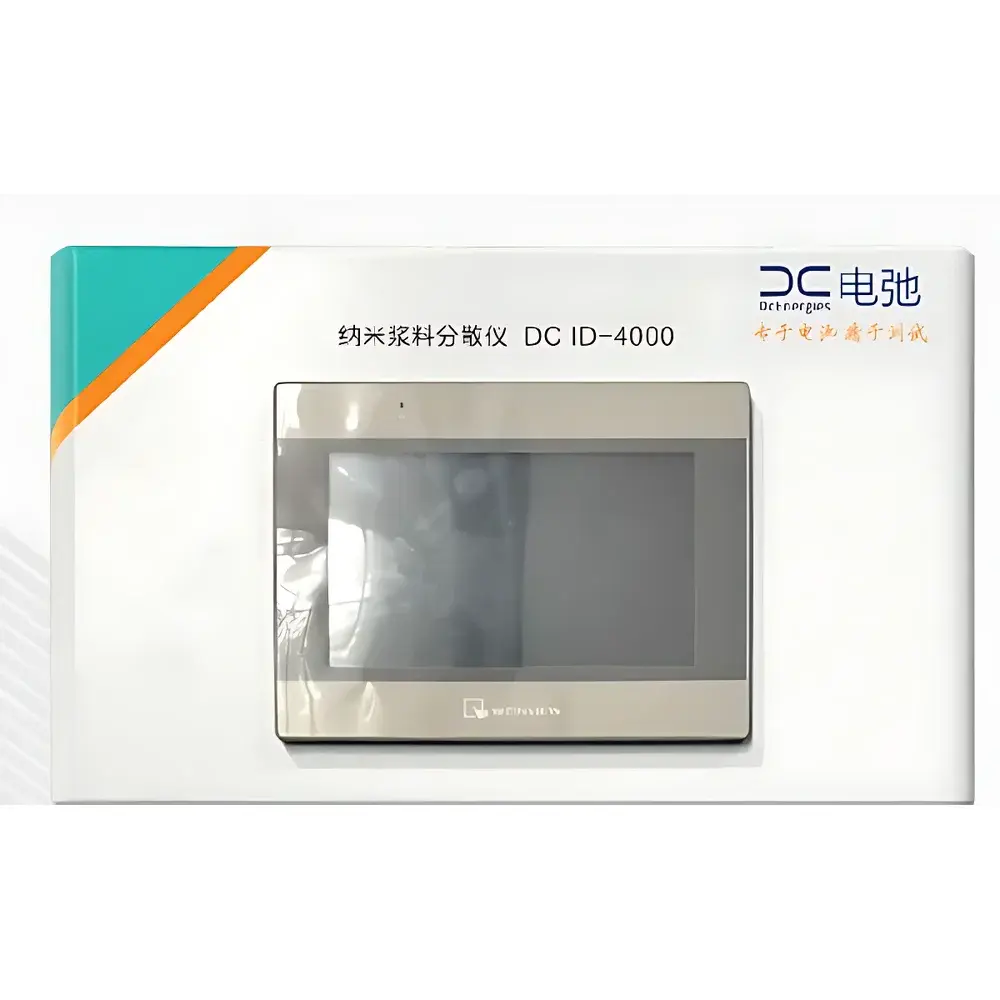
| Control Interface | 7-inch capacitive touchscreen |
Overview
The DC ID-4000 Ink Disperser is an integrated laboratory-scale dispersion system engineered specifically for the reproducible preparation of homogeneous catalyst inks used in electrochemical energy applications—including PEM fuel cells, water electrolyzers, and lithium–sulfur or solid-state battery R&D. It combines high-frequency ultrasonication (30 kHz) with controllable high-shear mechanical agitation to overcome interparticle agglomeration in nanoscale catalyst suspensions (e.g., Pt/C, IrO2, RuO2, NiFe LDH, or metal–organic framework composites). Unlike conventional sonicators or homogenizers operating in isolation, the DC ID-4000 implements synchronized or sequential ultrasonic + shear protocols—enabling controlled energy input across multiple physical dispersion mechanisms: cavitation-induced particle deagglomeration, hydrodynamic shear-induced breakage of weak flocs, and vacuum-assisted degassing to eliminate air entrapment that compromises ink rheology and electrode coating uniformity.
Key Features
- Multi-mode operation: Independent or combined ultrasonic dispersion, high-shear mixing, and hybrid ultrasonic–shear cycles for method optimization
- Precise temporal control: Adjustable ultrasonic pulse duration (0–1000 s), interval (10–100 s), shear runtime (0–1000 s), and inter-pulse delay (10–100 s)
- Vacuum-assisted processing: Integrated −0.1 MPa vacuum chamber to remove microbubbles prior to and during dispersion—critical for achieving low-viscosity, bubble-free inks suitable for slot-die or blade coating
- Scalable sample handling: Designed for standard microcentrifuge tubes (0.5–2 mL) and custom vials up to 4000 µL capacity; compatible with inert-atmosphere glovebox integration via optional sealing adapters
- Intuitive human–machine interface: 7-inch industrial-grade capacitive touchscreen with preloaded protocol templates, real-time parameter monitoring, and non-volatile memory for ≥100 user-defined methods
- Thermal management: Active cooling plate and duty-cycle limiting prevent localized overheating of sensitive catalysts (e.g., Fe–N–C ORR catalysts) during prolonged dispersion
Sample Compatibility & Compliance
The DC ID-4000 supports aqueous and organic solvent-based catalyst inks—including Nafion® dispersions in isopropanol/water mixtures, PVDF/NMP slurries, and ionomer-free formulations using alternative binders (e.g., PTFE, chitosan, or sulfonated polyether ether ketone). Its stainless-steel wetted parts and chemically resistant gaskets comply with ISO 8502-9 for surface cleanliness verification and meet material compatibility requirements per ASTM D4586 (coating dispersion stability testing). While not certified for GMP manufacturing environments, its repeatable process parameters, audit-ready method logs, and touchscreen timestamping support GLP-aligned lab documentation practices. The device operates within Class II laboratory safety standards per IEC 61010-1 and includes overtemperature, overpressure, and lid-interlock safeguards.
Software & Data Management
No proprietary PC software is required; all configuration, execution, and logging occur locally on the embedded Linux-based controller. Each run records timestamp, selected mode, cycle count, total energy-equivalent time (ultrasonic + shear), vacuum hold duration, and final status (completed/aborted/error code). Export is supported via USB flash drive in CSV format for traceability and statistical analysis (e.g., ANOVA of dispersion time vs. electrochemical surface area). Protocol files are encrypted and password-protected to ensure method integrity across multi-user labs. The system does not connect to networks or cloud services—ensuring data sovereignty and compliance with institutional IT security policies governing research instrumentation.
Applications
- Preparation of standardized catalyst inks for half-cell electrochemical evaluation (CV, LSV, EIS) in rotating disk electrode (RDE) and rotating ring–disk electrode (RRDE) setups
- Optimization of ink formulation parameters (solid loading, ionomer ratio, solvent blend) for membrane electrode assembly (MEA) fabrication
- Dispersion validation studies supporting ASTM D7823 (standard test method for dispersion quality of carbon black in rubber compounds) adapted for electrocatalyst systems
- Accelerated stability assessment of ink rheology under repeated thermal–mechanical stress (e.g., freeze–thaw cycling followed by dispersion recovery testing)
- Inter-laboratory method harmonization in DOE-funded fuel cell consortiums where reproducible ink preparation is a critical pre-analytical variable
FAQ
Is the DC ID-4000 suitable for dispersing graphene oxide or MXene suspensions?
Yes—its dual-mode capability enables gentle ultrasonic deagglomeration followed by low-rpm shear to preserve 2D flake integrity while ensuring colloidal stability.
Can the vacuum function be disabled for non-volatile solvents?
Yes—the vacuum step is fully programmable and may be omitted or shortened for solvents with low vapor pressure (e.g., NMP, DMF).
What maintenance is required for long-term reliability?
Annual inspection of ultrasonic transducer coupling gel integrity, shear rotor concentricity, and vacuum seal elastomer aging is recommended. No routine calibration is needed.
Does the instrument support external trigger signals for synchronization with other lab equipment?
No—it operates as a standalone unit without TTL or Ethernet trigger I/O. Synchronization must be managed externally via timer-based coordination.
Are replacement parts such as shear rotors or ultrasonic probes available separately?
Yes—DC-Energies supplies OEM-certified consumables including titanium alloy shear rotors (diameters: 3 mm, 5 mm), replaceable ultrasonic horns, and vacuum chamber gaskets with documented lot traceability.




