
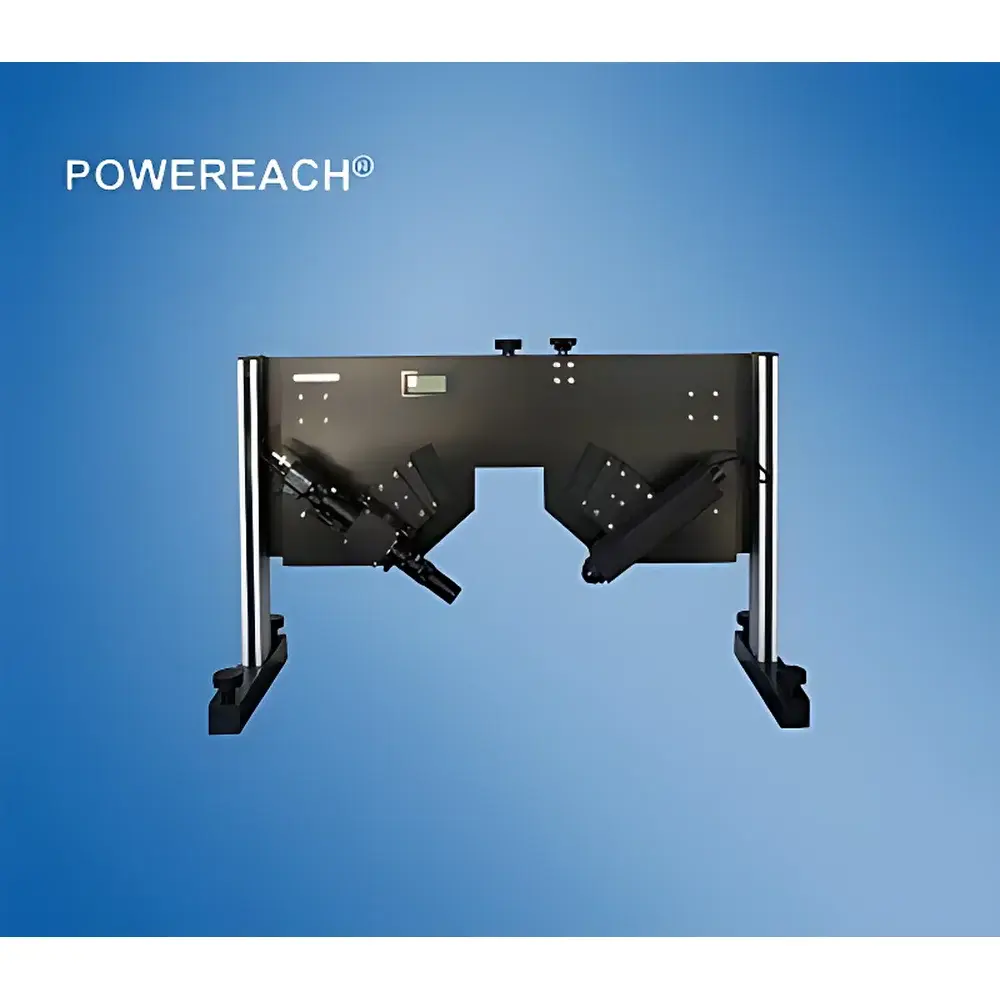
JB04 Brewster Angle Microscope (BAM) for Langmuir-Blodgett Trough Analysis
| Origin | Shanghai, China |
|---|---|
| Manufacturer Type | Authorized Distributor |
| Regional Origin | Domestic (PRC) |
| Model | JB04 |
| Price Range | USD 14,000 – 28,000 |
| Light Source | 532 nm Green Laser (20 mW or 50 mW) |
| Laser Intensity Control | Continuous 1–100% Adjustment |
| Objective Lens | Nikon MS-01 Continuous Zoom, Working Distance 90 mm, Magnification Equivalent to 700–110 px/mm |
| Spatial Resolution | 2 µm |
| Incident Angle Range | 45°–60° |
| Polarization System | High-Extinction-Ratio Glan-Taylor or Wollaston Prism Polarizer |
| Imaging Sensor | Scientific-Grade CCD with Software-Controlled Electronic Shutter |
| Frame Acquisition | CG400 High-Speed Image Capture Card |
| Operating System | Windows 2000/XP-Compatible Native GUI Application |
Overview
The JB04 Brewster Angle Microscope (BAM) is a precision optical instrument engineered for real-time, non-invasive visualization and morphological characterization of monolayers at the air–water interface. It operates on the fundamental principle of Brewster angle reflectivity: when p-polarized light strikes a dielectric interface at the Brewster angle (θB), the reflected intensity drops to near zero due to the absence of reflection for that polarization state. The presence of a Langmuir monolayer alters the effective refractive index and interfacial dielectric discontinuity, thereby restoring measurable p-polarized reflectance. This subtle change—quantifiable as contrast in the BAM image—enables label-free, in situ monitoring of molecular packing density, domain formation, phase coexistence, and lateral heterogeneity without perturbing the film. Designed explicitly for integration with commercial Langmuir troughs, the JB04 provides quantitative optical contrast correlated directly with surface pressure (π) and molecular area (A), making it indispensable for thermodynamic and kinetic studies of amphiphilic films under controlled compression.
Key Features
- Optimized optical path with high-stability 532 nm solid-state laser source (20 mW or 50 mW output), delivering consistent illumination intensity and minimal thermal drift at the interface.
- Continuously adjustable incident angle (45°–60°), enabling precise alignment to the experimentally determined Brewster condition for varying subphase compositions (e.g., salt concentration, pH, temperature).
- Nikon MS-01 zoom objective with 90 mm working distance ensures unobstructed access above the trough while maintaining optical fidelity across magnification ranges equivalent to 700–110 pixels per millimeter.
- High-extinction-ratio polarizing optics (Glan-Taylor or Wollaston configuration) guarantee >105:1 polarization contrast, essential for detecting sub-nanometer thickness variations in monolayer domains.
- Scientific-grade CCD imaging system with software-controlled electronic shutter and CG400 frame-grabber enables synchronized acquisition at up to 30 fps, supporting dynamic studies of collapse, nucleation, and domain mobility.
- Native Windows 2000/XP-compatible GUI application provides real-time display, contrast enhancement, ROI-based intensity profiling, and time-lapse export in TIFF/AVI formats—no third-party drivers required.
Sample Compatibility & Compliance
The JB04 is compatible with standard Langmuir trough configurations (e.g., KSV Nima, NIMA Technology, or custom-built systems) and supports all common monolayer-forming materials: fatty acids (e.g., stearic acid), phospholipids (DPPC, DMPC), block copolymers, conjugated polymers, and nanoparticle-laden films. It accommodates subphases ranging from pure water to buffered saline solutions (pH 2–12) and temperature-controlled environments (±0.1 °C). While the instrument itself does not carry CE or FDA certification, its optical design and data acquisition architecture comply with GLP-aligned documentation practices. Image timestamps, laser power logs, and angle calibration records are embedded in metadata—supporting traceability requirements under ISO/IEC 17025 and ASTM D1388 (Standard Test Method for Surface Tension of Monomolecular Films).
Software & Data Management
The bundled native software provides full instrument control—including laser intensity ramping, focus optimization, and angle fine-tuning—via intuitive graphical sliders and numeric input fields. All acquired images retain EXIF-style metadata: date/time stamp, exposure duration, gain setting, and user-defined annotation tags. Batch processing tools allow pixel-intensity histogram analysis, domain area quantification, and temporal evolution tracking via kymograph generation. Export options include calibrated 16-bit TIFF stacks and time-synchronized CSV files containing mean gray value vs. compression time—compatible with MATLAB, Python (OpenCV, scikit-image), and Igor Pro for advanced statistical modeling of phase transitions and critical point identification.
Applications
- In situ monitoring of 2D phase transitions (gas–liquid-condensed, LE–LC, solid–solid) during quasi-static compression.
- Quantitative assessment of monolayer homogeneity and defect distribution prior to LB transfer.
- Real-time observation of nucleation kinetics, domain growth anisotropy, and line tension effects in mixed lipid systems.
- Characterization of surfactant adsorption/desorption dynamics at ultra-low surface pressures (<0.1 mN/m).
- Validation of molecular tilt angles and orientational order via angular-dependent contrast modeling.
- Contamination detection: identification of insoluble impurities or oxidized species disrupting monolayer continuity.
FAQ
What is the minimum detectable monolayer thickness?
The JB04 detects optical contrast arising from refractive index changes induced by monolayers ≥0.3 nm thick—corresponding to well-ordered alkyl chains oriented near-vertical to the interface.
Can the JB04 be used with non-aqueous subphases?
Yes—provided the Brewster angle is recalibrated for the new liquid–vapor interface and the laser wavelength remains within the transmission window of the subphase (e.g., chloroform, hexane, or ethanol).
Is angle calibration required before each experiment?
Yes; the optimal Brewster angle shifts with subphase composition and temperature. A quick reflectance-vs.-angle scan (±2° around theoretical θB) is recommended for maximum contrast fidelity.
Does the system support automated synchronization with a Langmuir trough controller?
No native hardware trigger interface is included, but ASCII command protocols (RS-232 or TCP/IP) can be implemented via custom scripting to align image capture with surface pressure sweeps.
What maintenance is required for long-term stability?
Annual verification of laser collimation, polarizer extinction ratio, and CCD dark-current profile is advised. Optical components should be cleaned only with spectroscopic-grade solvents and lens tissue to avoid micro-scratches affecting contrast uniformity.



