
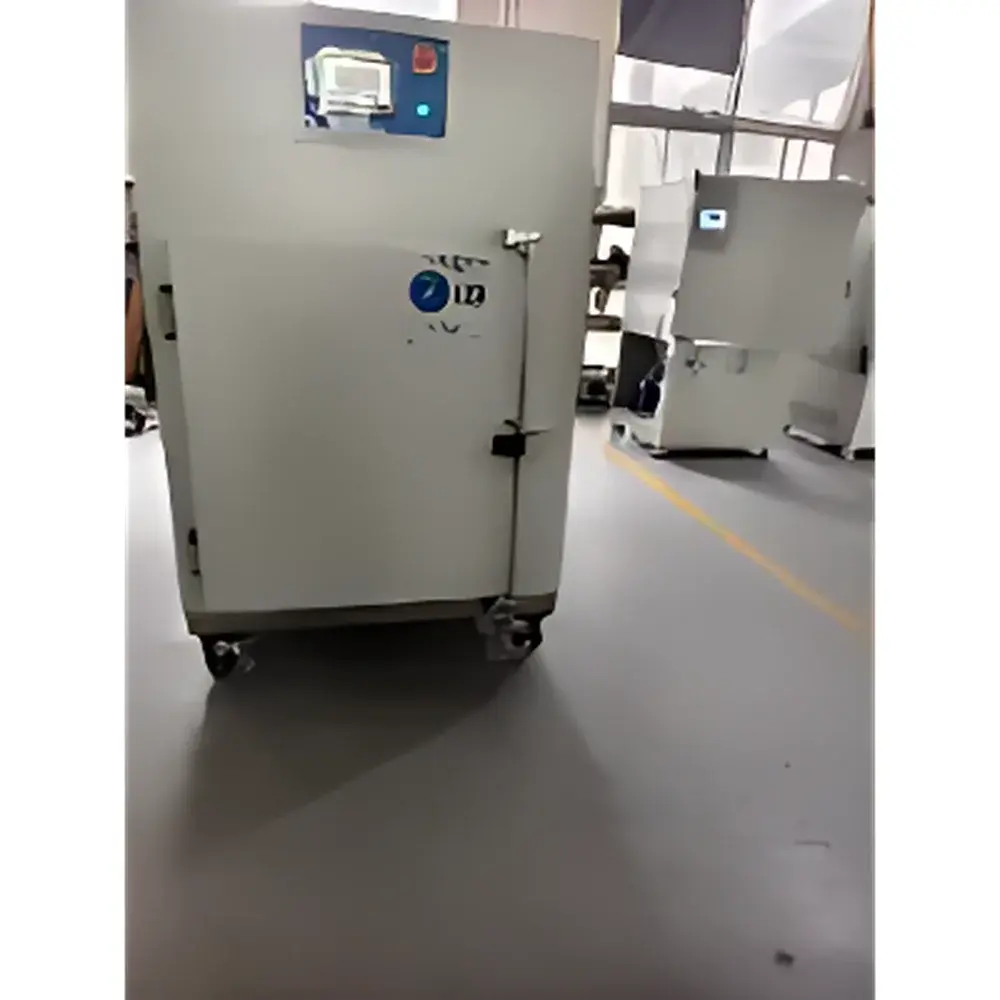
JH High-Temperature Aging Chamber with Vacuum PI Oven Capability, Wide-Range Temperature & Humidity Coverage, Rapid Thermal Cycling
| Brand | JH |
|---|---|
| Origin | Shanghai, China |
| Manufacturer Type | Authorized Distributor |
| Product Origin | Domestic (China) |
| Model | JH High-Temperature Aging Chamber |
| Price Range | USD 350 – 35,000 |
| Temperature Range | −70 °C to +150 °C |
| Cooling Method | Compressor-Based Refrigeration |
| Explosion-Proof Design | Yes |
| Temperature Fluctuation | ±0.5 °C |
| Temperature Uniformity | ±2.0 °C |
| Temperature Deviation | ±2.0 °C |
| Heating Rate | ≤60 min (−70 °C to +150 °C) |
| Cooling Rate | ≤45 min / ≤60 min / ≤80 min (depending on configuration) |
| Internal Chamber Dimensions | Available in Small, Medium, and Large Configurations |
Overview
The JH High-Temperature Aging Chamber with Vacuum PI Oven Capability is an engineered environmental test system designed for accelerated thermal aging, material stability evaluation, and process validation under controlled inert or vacuum conditions. It integrates dual-mode thermal management—conventional forced-air convection heating/cooling and optional vacuum-compatible high-temperature baking—for applications requiring oxygen-free thermal exposure, such as polyimide (PI) film curing, semiconductor packaging stress testing, and battery electrode drying. The chamber operates on a robust thermodynamic architecture combining compressor-based refrigeration, high-efficiency resistive and infrared hybrid heating elements, and precision airflow dynamics to achieve rapid thermal transitions across its full operational range of −70 °C to +150 °C. Its explosion-proof construction complies with IEC 60079-0 and GB 3836.1 standards, enabling safe operation in volatile organic or hydrogen-rich atmospheres.
Key Features
- Hybrid heating system: Integrated resistive coil arrays and near-infrared emitters enable simultaneous surface and volumetric heating, reducing thermal inertia and supporting sub-60-minute ramp rates from deep freeze to peak temperature.
- Intelligent adaptive PID control with real-time load compensation: Algorithms dynamically adjust proportional gain, integral reset time, and derivative action based on chamber thermal mass, door-open events, and sample-specific heat capacity profiles.
- Dual-path laminar airflow ducting: Asymmetric top-bottom air distribution with variable-frequency EC fans ensures uniform thermal delivery (<±2.0 °C spatial uniformity) and minimizes thermal stratification during rapid transients.
- Vacuum-rated internal chamber: Stainless steel 316L construction with welded seams and fluorosilicone door gaskets supports continuous operation at pressures down to 10−2 mbar, compatible with nitrogen purging or PI-grade vacuum bake protocols.
- Nanocomposite insulation layer: Aerogel-enhanced polyurethane panels reduce thermal conductivity to <0.022 W/m·K, limiting external surface temperature rise to <45 °C at +150 °C internal setpoint and improving energy efficiency by ≥35% versus conventional mineral wool.
- Class I, Division 1 explosion-proof certification: Intrinsically safe wiring, flameproof enclosure, and non-sparking fan impellers meet ATEX Directive 2014/34/EU and NEC Article 500 requirements.
Sample Compatibility & Compliance
The JH chamber accommodates diverse sample geometries—from wafer-level microelectronics and pouch-type lithium-ion cells to structural composites and polymer films—within configurable chamber volumes. All standard configurations support ASTM D3045 (thermal aging of plastics), ISO 188 (vulcanized rubber), and IEC 60068-2-1/2/14 (cold/heat/damp heat testing). Optional vacuum bake modules align with IPC-CC-830B (conformal coating qualification) and MIL-STD-883 Method 1008 (moisture removal for hermetic packages). Data logging and alarm thresholds are configurable to satisfy GLP and GMP documentation requirements, including audit trails compliant with FDA 21 CFR Part 11 when paired with validated software packages.
Software & Data Management
Equipped with embedded ARM Cortex-A9 controller running Linux RTOS, the system delivers deterministic thermal profile execution with 100 ms sampling resolution. The web-accessible HMI supports up to 99 programmable test cycles, each with unlimited step segments (ramp/soak/humidity hold), conditional branching, and real-time deviation alerts. Exported CSV and PDF reports include timestamped temperature/humidity/vacuum traces, event logs (door open/close, power loss, alarm triggers), and statistical summaries (mean, std dev, max/min per segment). Optional Ethernet/IP and Modbus TCP interfaces enable integration into MES platforms (e.g., Siemens Opcenter, Rockwell FactoryTalk) and centralized lab monitoring systems.
Applications
- Accelerated life testing of automotive electronics under combined thermal cycling and humidity exposure (ISO 16750-4).
- Oxygen-sensitive curing of polyimide substrates for flexible printed circuits (IPC-4101D, IPC-TM-650 2.6.27.1).
- Pre-conditioning of lithium-ion battery electrodes prior to cell assembly (UN 38.3 thermal preconditioning protocol).
- Stress screening of aerospace-grade adhesives and composite laminates per NASA-STD-6016.
- Validation of sterilization cycle parameters for medical device packaging materials (ISO 11137-1).
- Reliability assessment of optoelectronic components (LEDs, VCSELs) under high-temperature storage (JEDEC JESD22-A103).
FAQ
What vacuum level can the chamber achieve, and is it compatible with PI film processing?
The standard vacuum module reaches ≤1×10⁻² mbar with a two-stage rotary vane pump; optional turbomolecular pumping extends performance to ≤5×10⁻⁵ mbar, fully meeting polyimide imidization specifications requiring <10−3 mbar residual oxygen partial pressure.
Does the system support automated humidity control across the full temperature range?
Yes—integrated steam generator and desiccant wheel humidification deliver 10–95% RH at +20 °C to +85 °C; humidity control is disabled below +10 °C to prevent condensation and ensure sensor longevity.
How is temperature uniformity verified and maintained during rapid ramping?
Uniformity is validated per IEC 60068-3-5 using nine calibrated PT100 sensors mounted on a 3×3 grid; active airflow modulation and staggered heater zone activation compensate for transient thermal gradients during ramp phases.
Can the chamber be integrated into a factory-wide environmental monitoring network?
Yes—standard Ethernet port supports SNMP v3, OPC UA over TCP/IP, and RESTful API endpoints for status polling, remote start/stop, and real-time data streaming to SCADA or cloud-based analytics platforms.
What calibration documentation is provided with shipment?
Each unit ships with NIST-traceable as-found/as-left calibration certificates for all critical sensors (temperature, humidity, vacuum), performed per ISO/IEC 17025 accredited procedures by an ILAC-MRA signatory laboratory.



