
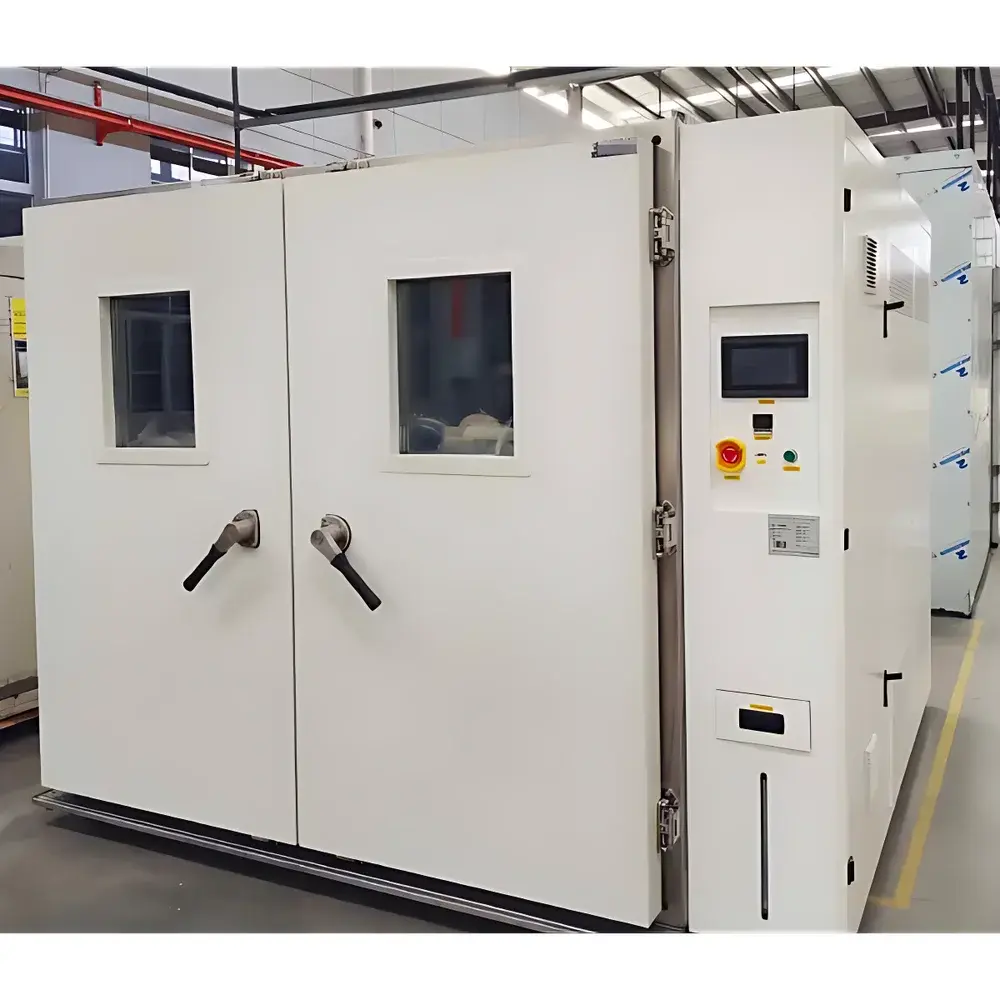
JH Walk-in Programmable Temperature & Humidity Chamber for新能源 Battery R&D
| Brand | JH |
|---|---|
| Origin | Shanghai, China |
| Model | JH Walk-in Programmable Environmental Test Chamber |
| Price Range | USD 1,100 – 110,000 (FOB) |
| Interior Dimensions | Customizable (D×W×H) |
| Temperature Range | −50 °C to +150 °C |
| Temperature Uniformity | ±2.0 °C |
| Temperature Control Resolution | 0.1 °C |
| Heating Rate | 3 °C/min |
| Humidity Control | Programmable RH range with dynamic coupling to temperature profile |
Overview
The JH Walk-in Programmable Temperature & Humidity Chamber is an engineered environmental simulation platform designed specifically for rigorous reliability validation and performance characterization of lithium-ion and next-generation electrochemical energy storage systems. Operating on the principle of forced-air convection with dual independent PID-controlled refrigeration and steam-based humidification subsystems, the chamber delivers precise, repeatable, and dynamically programmable thermal–hygric environments across a wide operational envelope. Its walk-in architecture supports full-scale battery modules, pack-level assemblies, and auxiliary thermal management units—enabling real-world boundary condition replication without spatial compromise. Unlike benchtop chambers constrained by volume and thermal inertia, this system maintains high-fidelity control during rapid transients (e.g., 3 °C/min ramp rates) while sustaining tight uniformity (±2.0 °C) and resolution (0.1 °C), essential for studying Arrhenius-dependent degradation mechanisms, SEI layer evolution, and electrolyte volatility under accelerated aging protocols.
Key Features
- Walk-in configuration with fully customizable interior dimensions (depth × width × height), accommodating EV battery packs up to 2.5 m in length and supporting integrated monitoring ports for voltage, current, and surface thermocouple feedthroughs.
- Programmable multi-segment temperature–humidity profiles: up to 999 steps per cycle, with independent ramp/soak/humidity hold parameters; supports complex sequences mimicking diurnal cycling, monsoon exposure, or desert-to-coast transitions.
- Dual-refrigeration system with cascade low-temperature stage (−50 °C capability) and high-efficiency hot-gas bypass modulation for stable sub-zero operation without compressor cycling artifacts.
- Steam-humidification system with stainless-steel boiler and precision pneumatic RH valve, delivering 10–98% RH control (±3% RH accuracy) with minimal droplet carryover—critical for condensation-sensitive cell-level testing.
- Industrial-grade PLC-based controller with Ethernet/IP interface, supporting Modbus TCP integration into factory MES or lab automation frameworks; compliant with IEEE 1626-2018 for environmental test system interoperability.
- Structural insulation using 150 mm polyurethane foam (λ = 0.022 W/m·K) and double-glazed observation windows with anti-fog heating—ensuring energy efficiency and operator safety during extended runtime validation.
Sample Compatibility & Compliance
The chamber accommodates heterogeneous sample configurations: prismatic pouch cells, cylindrical 21700/4680 modules, liquid-cooled battery packs, and BMS-integrated prototypes. Sample mounting interfaces include non-conductive polymer racks, grounded aluminum trays, and optional vibration-isolated platforms for concurrent thermo-mechanical stress testing. From a regulatory standpoint, the system adheres to ISO 16750-4 (road vehicles—environmental conditions), IEC 62660-2 (secondary lithium cells—mechanical and environmental tests), and UN 38.3 Section 38.3.4 (thermal test requirements). Data acquisition logs meet GLP audit trail requirements per FDA 21 CFR Part 11 when paired with validated software—supporting traceability of all setpoints, deviations, and alarm events with user authentication and electronic signature capability.
Software & Data Management
Control and monitoring are executed via JH-EnviroSoft™ v4.2—a Windows-based application certified for IEC 62304 Class B medical device software lifecycle compliance. The software enables offline profile authoring, real-time multi-parameter trending (T, RH, dew point, ΔT between zones), and automated report generation in PDF/CSV formats compliant with ISO/IEC 17025 clause 7.8. All data—including raw sensor outputs, control loop diagnostics, and hardware status flags—are timestamped with NTP-synchronized UTC and stored redundantly on internal SSD and network-attached storage. Audit logs record every user action (login, profile upload, setpoint change, emergency stop), preserving integrity for GMP-regulated battery qualification programs. Optional OPC UA server module allows bidirectional integration with Siemens Desigo, Rockwell FactoryTalk, or MATLAB Simulink for closed-loop stimulus-response modeling.
Applications
- Accelerated calendar and cycle life testing of LiNiMnCoO₂ (NMC), LiFePO₄ (LFP), and solid-state electrolyte cells under variable T/RH stressors to quantify capacity fade kinetics and impedance rise.
- Thermal runaway propagation studies across multi-cell arrays, utilizing synchronized IR camera feeds and gas chromatography sampling ports integrated into the chamber exhaust manifold.
- Validation of battery thermal management system (BTMS) performance—evaluating coolant flow stability, heat exchanger efficiency, and cold-start behavior across −40 °C to +60 °C ambient sweeps.
- Environmental stress screening (ESS) per MIL-STD-810H Method 502.7 for aerospace-grade battery packs, including combined temperature–humidity–vibration profiles.
- Material compatibility testing of sealants, gaskets, and busbar coatings exposed to high-humidity, elevated-temperature soak conditions to assess hydrolytic degradation and adhesion loss.
FAQ
What is the maximum allowable internal load mass for thermal stability during rapid ramping?
The chamber maintains specified uniformity and control accuracy with up to 800 kg of thermally inert ballast load; actual capacity depends on sample emissivity and airflow obstruction—detailed thermal load analysis is provided during site survey.
Can the system be configured for nitrogen-purged operation to suppress oxidation during high-temperature testing?
Yes—optional inert gas purge interface (ISO-KF 40 flange) supports continuous N₂ or Ar flow with O₂ sensor feedback loop and automatic pressure regulation to 1.05 bar(g).
Is remote monitoring supported for unattended overnight testing cycles?
All controllers include embedded web server functionality with TLS 1.2 encryption; users can view live trends, acknowledge alarms, and download logs via any modern browser without proprietary client software.
How is humidity calibration traceability maintained?
Factory calibration uses NIST-traceable chilled-mirror hygrometers (Michell Instruments Easidew XE); on-site verification kits and annual recalibration services are available under ISO/IEC 17025-accredited procedures.
Does the chamber support third-party SCADA integration for centralized lab fleet management?
Yes—Modbus TCP, MQTT, and OPC UA drivers are standard; API documentation and example Python/Node-RED integration scripts are included with delivery.



