
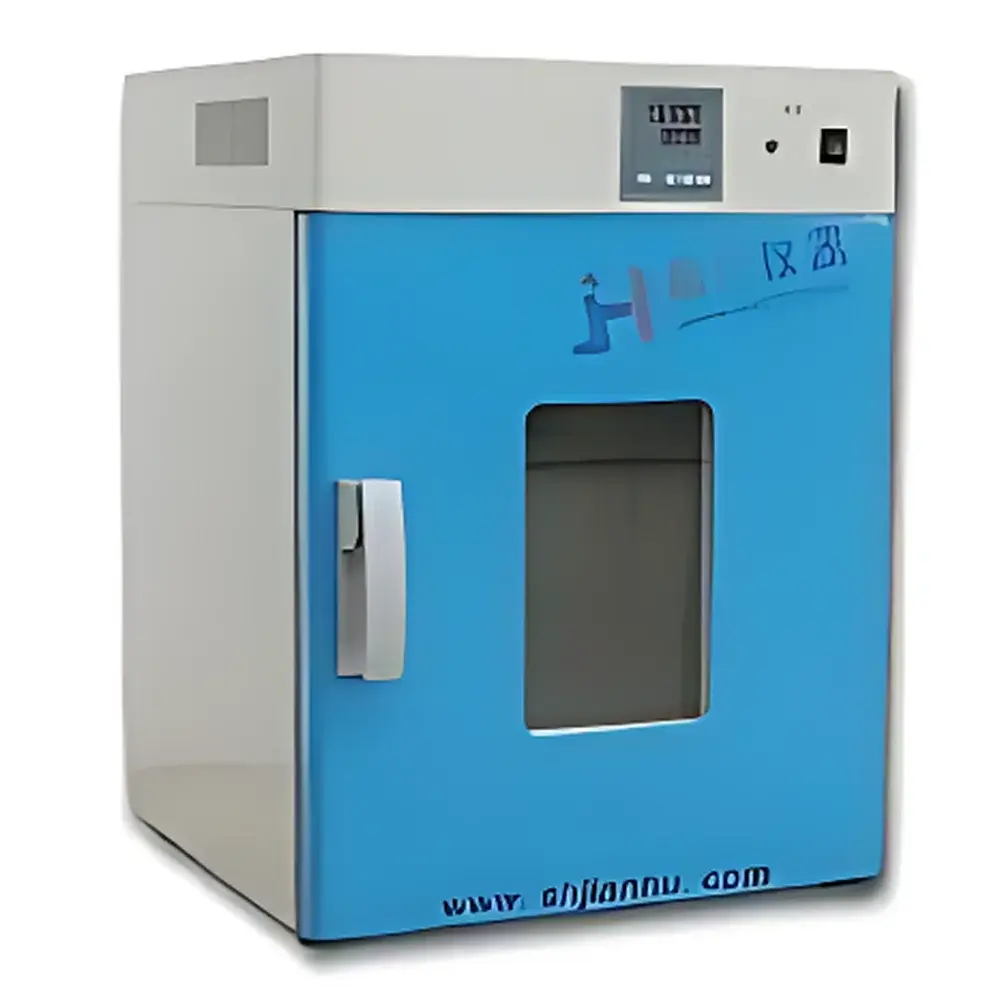
Jianhu DJH Series High-Temperature Environmental Test Chamber / Forced-Air Drying Oven
| Brand | Jianhu |
|---|---|
| Model | DJH |
| Origin | Shanghai, China |
| Construction | Mirror-finish stainless steel interior (argon arc welded) + high-grade cold-rolled steel exterior |
| Temperature Range | Ambient +10°C to 300°C (standard configuration) |
| Control System | Microcomputer-based digital temperature controller with ±0.5°C accuracy |
| Timer Function | 0–9999 minutes |
| Air Circulation | Adjustable axial fan with optimized duct design for uniform chamber temperature distribution (±1.5°C at 100°C, measured per IEC 60068-3-5) |
| Safety | Independent mechanical over-temperature cut-off (optional) |
| Communication | RS485 interface compliant with Modbus RTU protocol (optional) |
| Compliance | Designed in accordance with GB/T 5170.2–2017 (Electrical Equipment for Environmental Testing – Temperature Test Equipment), ISO 17025-compatible operation environment |
Overview
The Jianhu DJH Series High-Temperature Environmental Test Chamber and Forced-Air Drying Oven is an industrial-grade thermal processing instrument engineered for precision drying, curing, aging, and stability testing of materials under controlled elevated temperatures. Utilizing forced convection heat transfer principles, the chamber maintains stable and spatially uniform thermal conditions across its working volume through a dynamically balanced air circulation system. Its operational range extends from ambient +10°C up to 300°C—suitable for applications requiring accelerated thermal exposure without phase change or oxidative degradation beyond material-specific thresholds. The unit complies with national standard GB/T 5170.2–2017 for environmental test equipment performance verification and supports traceable calibration protocols required in GLP-compliant laboratories and manufacturing QA/QC environments.
Key Features
- Mirror-finish 304 stainless steel interior chamber fabricated via argon arc welding—ensuring corrosion resistance, structural integrity, and ease of cleaning under repeated thermal cycling.
- Exterior constructed from pre-painted cold-rolled steel with reinforced frame architecture, delivering long-term dimensional stability and mechanical durability in laboratory or production floor settings.
- Digital microcomputer temperature controller featuring PID algorithm-based regulation, offering ±0.5°C temperature stability (at setpoint) and programmable ramp-soak profiles when equipped with optional intelligent LCD controller.
- High-temperature-rated centrifugal blower integrated into a symmetrical air duct network, enabling consistent airflow velocity (adjustable via rear-mounted damper) and minimizing thermal gradients (≤ ±1.5°C uniformity at 100°C, per IEC 60068-3-5 methodology).
- Independent mechanical over-temperature protection circuit—physically isolated from the main control system—to interrupt power supply upon exceeding user-defined safety limit, satisfying essential risk mitigation requirements per IEC 61000-6-2 and ISO 13850.
Sample Compatibility & Compliance
The DJH chamber accommodates a broad spectrum of sample types including polymer specimens, pharmaceutical excipients, ceramic green bodies, metal coatings, electronic components, and analytical reference standards. Its non-reactive stainless steel interior ensures compatibility with mildly acidic or alkaline volatile residues common in solvent-based drying processes. Units are designed to operate within Class II cleanroom ambient conditions (ISO 14644-1) and support validation documentation packages aligned with FDA 21 CFR Part 11 data integrity expectations when paired with compliant data logging systems. Calibration certificates traceable to NIM (National Institute of Metrology, China) are available upon request.
Software & Data Management
An optional RS485 serial interface enables integration with external data acquisition systems—including standalone chart recorders, SCADA platforms, or custom LIMS environments—using Modbus RTU protocol. Logged parameters include real-time chamber temperature, elapsed time, and (if sensor-equipped) relative humidity. All communication events are timestamped and stored with audit trail capability, facilitating compliance with ISO/IEC 17025 clause 7.7 (result reporting) and internal SOPs governing instrument qualification (IQ/OQ/PQ). No proprietary software is required; raw ASCII data streams permit direct ingestion into MATLAB, Python pandas, or Excel-based trending tools.
Applications
- Thermal aging studies of elastomers and thermoplastics per ASTM D573 and ISO 188.
- Moisture content determination in bulk pharmaceutical powders prior to tablet compression (USP <1251>).
- Curing kinetics evaluation of epoxy resins and UV-curable coatings.
- Stability testing of lithium-ion battery electrode materials under inert atmosphere (when used with optional purge port).
- Pre-conditioning of test coupons for adhesion, hardness, and tensile property measurements (ASTM D638, D412).
- Residual solvent removal from printed circuit board assemblies prior to conformal coating.
FAQ
What is the maximum continuous operating temperature of the DJH series?
The standard configuration supports continuous operation up to 300°C. Extended-range variants capable of 400°C are available under custom engineering order.
Is the temperature controller compliant with GLP data integrity requirements?
The base microcomputer controller provides non-editable time-stamped setpoint logs. For full 21 CFR Part 11 compliance, the optional RS485 interface must be connected to a validated third-party data system with electronic signature and audit trail functionality.
Can the chamber be validated for IQ/OQ/PQ protocols?
Yes. Jianhu supplies documented evidence packages—including factory-assembled temperature mapping reports, sensor calibration certificates, and electrical safety test records—to support formal qualification activities.
Does the unit meet international electromagnetic compatibility (EMC) standards?
All DJH models comply with GB/T 18268.1–2010 (equivalent to IEC 61326-1:2012) for EMC in laboratory environments, covering emissions, immunity, and electrostatic discharge tolerance.
What maintenance intervals are recommended for optimal performance?
Fan bearing lubrication and door gasket inspection are advised every 12 months; temperature sensor recalibration is recommended annually or after 500 cumulative hours above 250°C.



