
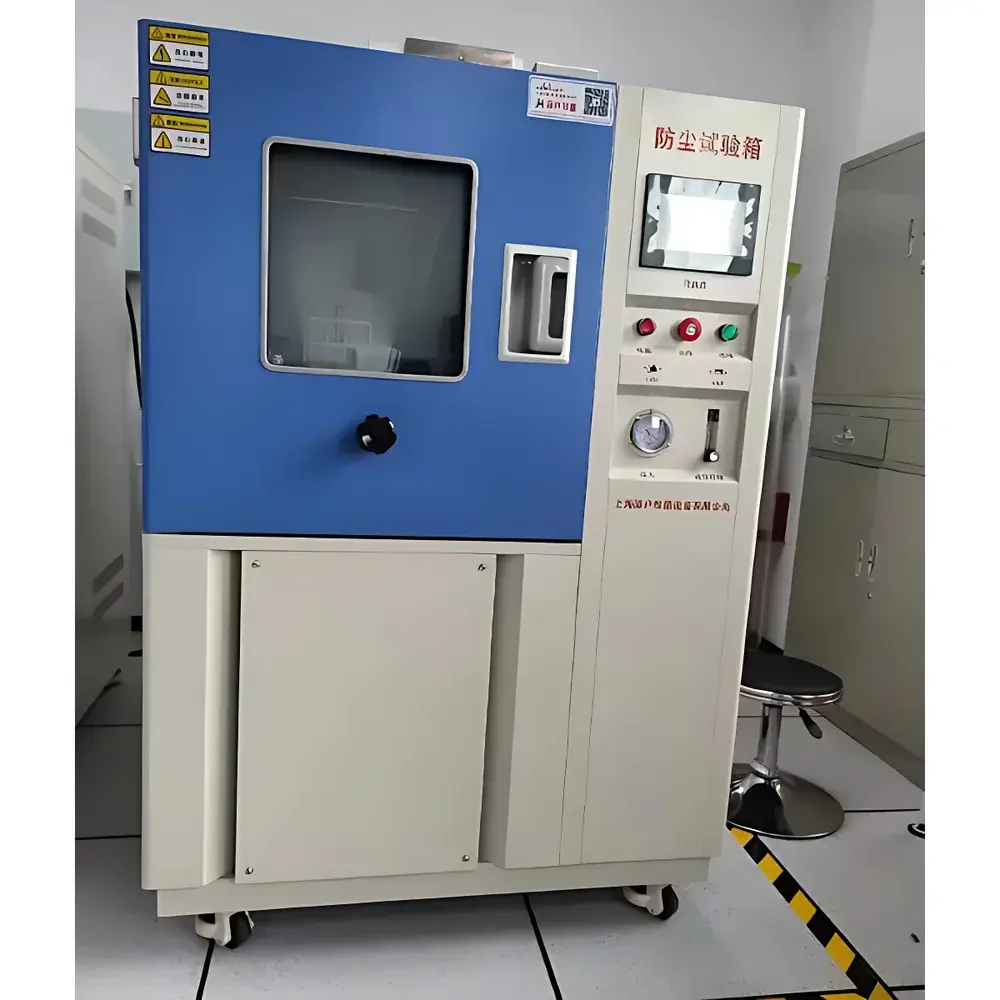
Jianhu DV-SDP Programmable Sand and Dust Test Chamber with High-Temperature Integration
| Brand | Jianhu |
|---|---|
| Origin | Shanghai, China |
| Manufacturer Type | Authorized Distributor |
| Product Category | Domestic |
| Model | DV-SDP |
| Price Range | USD 800 – 80,000 |
| Silica Content | 97–99% SiO₂ |
| Sand Blowing Concentration | 1.1 g/m³ ±0.25 g/m³ to 2.2 g/m³ ±0.5 g/m³ |
| Sand Blowing Velocity | 0–29 m/s |
| Dust Blowing Concentration | 0.1–10.6 g/m³ ±7 g/m³ |
| Dust Blowing Velocity | 8.9 m/s ±1.2 m/s |
Overview
The Jianhu DV-SDP Programmable Sand and Dust Test Chamber is an engineered environmental simulation system designed to replicate arid, particulate-laden atmospheric conditions under controlled thermal and dynamic airflow parameters. It operates on the principle of forced-air suspension and gravitational settling of standardized silica-based particulates within a sealed test volume, enabling reproducible exposure of specimens to defined sand and dust loading profiles. Unlike basic dust cabinets, the DV-SDP integrates programmable temperature control (up to +85 °C) with independent regulation of particle concentration, velocity, and distribution uniformity—making it suitable for evaluating ingress protection (IP5X/IP6X), long-term abrasion resistance, thermal-dust synergistic degradation, and functional reliability of enclosures, connectors, optical sensors, and moving mechanisms. Its architecture complies with the mechanical and operational requirements outlined in IEC 60529, MIL-STD-810H Method 510.7, and ISO 20623 for airborne particulate testing. The chamber’s dual-mode capability—switching between low-velocity dust suspension (for fine particulate infiltration assessment) and high-velocity sand impact (for erosion and sealing integrity validation)—supports tiered qualification protocols across aerospace, defense, automotive, and renewable energy sectors.
Key Features
- Programmable multi-segment test profiles with up to 99 cycles, supporting time-synchronized temperature ramping and particulate injection sequences
- Dual-pump airflow system: one dedicated to recirculating and conditioning air, the other for precise metering of dry silica particles (SiO₂ ≥97%) into the test volume
- Integrated PID-controlled heating system enabling stable operation from ambient +10 °C to +85 °C, with ±1.5 °C uniformity across the working chamber
- Calibrated mass flow controllers and laser scattering particle counters for real-time verification of dust/sand concentration (traceable to NIST-traceable reference standards)
- Adjustable nozzle array with directional vector control to simulate natural wind-angle deposition and oblique impact trajectories
- Stainless-steel interior with removable stainless mesh floor grating and integrated cyclonic separator for efficient particulate recovery and reuse
- Touchscreen HMI with embedded data logging (timestamped temperature, airflow velocity, particle concentration, cycle phase)
Sample Compatibility & Compliance
The DV-SDP accommodates specimens up to 600 mm × 600 mm × 600 mm (W×D×H) and supports both static and rotating mounting configurations via optional turntable kits. It is routinely deployed for IP code validation (IEC 60529 Annex B), MIL-STD-810H Method 510.7 Sand and Dust testing, and automotive OEM specifications such as GMW 14872 and Ford CETP 00.00-L-467. All airflow and particulate delivery subsystems are validated per ISO/IEC 17025 calibration guidelines. The chamber’s construction meets UL 61010-1 safety requirements for laboratory equipment, and its control firmware supports audit-ready event logging compliant with FDA 21 CFR Part 11 when paired with optional electronic signature modules.
Software & Data Management
The proprietary Jianhu TestSuite™ software provides Windows-based remote configuration, real-time monitoring, and post-test analysis. Users define test sequences using a drag-and-drop timeline interface, specifying temperature setpoints, airflow velocity ramps, particulate injection durations, and dwell periods. Raw sensor data—including thermocouple readings, differential pressure across filter banks, and photometric turbidity signals—are recorded at 1 Hz resolution and exported in CSV or .tdms formats. The software includes built-in statistical tools for calculating mean concentration deviation, velocity coefficient of variation (CV < 8%), and thermal stability index (TSI). Optional integration with LIMS platforms is supported via OPC UA and Modbus TCP protocols, enabling traceability in GLP/GMP-regulated laboratories.
Applications
- Validation of IP6K9K-rated vehicle lighting systems under combined high-temperature and sand-blast conditions
- Assessment of UAV motor housing seal integrity after prolonged exposure to desert-simulated dust loading
- Functional endurance testing of solar inverter cooling fans subjected to cyclic dust accumulation and thermal cycling
- Qualification of military-grade handheld radios per MIL-STD-810H Clause 510.7c (sandstorm ingress resistance)
- Material erosion rate quantification for protective coatings on turbine blades and radar domes
- Development testing of filtration media used in HVAC systems for cleanroom and semiconductor fab environments
FAQ
What particle size distribution does the DV-SDP generate?
The standard silica test dust (ISO A2 fine test dust) produces a median particle diameter (D50) of approximately 10–75 µm, adjustable via sieving and fluidization optimization. Coarser sand fractions (100–500 µm) are supported using optional calibrated nozzles.
Can the chamber operate continuously for extended durations?
Yes—designed for unattended 72-hour test cycles with automatic particulate replenishment and thermal drift compensation. Continuous operation beyond 168 hours requires scheduled maintenance intervals per the operator manual.
Is third-party calibration documentation available?
Each unit ships with a factory calibration certificate covering airflow velocity (NIST-traceable pitot tube), temperature uniformity (12-point thermocouple mapping), and concentration linearity (gravimetric reference method per ISO 12103-1).
Does the system support automated pass/fail reporting?
Yes—TestSuite™ allows users to define acceptance thresholds for key parameters (e.g., max allowable concentration deviation, min required temperature hold time); results are auto-flagged and included in PDF test reports.
How is particulate contamination managed during and after testing?
A three-stage filtration system (pre-filter, HEPA H14, activated carbon) ensures >99.995% capture efficiency. Recovered silica is collected in a sealed stainless reservoir for disposal or reuse, minimizing operator exposure and environmental release.



