
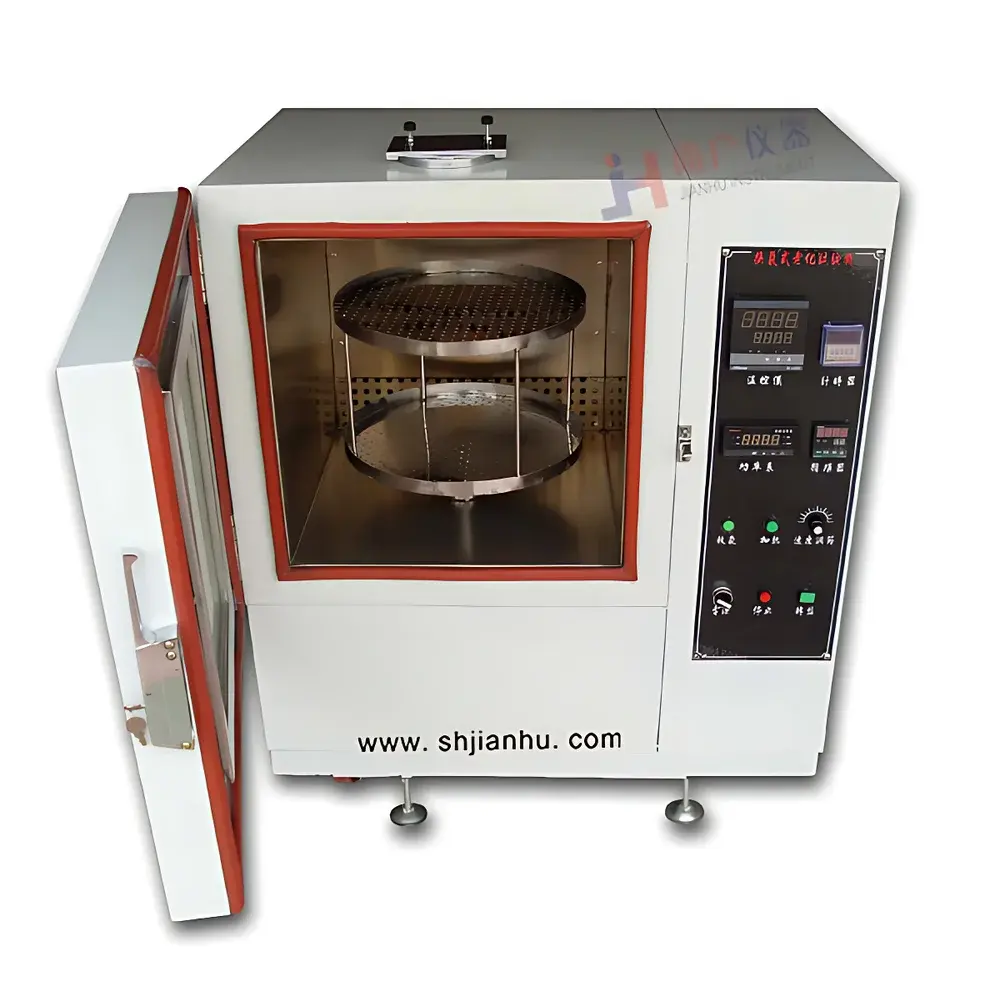
Jianhu JH-350F Forced-Air Thermal Aging Test Chamber
| Brand | Jianhu |
|---|---|
| Origin | Guangdong, China |
| Manufacturer Type | Authorized Distributor |
| Country of Origin | China |
| Model | JH-350F |
| Temperature Range | RT+10°C to 200°C (optional 300°C) |
| Temperature Uniformity | ±1% |
| Temperature Control | PID + SCR with LED Digital Display |
| Sensor | PT-100 Platinum Resistance Thermometer (0.1°C resolution) |
| Air Exchange Rate | 0–200 cycles/hour (adjustable via calibrated knob, with digital wattmeter for power and airflow correlation) |
| Internal Dimensions (Standard) | 450 × 450 × 450 mm |
| External Dimensions (Standard) | 1070 × 1440 × 690 mm |
| Compliance | GB/T 2951, ISO 188, ASTM D573, ASTM D865, UL 1581, EN 60811, CEN/TS 15371 |
Overview
The Jianhu JH-350F Forced-Air Thermal Aging Test Chamber is an engineered environmental test system designed for accelerated thermal aging evaluation of polymeric materials—primarily elastomers, cable insulation compounds, and rubber formulations—under controlled, reproducible convection-heated conditions. It operates on the principle of forced-air convection, where heated ambient air is continuously circulated through the test chamber at a precisely regulated exchange rate, ensuring uniform thermal exposure across all specimen surfaces. This methodology aligns with standardized accelerated aging protocols defined in ISO 188 (Rubber—Accelerated ageing and heat resistance tests), ASTM D573 (Rubber—Deterioration by heating in air), and GB/T 2951.12 (Electric cables—Test methods for non-metallic materials). The chamber supports both static and dynamic aging studies, enabling laboratories to estimate service life, evaluate antioxidant efficacy, and assess material degradation kinetics under elevated temperature stress.
Key Features
- Forced-air circulation system with multi-blade centrifugal horizontal-flow fan, delivering adjustable air exchange rates from 0 to 200 cycles per hour—critical for simulating real-world ventilation conditions in wire harnesses or enclosed enclosures.
- PID + SCR (Silicon Controlled Rectifier) temperature control architecture, paired with a Class A PT-100 platinum resistance sensor (IEC 60751), achieving ±0.1°C setpoint resolution and long-term stability within ±1% uniformity across the working volume.
- Dual-stage safety architecture: independent overtemperature cut-off (mechanical backup) plus programmable high-limit alarm; integrated airflow monitoring ensures thermal integrity during extended unattended operation.
- Chamber construction features full TIG-welded SUS304 stainless steel interior (electropolished finish, non-reactive, corrosion-resistant) and powder-coated cold-rolled steel exterior with structural reinforcement for dimensional stability at elevated temperatures.
- Integrated digital wattmeter enables real-time measurement of heater power consumption, allowing users to correlate energy input with actual air exchange performance—essential for audit-ready validation per ISO/IEC 17025 requirements.
- Microprocessor-based controller with dual timer functionality: independent setup for test duration and elapsed runtime tracking, supporting sequential aging protocols with automatic shutdown and data logging triggers.
Sample Compatibility & Compliance
The JH-350F accommodates standard flat-strip specimens (e.g., ASTM D573 Type 1, ISO 188 dumbbell No. 1), insulated wire segments (UL 1581 Section 1060), and molded elastomer plaques up to 450 mm × 450 mm × 450 mm internal volume. Specimen support fixtures are supplied with non-metallic, low-thermal-mass carriers to minimize conductive interference. The system complies with mandatory regulatory frameworks for materials qualification in electrical, automotive, and aerospace supply chains—including UL recognition criteria for insulation aging, EN 60811 series for cable sheath testing, and CEN/TS 15371 for polymer durability assessment. All calibration points and operational parameters meet traceability requirements for GLP-compliant laboratories.
Software & Data Management
While the base JH-350F operates via standalone microcontroller interface, optional RS-485/Modbus RTU connectivity enables integration into centralized LabVantage or LabWare LIMS environments. Logged parameters—including chamber temperature, elapsed time, air exchange rate (derived from wattmeter output), and alarm events—are timestamped and exportable as CSV for FDA 21 CFR Part 11–compliant audit trails when paired with validated third-party data acquisition software. Firmware supports user-defined calibration offsets and NIST-traceable sensor verification routines.
Applications
- Accelerated aging of cross-linked polyethylene (XLPE), ethylene propylene diene monomer (EPDM), and silicone rubber used in automotive wiring harnesses.
- Thermal oxidative stability screening of halogen-free flame-retardant (HFFR) compounds per IEC 60754-2.
- Pre-qualification testing of printed circuit board (PCB) substrate materials and passive component terminations per IPC-TM-650 2.6.22.
- Validation of shelf-life predictions for medical-grade elastomeric seals under ISO 10993-12.
- Comparative evaluation of antioxidant packages in synthetic rubber formulations using Arrhenius modeling (Ea determination via multi-temperature aging).
FAQ
What standards does the JH-350F explicitly support for cable insulation testing?
It is configured and validated for GB/T 2951.12, ASTM D573, ISO 188, UL 1581 Clause 1060, and EN 60811-1-2—covering tensile retention, elongation loss, and embrittlement point assessments after thermal exposure.
Can the air exchange rate be verified independently of the built-in wattmeter?
Yes. The chamber includes calibrated orifice plates and inlet/outlet ports compatible with hot-wire anemometry or tracer-gas decay methods (e.g., SF₆) for third-party airflow validation per ISO 16000-22.
Is the JH-350F suitable for testing lithium-ion battery separator films?
It meets thermal ramp and hold requirements for separator shrinkage testing per UL 2580 Annex D, though vacuum or inert-atmosphere variants (JH-350F-N₂ option) are recommended for oxidation-sensitive chemistries.
How is temperature uniformity verified during IQ/OQ protocols?
A 9-point thermocouple mapping procedure (per ASTM E2297) is supported using the standard PT-100 reference channel and optional 9-channel data logger; deviation limits are maintained at ≤±1% of setpoint across the entire usable volume.
Does the system include documentation for regulatory submissions?
Factory-supplied documents include Factory Acceptance Test (FAT) report, calibration certificate (NIST-traceable), materials of construction compliance statement, and electrical safety certification (GB 4793.1 / IEC 61010-1).



