
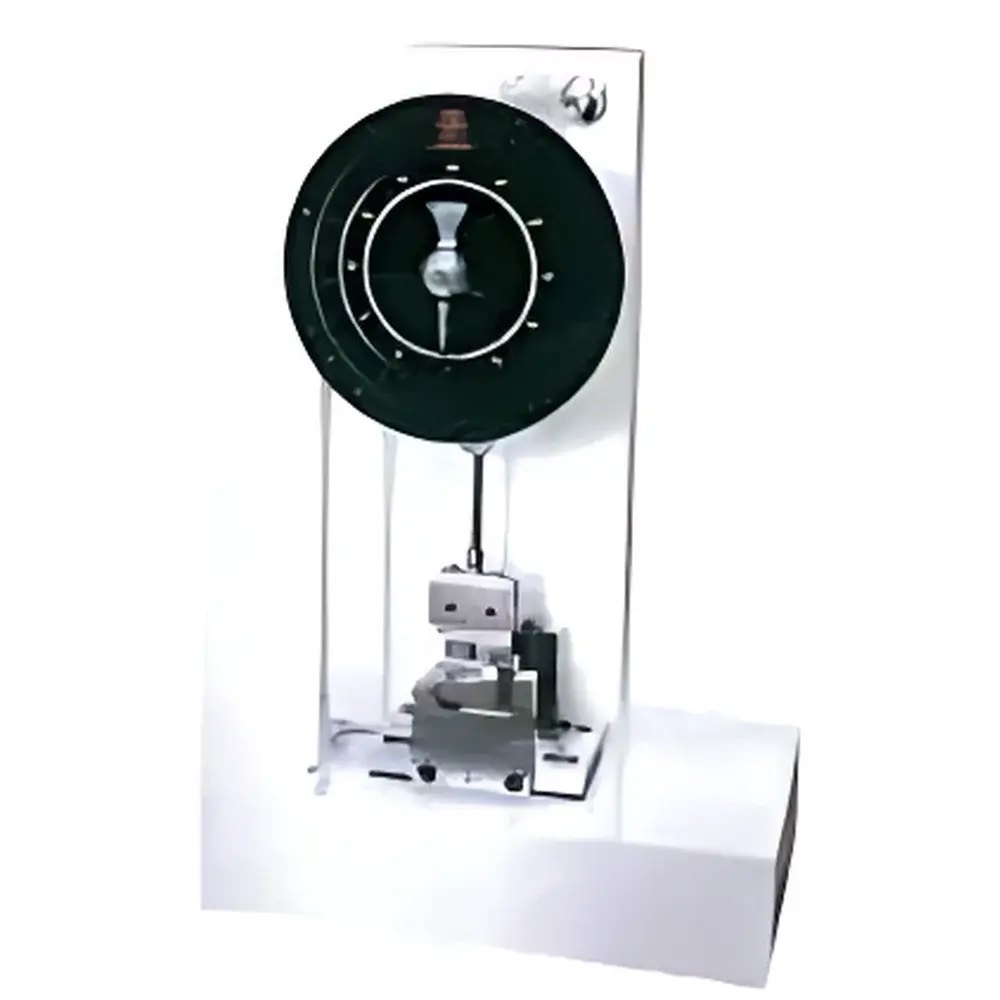
Jianhu JH Cantilever Beam Impact Tester
| Brand | Jianhu |
|---|---|
| Origin | Shanghai, China |
| Model | JH |
| Impact Velocity | 2.9–3.8 m/s |
| Impact Energy Range | 0.5, 1.0, 2.0, 4.0, 5.0, 7.5, 15.0, 25.0, 50.0 J |
| Pendulum Pre-lift Angle | 150° |
| Distance from Pivot to Strike Center | 230 mm / 395 mm |
| Specimen Support Span (Clamp Spacing) | 40, 60, 62, 70, 95 mm |
| Impact Blade Radius | R2.0 mm ± 0.5 mm |
| Power Supply | AC 220 V, 50 Hz |
| Dimensions (L×W×H) | 550 × 300 × 900 mm |
| Net Weight | 145 kg |
Overview
The Jianhu JH Cantilever Beam Impact Tester is a precision mechanical testing instrument engineered for standardized determination of impact resistance in rigid and semi-rigid polymeric materials, thermoplastics, composites, and engineering plastics under controlled Charpy-type cantilever beam conditions. Unlike pendulum-based Izod testers that fix specimens vertically, this system employs a horizontal, clamped-free beam configuration—where the specimen is rigidly secured at one end and struck by a calibrated pendulum at a defined distance from the clamp. The device operates on classical conservation-of-energy principles: potential energy stored in the raised pendulum is converted into kinetic energy at impact, with the residual energy measured via pendulum rebound height. The resulting absorbed energy—expressed in joules (J)—quantifies material toughness and notch sensitivity per ASTM D256, ISO 180, and GB/T 2611 standards.
Key Features
- Multi-range calibrated pendulum system supporting nine discrete impact energies (0.5 J to 50.0 J), enabling precise selection based on material stiffness and thickness requirements.
- Dual strike center distances (230 mm and 395 mm) accommodate varying specimen geometries and standard compliance needs—particularly relevant for ISO 180-1A (230 mm) and ASTM D256 Type A (395 mm) configurations.
- Precision-machined impact blade with certified radius tolerance (R2.0 mm ± 0.5 mm), traceable to national metrological standards, ensuring consistent stress concentration at the notch root.
- Adjustable clamp spacing (40 mm, 60 mm, 62 mm, 70 mm, and 95 mm) facilitates testing across standardized span lengths for both notched and unnotched specimens per ISO 180-1 and ASTM D256.
- Robust cast-iron frame with vibration-damped base minimizes energy loss during impact events, enhancing measurement reproducibility and long-term mechanical stability.
- Integrated digital angle encoder and optical position sensor provide real-time pendulum angular displacement data, supporting manual or optional automated energy calculation workflows.
Sample Compatibility & Compliance
The JH tester accepts rectangular bar specimens conforming to ISO 180 (80 × 10 × 4 mm) and ASTM D256 (63.5 × 12.7 × 3.2 mm or 127 × 12.7 × 6.4 mm), with optional notching tools available for standardized V-notch (ISO) or U-notch (ASTM) preparation. It supports testing of unreinforced thermoplastics, filled polymers, fiber-reinforced composites, and rigid elastomers within ambient temperature ranges (15–30 °C). All operational procedures align with ISO/IEC 17025 general requirements for competence of testing laboratories. Calibration certificates—including pendulum moment of inertia, blade geometry verification, and energy scale linearity—are issued traceable to CNAS-accredited reference laboratories. The system meets mechanical safety requirements per EN ISO 12100 and carries CE marking for conformity with EU Machinery Directive 2006/42/EC.
Software & Data Management
While the base JH model operates as a manual-readout mechanical tester, optional digital upgrade kits integrate with PC-based acquisition software compliant with GLP/GMP documentation practices. The software records impact event timestamps, calculates absorbed energy using calibrated angular displacement algorithms, and exports CSV- and PDF-formatted reports with operator ID, calibration date, environmental conditions, and specimen identification fields. Audit trail functionality satisfies FDA 21 CFR Part 11 requirements when configured with user authentication, electronic signatures, and immutable data logging. Raw angular position data can be exported for third-party statistical process control (SPC) integration or advanced fracture mechanics modeling.
Applications
- Quality control of injection-molded plastic components in automotive interiors and consumer electronics housings.
- R&D evaluation of polymer blend formulations for improved impact-modified performance.
- Comparative assessment of aging effects (thermal, UV, hydrolytic) on polymer ductility and brittle-to-ductile transition behavior.
- Supplier qualification testing against contractual impact specifications per ISO 9001 Clause 8.4.2.
- Educational laboratory instruction in polymer physics and mechanical behavior of solids.
FAQ
What standards does the JH Cantilever Beam Impact Tester comply with?
It is designed and validated for full conformance with ASTM D256 (Types A and B), ISO 180 (Parts 1 and 2), and GB/T 2611—covering both notched and unnotched specimen configurations.
Can the tester be used for both notched and unnotched specimens?
Yes. The standard configuration supports both; however, notched specimens require separate notch-machining equipment (e.g., precision milling fixture or pendulum-type notcher) to meet dimensional tolerances specified in ASTM D256 and ISO 180.
Is calibration documentation provided with shipment?
Each unit ships with a factory calibration certificate verifying pendulum energy scale accuracy, blade radius, and strike center alignment, traceable to primary standards maintained by Shanghai Institute of Measurement and Testing Technology (SIMT).
What maintenance is required to ensure long-term accuracy?
Biannual verification of pendulum bearing friction, blade wear inspection, and recalibration of angular displacement sensors are recommended. Full recalibration should be performed annually or after any mechanical shock or relocation.



