
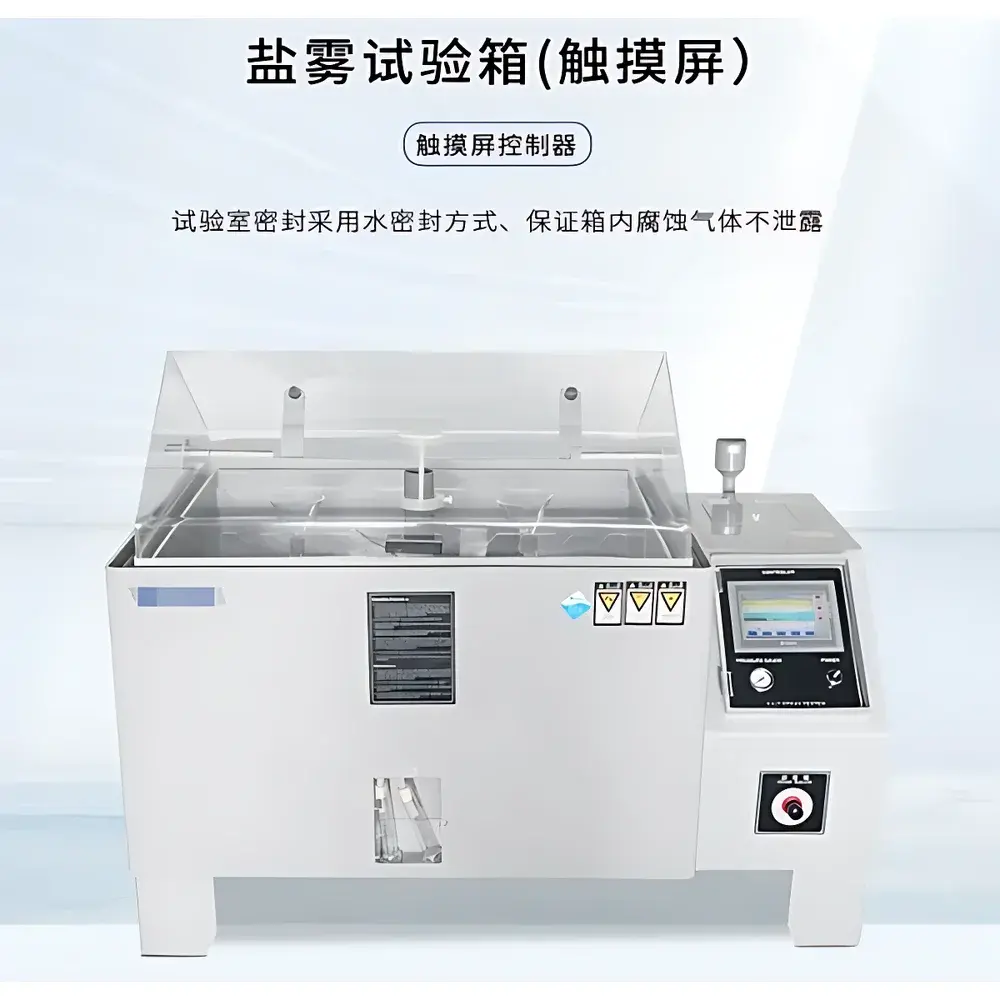
Jianhu JH-CCT Smart Programmable Cyclic Salt Spray Corrosion Test Chamber
| Brand | Jianhu |
|---|---|
| Origin | Shanghai, China |
| Type | Neutral Salt Spray (NSS) Test Chamber |
| Spray Mode | Continuous Atomization |
| Fog Deposition Rate | 1–2 mL/(80 cm²·h) |
| Nozzle Pressure | 0.7–1.0 kg/cm² |
| De-fogging Method | Air-Pressure Exhaust |
| Temperature Control Range | 35 °C ±2 °C |
| Compliance | ISO 9227, GB/T 10125, ASTM B117 (NSS mode) |
| Construction | Industrial-grade stainless steel chamber with PID-controlled heating and corrosion-resistant internal components |
Overview
The Jianhu JH-CCT Smart Programmable Cyclic Salt Spray Corrosion Test Chamber is an industrial-grade environmental test system engineered for precise simulation of corrosive saline atmospheres in accordance with internationally recognized standards—including ISO 9227, GB/T 10125, and ASTM B117 for Neutral Salt Spray (NSS) testing. It operates on the principle of continuous atomization of a standardized sodium chloride solution to generate a stable, reproducible salt fog environment within a thermally insulated stainless steel chamber. Unlike basic static salt spray cabinets, the JH-CCT integrates programmable cyclic operation capability—enabling automated transitions between salt spray, humidification, drying, and ambient recovery phases—to replicate real-world exposure conditions such as coastal, marine, or industrial atmospheric corrosion cycles. Its core function is to accelerate electrochemical corrosion processes under controlled thermal and aerosol conditions, thereby enabling quantitative evaluation of coating integrity, metallic substrate resistance, and material passivation behavior over defined test durations.
Key Features
- Programmable multi-phase cycling: Supports customizable sequences of salt spray, high-humidity soak, dry-off, and room-temperature recovery—essential for evaluating coating delamination, blistering, and underfilm corrosion per ISO 14993 and ASTM G85 Annex A5.
- PID-controlled temperature regulation: Maintains chamber setpoint at 35 °C ±2 °C using calibrated platinum resistance thermometers (PT100) and redundant heating elements with over-temperature cut-off protection.
- Stable fog deposition: Achieves uniform 1–2 mL/(80 cm²·h) salt fog collection rate across standardized collector arrays, verified via gravimetric measurement per ISO 9227 Annex B.
- Corrosion-resistant construction: Chamber interior and structural frame fabricated from SUS316L stainless steel; no copper or galvanized components to prevent cross-contamination.
- Integrated air-pressure de-fogging system: Eliminates residual mist post-test without thermal shock or condensation buildup—preserving sample surface morphology for post-test metrology.
- Nozzle pressure stabilization: Regulated compressed air supply (0.7–1.0 kg/cm²) ensures consistent droplet size distribution and minimizes nozzle clogging from NaCl crystallization.
Sample Compatibility & Compliance
The JH-CCT accommodates flat-panel, cylindrical, and irregularly shaped specimens up to 600 mm × 450 mm × 400 mm (W×D×H), with adjustable sample racks and non-metallic support fixtures. It supports test specimen mounting per ASTM B117 orientation requirements (15°–30° from vertical). All operational parameters—including fog deposition rate, temperature stability, and chamber airflow velocity (maintained at ≤1.2 m/s via optimized duct geometry)—are traceable to national metrological standards. The system is designed for full compliance with GLP documentation requirements: calibration logs, operator ID tracking, and parameter deviation alerts are supported through optional audit-trail-enabled firmware. It meets the physical and procedural prerequisites for accreditation under ISO/IEC 17025 for materials corrosion testing laboratories.
Software & Data Management
The embedded controller features a 7-inch TFT touchscreen interface with multilingual support (English, Chinese, Spanish, German) and local data storage (≥10,000 test records). Optional Ethernet/RS485 connectivity enables integration with LIMS platforms and centralized lab management systems. All critical parameters—including real-time temperature, cumulative spray duration, and chamber humidity—are logged at user-defined intervals (1 s to 60 min resolution) and exportable in CSV or XML format. Firmware supports digital signature authentication for test method uploads, ensuring version-controlled execution of standard protocols. For regulated environments, optional 21 CFR Part 11-compliant software packages provide electronic signatures, role-based access control, and immutable audit trails for all configuration changes and test initiations.
Applications
This chamber serves quality assurance and R&D laboratories across aerospace (e.g., fastener and alloy qualification per AMS 2700), automotive (coating adhesion validation per GMW 14872), electronics (PCB conformal coating durability per IPC-TM-650 2.6.12), and medical device manufacturing (stainless steel implant corrosion screening per ISO 10993-15). It is routinely deployed for comparative benchmarking of zinc-nickel, epoxy-polyester, and chromate conversion coatings; validation of cathodic protection systems; and accelerated aging studies of polymer composites exposed to chloride-rich environments. Universities and national metrology institutes utilize the JH-CCT for inter-laboratory round-robin studies requiring strict adherence to ISO 9227 repeatability criteria (±10% fog deposition variance across three consecutive runs).
FAQ
What standards does the JH-CCT comply with for NSS testing?
It conforms to ISO 9227, GB/T 10125, and ASTM B117 for neutral salt spray operation, with full traceability of fog deposition rate, temperature uniformity, and pH control.
Can the chamber perform cyclic corrosion tests beyond NSS?
Yes—the programmable controller supports custom multi-step cycles including acidic salt spray (ASS), copper-accelerated acetic acid salt spray (CASS), and humidity-dry-spray sequences per ASTM G85 Annexes A1–A5.
How is salt solution concentration monitored and maintained?
Users must prepare 50 ±5 g/L NaCl solution per standard; the chamber itself does not measure concentration—but integrated conductivity sensors (optional) can verify batch consistency prior to loading.
Is third-party calibration and certification available?
Jianhu provides factory calibration certificates traceable to CNAS-accredited reference standards; on-site verification and ISO/IEC 17025-compliant calibration services are available upon request.
What maintenance is required to ensure long-term fog deposition accuracy?
Bi-weekly nozzle inspection and ultrasonic cleaning, quarterly verification of pressure regulators and collector cup placement, and annual recalibration of PT100 sensors are recommended per the maintenance schedule in the technical manual.



