
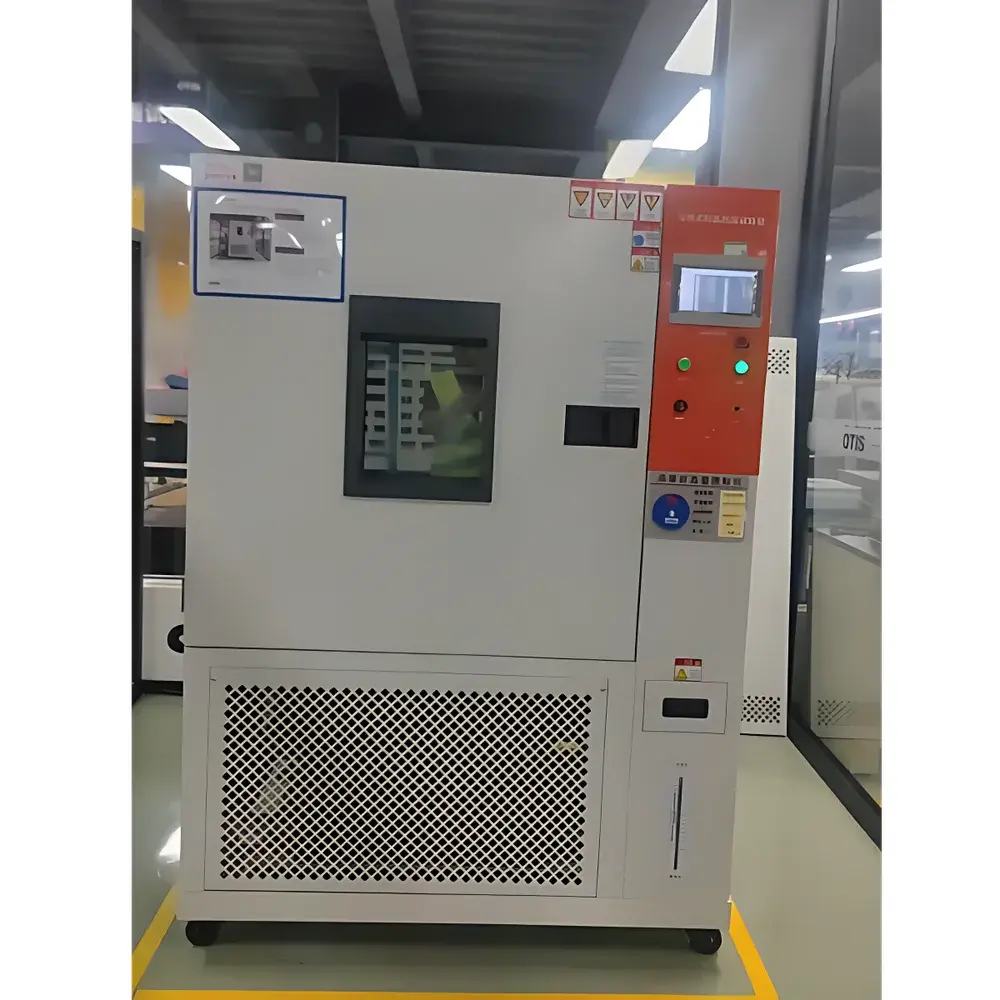
Jianhu JH-ELT Series Automotive Component High-Low Temperature Environmental Test Chamber
| Brand | Jianhu |
|---|---|
| Origin | Shanghai, China |
| Model | JH-ELT Series |
| Temperature Range | -70 °C to +150 °C |
| Refrigeration Method | Compressor-based |
| Explosion-Proof Design | Yes |
| Temperature Fluctuation | ±0.5 °C |
| Temperature Uniformity | ±2.0 °C |
| Temperature Deviation | ±2.0 °C |
| Heating Rate | ≤60 min (from 25 °C to +150 °C) |
| Cooling Rate | ≤45 min (25 °C to -40 °C), ≤60 min (25 °C to -55 °C), ≤80 min (25 °C to -70 °C) |
| Interior Dimensions | Customizable |
Overview
The Jianhu JH-ELT Series Automotive Component High-Low Temperature Environmental Test Chamber is an engineered solution for accelerated environmental stress screening (ESS) and qualification testing of automotive components under extreme thermal conditions. Designed in accordance with ISO 16750-4 (Road vehicles — Environmental conditions and testing for electrical and electronic equipment — Part 4: Climatic loads), SAE J2334, and GB/T 2423.1–2423.2 (IEC 60068-2-1 & -2), this chamber employs a dual-stage compressor refrigeration system coupled with PID-controlled resistive heating to deliver precise, repeatable thermal profiles across a wide operational range (–70 °C to +150 °C). Its robust stainless-steel inner chamber, reinforced insulation, and explosion-proof enclosure meet ATEX/IECEx Category 2G requirements for use in hazardous areas where flammable vapors or dust may be present—critical for testing fuel system components, battery enclosures, and high-voltage power electronics used in EV platforms.
Key Features
- Energy-efficient dual-stage refrigeration using R513A/R134a blended refrigerant, achieving ≥30% lower power consumption versus conventional single-stage systems under continuous operation.
- Intelligent adaptive temperature control algorithm with real-time feedback from triple-redundant PT100 sensors (Class A tolerance), enabling dynamic compensation for ambient load variations and maintaining setpoint stability within ±0.5 °C during steady-state operation.
- Explosion-proof construction compliant with EN 60079-1 (flameproof enclosure “d”) and EN 60079-7 (increased safety “e”), certified for Zone 1/21 hazardous locations.
- Customizable internal chamber dimensions (standard options: W600 × D600 × H750 mm up to W2000 × D1500 × H2000 mm) with reinforced 304 stainless-steel interior and high-density polyurethane insulation (≥150 mm thickness).
- Integrated safety architecture including over-temperature cut-off, refrigerant pressure monitoring, door interlock, ground-fault circuit interruption (GFCI), and audible/visual alarm escalation via Ethernet-connected PLC.
- Modular heating/cooling capacity scaling to match test specimen thermal mass—enabling optimized energy use without oversizing compressors or heaters.
Sample Compatibility & Compliance
The JH-ELT Series accommodates full-scale automotive subsystems—including powertrain modules, ADAS sensor housings, infotainment units, battery management systems (BMS), and structural castings—without requiring disassembly. Its large access ports, removable shelves, and optional internal lighting support visual inspection and in-situ electrical continuity checks during thermal cycling. The chamber meets the mechanical and climatic test requirements defined in ISO 16750-4, IEC 60068-2-14 (thermal shock), and USCAR-2 (Automotive Electronics Council) standards. It supports GLP-compliant validation protocols per ASTM E2500 and is compatible with IQ/OQ/PQ documentation packages required for GMP-regulated Tier 1 supplier audits.
Software & Data Management
Equipped with Jianhu’s proprietary JH-TCM v4.2 control software, the chamber provides full traceability through time-stamped, encrypted CSV/Excel data logging at user-selectable intervals (1 s to 60 min resolution). The interface supports multi-segment ramp-soak profiles, programmable dwell times, and conditional branching logic (e.g., trigger soak phase upon reaching ±0.3 °C of setpoint). All operational parameters—including compressor runtime, heater duty cycle, and sensor diagnostics—are archived with audit trail functionality compliant with FDA 21 CFR Part 11 Annex 11 requirements. Remote monitoring and alarm notification are enabled via Modbus TCP, OPC UA, and HTTPS REST API integration with enterprise MES/LIMS platforms.
Applications
- Thermal cycling validation of electric vehicle battery packs per UN ECE R100 and GB/T 31467.3.
- Low-temperature brittleness assessment of polymer seals, gaskets, and elastomeric bushings per ISO 22867.
- High-temperature aging of engine control units (ECUs) and DC-DC converters under sustained +125 °C load conditions.
- Environmental stress screening (ESS) of radar modules and camera lens assemblies prior to field deployment.
- Correlation testing between laboratory thermal profiles and real-world vehicle cabin/under-hood temperature histories captured via CAN bus loggers.
- Qualification of autonomous driving hardware for compliance with ISO 26262 ASIL-B thermal robustness requirements.
FAQ
What international standards does the JH-ELT Series comply with?
It conforms to ISO 16750-4, IEC 60068-2-1/-2/-14, SAE J2334, USCAR-2, and GB/T 2423.1–2423.2. Explosion-proof variants carry EN 60079-1 and EN 60079-7 certification.
Can the chamber perform rapid thermal cycling?
Yes—it achieves typical ramp rates of 5–10 °C/min depending on chamber size and load, supporting both standard thermal cycling (IEC 60068-2-14) and aggressive ESS profiles.
Is remote calibration and validation support available?
Jianhu provides on-site IQ/OQ services, third-party calibration traceable to NIM (China National Institute of Metrology), and remote software validation support aligned with ASTM E2500 Annex A.
How is data integrity ensured during long-duration tests?
All measurements are logged with microsecond timestamp precision; data files are digitally signed and stored redundantly on internal SSD and network-attached storage (NAS) with automatic backup scheduling.
Does the system support integration with existing lab automation infrastructure?
Yes—via native Modbus TCP, OPC UA, and HTTP(S) APIs, enabling seamless connection to LabVIEW, MATLAB, Siemens Desigo, and custom Python-based test orchestration frameworks.



