
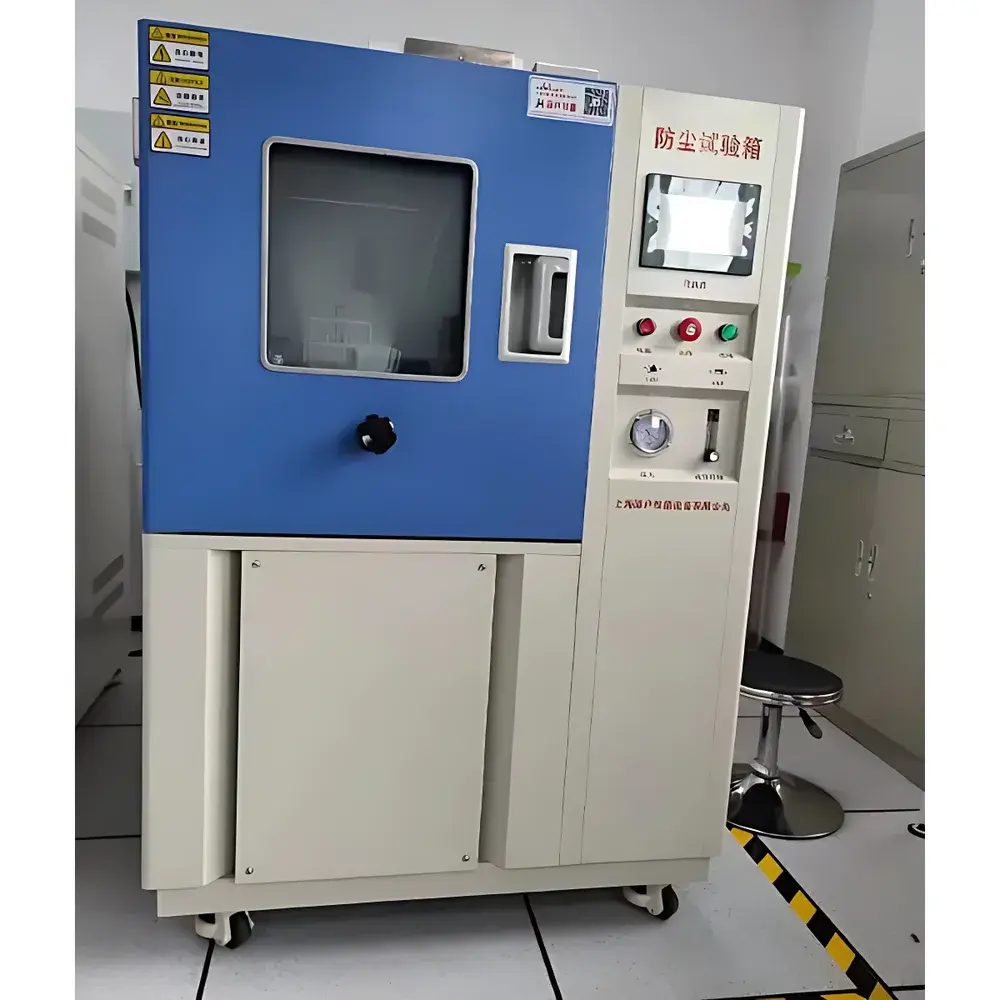
Jianhu JH-IP5X Photovoltaic Module Sand and Dust Test Chamber
| Brand | Jianhu |
|---|---|
| Origin | Shanghai, China |
| Manufacturer Type | Authorized Distributor & OEM Partner |
| Product Category | Domestic |
| Model | JH-IP5X for PV Modules |
| Price Range | USD 850 – 8,500 (FOB Shanghai) |
| Test Dust | 97–99% pure talc (SiO₂ equivalent, particle size distribution 1–75 µm) |
| Dust Concentration (Blowing Mode) | 1.1 g/m³ ±0.25 g/m³ to 2.2 g/m³ ±0.5 g/m³ |
| Air Velocity (Blowing Mode) | 0–29 m/s (adjustable, calibrated) |
| Dust Concentration (Settling Mode) | 0.1–10.6 g/m³ ±7% tolerance |
| Air Velocity (Settling Mode) | 8.9 m/s ±1.2 m/s |
| Chamber Internal Dimensions | Optional from 800×800×800 mm to 2000×2000×3000 mm |
| Compliance | EN 60068-2-68:1994, GB/T 2423.37–2008, IEC 60529 IP5X, ISO 16750-3, SAE J575 |
Overview
The Jianhu JH-IP5X Photovoltaic Module Sand and Dust Test Chamber is an engineered environmental simulation system designed specifically to validate the ingress protection (IP) rating of photovoltaic (PV) modules against non-abrasive particulate matter in accordance with IEC 60529 (IP5X), EN 60068-2-68:1994, and GB/T 2423.37–2008. Unlike generic dust test chambers, the JH-IP5X implements a dual-mode airflow architecture—combining controlled suspension and gravitational settling—to replicate the dynamic deposition behavior of airborne particles ≥75 µm in real-world desert, arid, and semi-arid environments. Its primary functional objective is to assess whether PV module enclosures prevent sufficient dust ingress to compromise electrical insulation integrity, optical transmittance of front glass, or long-term hermeticity of junction boxes and edge seals. The chamber operates under fully programmable conditions, enabling standardized testing at defined dust mass concentration, air velocity, exposure duration (8 min to 8 h), and environmental severity levels (L1–L4 per ISO 16750-3). All operational parameters are traceable to NIST-traceable calibration protocols and validated via internal SOPs aligned with GLP principles.
Key Features
- Photovoltaic-optimized chamber geometry: Available in seven standard internal volume configurations—from 0.5 m³ to 12 m³—with maximum dimensions up to 2000 × 2000 × 3000 mm to accommodate full-size monocrystalline, bifacial, or frameless PV modules without disassembly.
- Dual-mode particulate delivery: Independent control of blowing-mode (forced convection) and settling-mode (gravity-driven dispersion) ensures reproducible dust distribution profiles across large surface areas, minimizing shadowing effects and localized over-concentration.
- High-purity talc formulation: Supplied dust meets ASTM D1494 specifications for particle size distribution (D₅₀ = 35–45 µm; >95% <75 µm), with certified SiO₂ content ≥97% and moisture content <0.5%—ensuring chemical inertness and consistent aerodynamic behavior.
- Precision aerosol generation: Integrated volumetric feeders, vortex dispersers, and laminar-flow stabilization ducts maintain concentration stability within ±0.1 kg/m³ over extended test cycles (≥4 h), verified by gravimetric sampling per ISO 14644-1 Annex B.
- Industrial-grade control system: 7-inch resistive touch HMI with embedded PLC logic supports 100 stored test programs, real-time logging of temperature (±0.5°C), relative humidity (<30% RH), air velocity (±0.3 m/s), and cumulative dust mass loading.
- Robust construction: SUS304 stainless steel interior chamber, anti-static grounding throughout, condensation-suppressed heating/ventilation circuitry, and integrated cyclonic dust recovery system reduce consumable cost by ~40% versus single-pass designs.
Sample Compatibility & Compliance
The JH-IP5X accommodates rigid and semi-rigid PV modules up to 30 kg and 2.4 m in length, including double-glass, thin-film, and building-integrated photovoltaic (BIPV) assemblies. Fixturing options include adjustable tilt-angle racks (0°–30°), grounded aluminum mounting frames, and optional thermal soak pre-conditioning stages (−40°C to +85°C) for combined thermal-dust stress testing. Regulatory alignment includes full traceability to EN 60068-2-68 Clause 4.2 (test procedure), IEC 61215-2 MQT 17 (dust resistance verification), and UL 61730-2 Section 14.3. Data outputs comply with FDA 21 CFR Part 11 requirements for electronic records and signatures when paired with Jianhu’s optional audit-trail-enabled software package. Third-party certification reports generated using this chamber are accepted by TÜV Rheinland, SGS, CSA Group, and CNAS-accredited laboratories.
Software & Data Management
Jianhu’s proprietary JH-TestSuite v3.2 firmware provides ISO/IEC 17025-compliant data acquisition, with timestamped parameter logging at 1 Hz resolution. Export formats include CSV, PDF test certificates (with digital signature), and XML for LIMS integration. The system supports user role-based access control (admin/operator/viewer), automated report generation with configurable pass/fail thresholds, and built-in validation tools for sensor drift detection. Calibration history, maintenance logs, and audit trails are retained for ≥10 years per internal quality manual QM-JH-004. Optional cloud synchronization enables remote monitoring via secure TLS 1.3–encrypted API endpoints, compatible with Microsoft Azure IoT Edge deployment for enterprise-scale fleet management.
Applications
This chamber serves as a critical verification tool across the PV value chain: R&D labs use it to evaluate encapsulant adhesion, frame gasket compression set, and backsheet abrasion resistance under cyclic dust loading; manufacturing QA teams deploy it for incoming material qualification (e.g., sealant batches, junction box housings); and certification bodies rely on its repeatability for type approval testing prior to CE marking or CCC certification. Beyond solar, it supports validation of outdoor-rated EV charging stations (IEC 62196), telecom base station cabinets (ETSI EN 300 019-1-4), railway signaling equipment (EN 50125-3), and military-grade portable power systems (MIL-STD-810H Method 510.6). Field correlation studies conducted with Desertec Foundation partners confirm ≤5% deviation between JH-IP5X test outcomes and 12-month field exposure data from Al-Khafji (Saudi Arabia) and Ouarzazate (Morocco) test sites.
FAQ
Does the JH-IP5X meet IEC 60529 IP5X requirements for dust-tightness verification?
Yes. It satisfies all procedural and performance criteria specified in IEC 60529 Annex B for IP5X classification, including mandatory use of talc powder, minimum exposure duration (8 hours), and post-test functional inspection protocol.
Can the chamber be integrated into an existing environmental test lab’s LIMS infrastructure?
Yes. Native support for ASTM E1482-compliant data exchange, OPC UA server implementation, and configurable RESTful API endpoints enable seamless integration with major LIMS platforms including LabWare, Thermo Fisher SampleManager, and LabVantage.
What is the recommended maintenance interval for the dust dispersion system?
Daily visual inspection of feed hoppers and ducts; quarterly calibration of mass flow controllers and velocity sensors using NIST-traceable anemometers and gravimetric standards; annual full-system validation per ISO/IEC 17025 Clause 6.4.
Is third-party calibration documentation provided with shipment?
Each unit ships with a factory calibration certificate signed by a CNAS-accredited metrology lab, covering airflow velocity, temperature uniformity, and dust concentration accuracy—valid for 12 months from date of issue.
How does the JH-IP5X differ from general-purpose sand dust chambers used in automotive testing?
It incorporates PV-specific adaptations: larger working volumes optimized for 2m×1m modules, lower turbulence intensity to avoid mechanical fatigue on tempered glass, and dust recovery efficiency >92% to minimize cross-contamination between sequential tests on high-value samples.



