
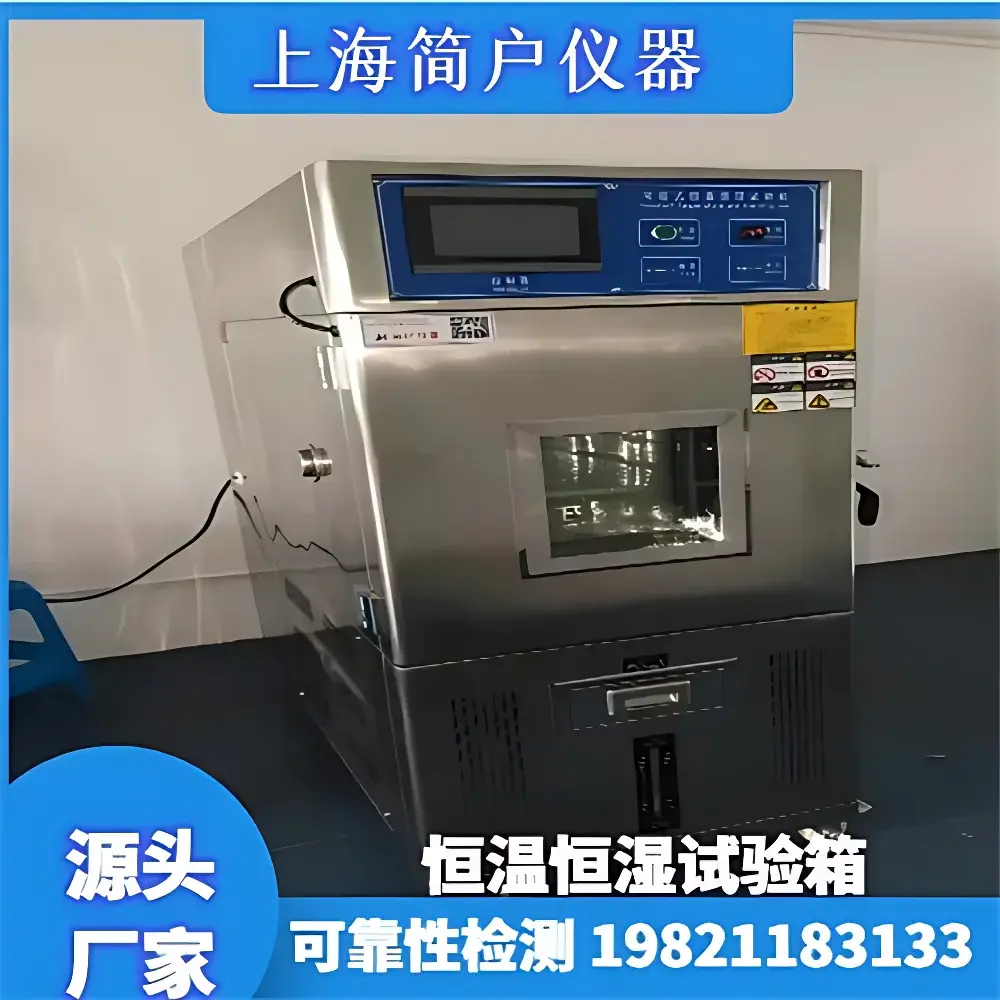
JianHu JH-Series High-Precision Thermal Shock Test Chamber
| Brand | JianHu |
|---|---|
| Origin | Shanghai, China |
| Model | JH-Series |
| Temperature Uniformity | ±0.5 °C |
| High-Temperature Range | +80 °C to +120 °C |
| Low-Temperature Range | −55 °C to +125 °C |
| Thermal Shock Range | −60 °C to +200 °C |
| Temperature Stability | ±0.5 °C (uniformity across working volume) |
| Heating Rate | Rapid |
| Cooling Rate | Rapid |
Overview
The JianHu JH-Series High-Precision Thermal Shock Test Chamber is engineered for rigorous reliability validation under extreme thermal transients. It operates on a three-zone mechanical separation architecture—comprising independent high-temperature, low-temperature, and test chamber zones—enabling rapid, repeatable thermal transitions without cross-contamination of air streams. This design adheres to the fundamental principles of accelerated thermal stress testing defined in IEC 60068-2-14 (Test N: Change of temperature) and MIL-STD-810H Method 503.7. The chamber’s core performance metric—±0.5 °C temperature uniformity across the full working volume—is achieved through precision-calibrated PID-controlled dual-refrigeration circuits, laminar airflow distribution via perforated stainless-steel plenums, and real-time multi-point sensor feedback (typically 9–12 PT100 sensors distributed per zone). Such uniformity ensures that all specimens—whether surface-mount devices (SMDs), aerospace structural coupons, or polymer composite samples—experience identical thermal boundary conditions during transition phases, eliminating spatial thermal gradients that compromise failure mode identification and acceleration factor modeling.
Key Features
- Three-compartment mechanical isolation system with independent refrigeration and heating loops for minimized thermal inertia and enhanced repeatability
- ±0.5 °C temperature uniformity (measured per IEC 60068-3-5) across the entire usable test volume, verified via NIST-traceable sensor mapping
- Wide operational range: −60 °C to +200 °C, supporting both cryogenic electronics qualification and high-temperature ceramic matrix composite (CMC) evaluation
- Rapid thermal transition capability: typical transfer time ≤15 seconds between extreme zones, enabling high-throughput cycling protocols
- Stainless-steel interior with electropolished finish and seamless welded corners for corrosion resistance and cleanroom-compatible operation
- Integrated safety interlocks including over-temperature cut-off, refrigerant pressure monitoring, and door-open freeze protection
- Compliance-ready hardware architecture supporting optional 21 CFR Part 11 audit trail modules and electronic signature integration
Sample Compatibility & Compliance
The JH-Series accommodates diverse specimen geometries—from 0.5 mm × 0.5 mm semiconductor die to 400 mm × 300 mm printed circuit board assemblies—via configurable tray systems and adjustable shelf spacing. Its internal dimensions are optimized to maintain uniformity even at maximum load capacity (typically ≥80% volume utilization). The chamber meets essential regulatory and industry standards for environmental stress screening (ESS), including but not limited to: IEC 60068-2-14, JEDEC JESD22-A104F (Temperature Cycling), AEC-Q200 (Automotive Passive Components), and IPC-9701A (Performance Testing of Solder Attachments). For GLP/GMP environments, optional calibration certificates (ISO/IEC 17025 accredited), preventive maintenance logs, and deviation reporting templates are available. All units undergo factory verification per ISO 17025-based procedures prior to shipment.
Software & Data Management
Control and data acquisition are managed via the JianHu TSC-Manager v4.x software platform, a Windows-based application compliant with IEEE 1012-2016 (Software Verification and Validation). It supports fully programmable thermal profiles—including ramp-hold-soak sequences, step transitions, and user-defined dwell times—with up to 999 cycles per program. Real-time data logging records temperature readings from all internal sensors at configurable intervals (100 ms to 10 s resolution), stored in CSV and binary formats with embedded metadata (operator ID, test ID, timestamp, firmware version). Exported datasets include traceable calibration coefficients and uncertainty budgets. Optional add-ons enable automated report generation (PDF/Excel), remote monitoring via HTTPS API, and integration with LIMS systems using ASTM E1482-compliant data exchange schemas.
Applications
- Electronics reliability engineering: solder joint fatigue assessment, wafer-level packaging validation, and MEMS device thermo-mechanical stability analysis
- Aerospace component qualification: turbine blade coating adhesion testing, avionics enclosure thermal cycling, and space-grade battery performance mapping
- Advanced materials development: phase transformation kinetics in shape-memory alloys, glass transition behavior in thermosets, and interfacial delamination studies in fiber-reinforced composites
- Automotive electronics: power module cycling under combined thermal and vibration stress (when integrated with external shaker systems)
- Pharmaceutical packaging integrity: cold-chain container thermal shock resistance and barrier layer performance under cyclic condensation scenarios
- Academic research: calorimetric correlation studies, thermal expansion coefficient measurement via digital image correlation (DIC)-coupled setups
FAQ
What is the recommended calibration interval for the JH-Series chamber?
Per ISO/IEC 17025 and manufacturer guidelines, initial calibration is performed pre-shipment; subsequent recalibration is recommended every 12 months or after any major maintenance event affecting thermal control subsystems.
Does the chamber support custom test protocols beyond standard IEC or MIL specifications?
Yes—TSC-Manager software allows users to define non-standard profiles with variable ramp rates, asymmetric hold durations, and conditional branching logic based on real-time sensor thresholds.
Can the system be integrated into an existing factory automation infrastructure?
The chamber includes Modbus TCP and Ethernet/IP communication interfaces, enabling direct integration with SCADA, MES, and PLC systems for centralized test orchestration and data aggregation.
Is the temperature uniformity specification maintained at full load?
Yes—uniformity of ±0.5 °C is guaranteed across the entire working volume under nominal loading conditions as defined in the user manual (typically 75% of max payload by mass and volume).
Are validation documents (IQ/OQ/PQ) provided with the system?
Standard delivery includes Factory Acceptance Test (FAT) reports and calibration certificates; site-specific IQ/OQ/PQ documentation packages are available as optional services, aligned with Annex 11 and GAMP 5 guidance.



