
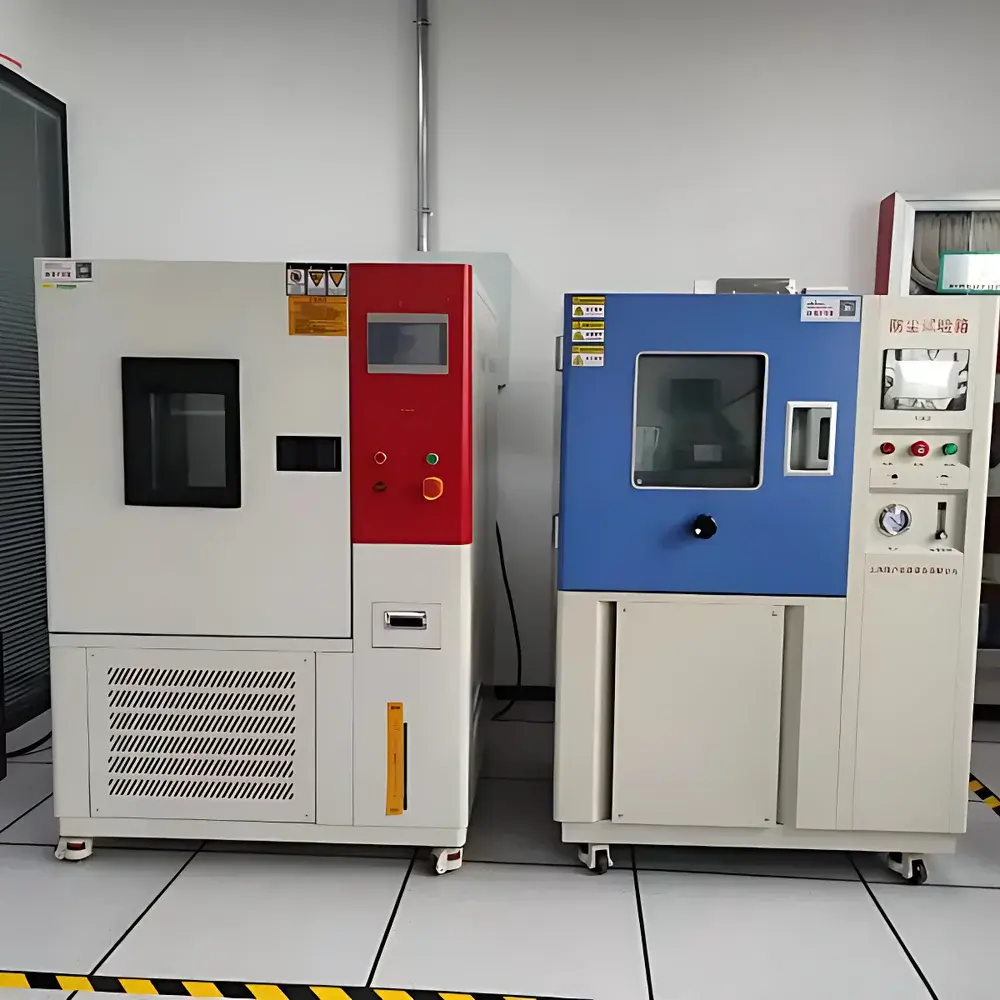
Jianhu JH-Series Large-Scale Ice-Water Thermal Shock Chamber
| Brand | Jianhu |
|---|---|
| Origin | Shanghai, China |
| Manufacturer Type | Authorized Distributor |
| Product Category | Domestic |
| Model | JH-Series Large-Scale Ice-Water Thermal Shock Chamber |
| Pricing | Upon Request |
Overview
The Jianhu JH-Series Large-Scale Ice-Water Thermal Shock Chamber is an engineered environmental test system designed to evaluate the structural integrity and functional reliability of oversized components under rapid, extreme thermal transitions between sub-zero ice-water immersion and elevated temperature exposure. Unlike conventional thermal shock chambers limited by internal volume and hydraulic delivery constraints, this system employs a dual-bath architecture with independent cryogenic and heated water reservoirs, enabling programmable shock cycles with precise control over dwell time, transition rate, and immersion depth. Its core operational principle relies on forced convection heat transfer across solid–liquid interfaces, simulating real-world thermal stress events such as sudden coolant ingress in aerospace actuators, battery pack submersion in EV crash scenarios, or rapid thermal cycling during marine equipment deployment. The chamber complies with fundamental test methodologies referenced in IEC 60068-2-14 (Change of Temperature), MIL-STD-810H Method 503.6 (Temperature Shock), and supports custom protocol development aligned with internal quality assurance standards.
Key Features
- Extra-large internal test volume (standard configurations up to 2000 × 1500 × 1200 mm W×D×H) accommodating full-scale battery modules, aircraft wing sections, and industrial power converters
- Dual independent fluid circuits: stainless-steel insulated cold bath (–40 °C to 0 °C) and heated bath (25 °C to 95 °C), both equipped with high-flow submersible pumps and pressure-regulated nozzles
- Imported hermetic scroll compressors (Embraco or Danfoss), platinum RTD sensors (Class A, ±0.15 °C accuracy), and PID-controlled solid-state relays for stable thermal regulation
- Mechanically adjustable multi-axis sample support frame with T-slot rails, load-rated quick-release clamps, and non-slip anodized aluminum mounting plates
- Human-centered front-access design featuring counterbalanced double-seal door, ergonomic control console with 10.1″ capacitive touchscreen, and integrated LED status lighting
- Exterior housing fabricated from 1.5 mm cold-rolled steel with electrostatic powder coating (RAL 7035), corrosion-resistant hinges, and reinforced structural framing
Sample Compatibility & Compliance
The JH-Series accommodates irregularly shaped, high-mass specimens weighing up to 300 kg without compromising thermal uniformity or mechanical stability during shock transitions. Its open-chamber layout allows direct integration with external robotic handlers or gantry systems for automated loading/unloading in production-line validation environments. All fluid-contact components—including spray manifolds, immersion baskets, and drain piping—meet ASTM A240 Type 316L stainless steel requirements for chloride resistance. The system’s thermal performance validation follows ISO/IEC 17025-compliant procedures, with temperature mapping conducted per IEC 60068-3-5 using NIST-traceable calibrated probes. While not certified to UL or CE as a complete unit, it is supplied with component-level safety documentation (e.g., CE-marked compressors, UL-listed controllers) to facilitate end-user regulatory submissions under FDA 21 CFR Part 11 (for pharmaceutical device qualification) or AS9100 (aerospace).
Software & Data Management
Control and data acquisition are managed via Jianhu’s proprietary TestMaster™ v4.2 software, installed on an embedded industrial PC running Windows IoT Enterprise. The interface supports ISO/IEC 17025-compliant audit trails, user role-based access (admin/operator/viewer), and encrypted local storage of all test logs—including timestamped temperature profiles, pump pressure curves, and door-open event records. Raw data exports to CSV, XML, or PDF formats; optional OPC UA server enables seamless integration into MES platforms (e.g., Siemens Opcenter, Rockwell FactoryTalk). Software-defined test sequences allow multi-step shock profiles with conditional branching (e.g., “if ΔT > 80 °C within 15 s, initiate 30-min soak”), supporting both pre-validated standard methods and customer-specific qualification protocols. All firmware updates undergo version-controlled release testing and include rollback capability.
Applications
This chamber serves critical validation roles across sectors where dimensional scale and thermal transience jointly govern failure modes. In electric vehicle development, it subjects full-format traction battery enclosures to simulated flood immersion followed by rapid heating—replicating post-crash thermal runaway initiation pathways. Aerospace suppliers use it to verify sealant adhesion and composite matrix integrity in wing leading-edge assemblies subjected to de-icing fluid shock. Renewable energy manufacturers validate offshore wind turbine pitch-control housings against North Sea winter conditions. Industrial automation firms qualify large-format servo drives for semiconductor fab tooling applications requiring IP67-rated thermal resilience. Academic research groups employ it in materials science studies of interfacial fracture mechanics under cyclic cryo-thermal loading, with documented use at Tsinghua University and Harbin Institute of Technology.
FAQ
What is the maximum specimen weight supported without compromising thermal uniformity?
Standard configurations maintain ±2 °C uniformity across the working volume for loads up to 300 kg. Custom reinforcement packages are available for 500 kg capacity.
Can the system be integrated into an existing factory automation network?
Yes—OPC UA, Modbus TCP, and Ethernet/IP communication protocols are supported out-of-the-box; hardware I/O terminals enable direct PLC interfacing.
Is calibration documentation provided with shipment?
Each unit ships with a factory calibration certificate covering temperature sensors, pressure transducers, and timer accuracy, traceable to CNAS-accredited laboratories.
Does the chamber meet any international safety standards?
Components comply with IEC 61000-6-2 (EMC immunity) and IEC 61000-6-4 (EMC emissions); full-system safety evaluation follows GB/T 5226.1 (equivalent to EN 60204-1).
What maintenance intervals are recommended for long-term reliability?
Compressor oil and refrigerant filter replacement every 18 months; annual verification of sensor drift and door gasket compression set; biannual inspection of hydraulic line integrity.



