
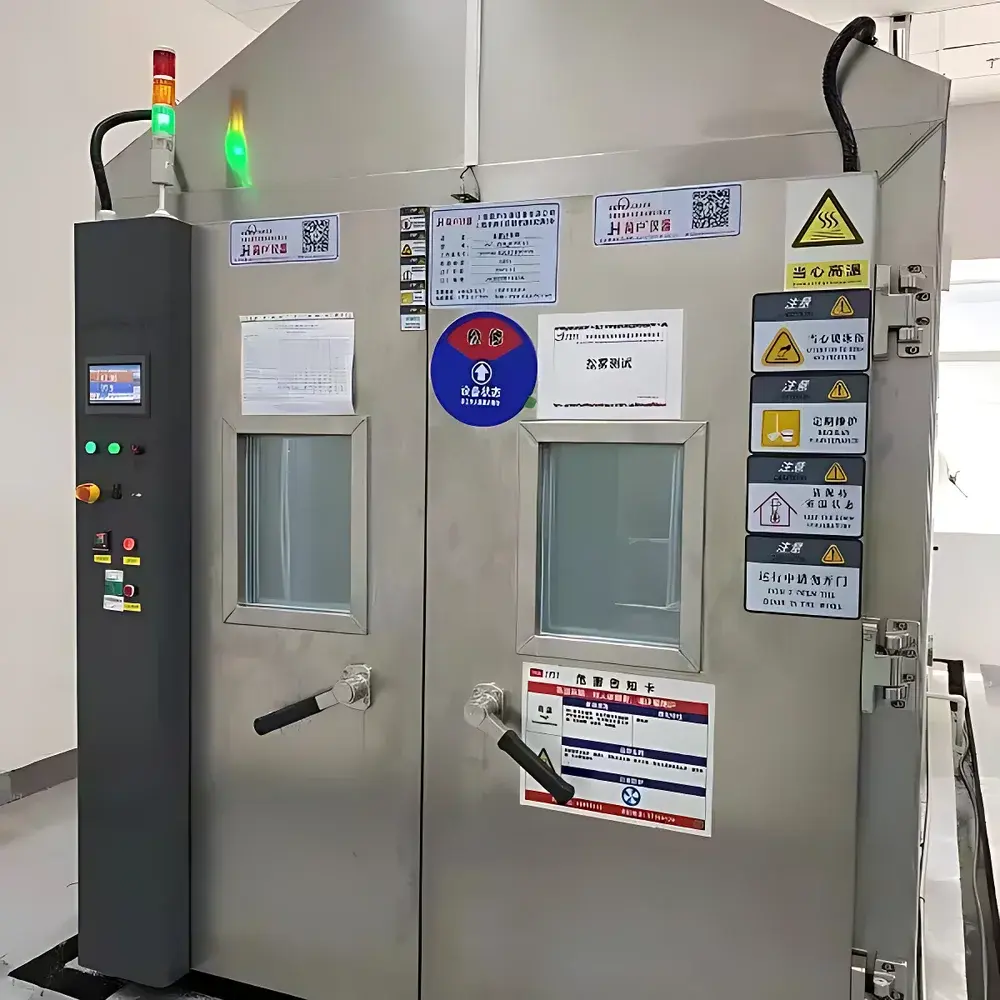
JianHu JH-Series Walk-In Salt Spray Test Chamber
| Brand | JianHu |
|---|---|
| Origin | Shanghai, China |
| Model | JH-Series Walk-In Salt Spray Test Chamber |
| Spray Method | Continuous Atomization |
| Fog Output | 1–2 mL / 80 cm²·hr |
| Nozzle Pressure | 0.7–1.0 kg/cm² |
| De-fogging Method | Compressed Air Exhaust System |
| Control System | High-Precision PID-Based Digital Controller |
| Chamber Capacity | Walk-in (Customizable Internal Dimensions) |
| Compliance | ASTM B117, ISO 9227, GB/T 2423.17, JIS Z2371 |
Overview
The JianHu JH-Series Walk-In Salt Spray Test Chamber is an engineered environmental test system designed to accelerate corrosion evaluation under controlled saline atmospheric conditions. Based on the standardized principles of continuous salt fog generation and uniform chamber conditioning—aligned with ASTM B117 (Standard Practice for Operating Salt Spray (Fog) Apparatus) and ISO 9227 (Corrosion Tests in Artificial Atmospheres)—this chamber subjects metallic and coated materials to reproducible chloride-laden environments. Unlike benchtop units, its walk-in architecture enables full-scale testing of large components (e.g., automotive body panels, aerospace subassemblies, structural steel elements) or high-volume sample batches, supporting industrial-scale validation of coating integrity, galvanic compatibility, and substrate passivation performance. The system maintains stable chamber temperature (typically 35 °C ± 2 °C), pH-controlled 5 wt% NaCl solution delivery, and laminar fog distribution via precision nozzles—ensuring metrological consistency across extended test durations (up to 1,000+ hours).
Key Features
- Walk-in configuration with reinforced PVC-coated steel interior and corrosion-resistant chamber walls, rated for long-term exposure to aggressive chloride aerosols.
- High-precision digital PID controller with real-time monitoring of chamber temperature, solution tank level, and spray pressure—enabling traceable parameter logging at user-defined intervals.
- Continuous spray system utilizing calibrated glass or ceramic nozzles operating at 0.7–1.0 kg/cm² pressure; fog output verified at 1–2 mL per 80 cm² surface area per hour per ASTM B117 requirements.
- Integrated compressed-air de-fogging mechanism that rapidly evacuates residual mist post-test without thermal shock or condensation buildup—critical for preserving sample surface morphology prior to inspection.
- Modular design supports optional upgrades: humidity control (for cyclic salt spray per ISO 9227 Annex C), programmable test sequencing, and external data interface (RS-485/Modbus RTU) for integration into centralized lab management systems.
- Compliance-ready architecture: meets structural and operational prerequisites for GLP-compliant laboratories, including audit-trail-capable event logging and password-protected parameter modification.
Sample Compatibility & Compliance
The JH-Series accommodates specimens up to 2.4 m (H) × 2.0 m (W) × 1.8 m (D), permitting evaluation of finished assemblies, architectural cladding, marine hardware, and defense-grade enclosures. Sample racks are configurable with non-metallic, acid-resistant supports to prevent galvanic interference. All operational parameters—including solution concentration, collection rate verification (via funnel-and-cylinder method per ASTM B117 Section 7), and chamber temperature uniformity (±2 °C tolerance zone)—are verifiable using NIST-traceable calibration tools. The system conforms to mandatory clauses of ISO/IEC 17025:2017 for testing laboratories, and its control firmware supports 21 CFR Part 11-compliant electronic signatures when paired with validated third-party software.
Software & Data Management
The embedded controller records time-stamped chamber temperature, spray duration, solution conductivity, and fault events to internal flash memory (retention ≥10 years). Data export is supported via USB 2.0 or Ethernet (TCP/IP), generating CSV-formatted logs compatible with LIMS platforms and statistical process control (SPC) tools. Optional JianHu TestSuite™ software provides graphical trend analysis, automated report generation (PDF/Excel), and comparative overlay of multiple test runs—facilitating root-cause analysis of coating delamination, pitting depth progression, or white rust formation. Audit trails include operator ID, timestamped parameter changes, and system calibration history—satisfying GMP documentation requirements for regulated sectors including medical device manufacturing and aerospace component certification.
Applications
- Automotive: Validation of electroplated fasteners, zinc-nickel coated chassis parts, and aluminum die-cast housings per OEM-specific standards (e.g., GMW14872, Ford CETP).
- Electronics: Corrosion resistance assessment of PCB conformal coatings, connector plating, and hermetic seal integrity under accelerated chloride ingress conditions.
- Construction & Infrastructure: Long-term performance benchmarking of stainless steel grades, weathering steel (Corten), and protective paint systems for coastal installations.
- Aerospace: Qualification of titanium alloy surface treatments, anodized aluminum skins, and fastener corrosion inhibitors per SAE AMS2700 and MIL-STD-810H Method 509.6.
- Academic Research: Controlled investigation of corrosion mechanisms (e.g., crevice, galvanic, stress-corrosion cracking) using synchronized electrochemical impedance spectroscopy (EIS) add-ons.
FAQ
What international standards does the JH-Series chamber support?
It is fully configured to execute tests per ASTM B117, ISO 9227, GB/T 2423.17, and JIS Z2371. Optional modules extend compliance to cyclic corrosion testing (CCT) protocols such as VDA 621-415 and GMW14872.
Can the chamber operate unattended for multi-day tests?
Yes—the system includes automatic solution replenishment alerts, over-temperature cutoff, low-level tank shutdown, and remote status notification via relay output or SNMP trap.
Is calibration documentation provided with shipment?
Each unit ships with a factory calibration certificate covering temperature sensor accuracy (±0.5 °C), pressure transducer linearity (±1% FS), and fog collection rate verification per ASTM B117 Annex A1.
How is chamber uniformity validated?
Temperature mapping is performed at 16 predefined locations (per ICH Q5C Annex 3) during commissioning; spatial deviation remains ≤±2 °C across the working volume.
Does the system support GLP audit requirements?
Yes—data integrity features include immutable event logs, user access levels (admin/operator/viewer), and electronic signature capability when integrated with validated software per FDA 21 CFR Part 11.



