
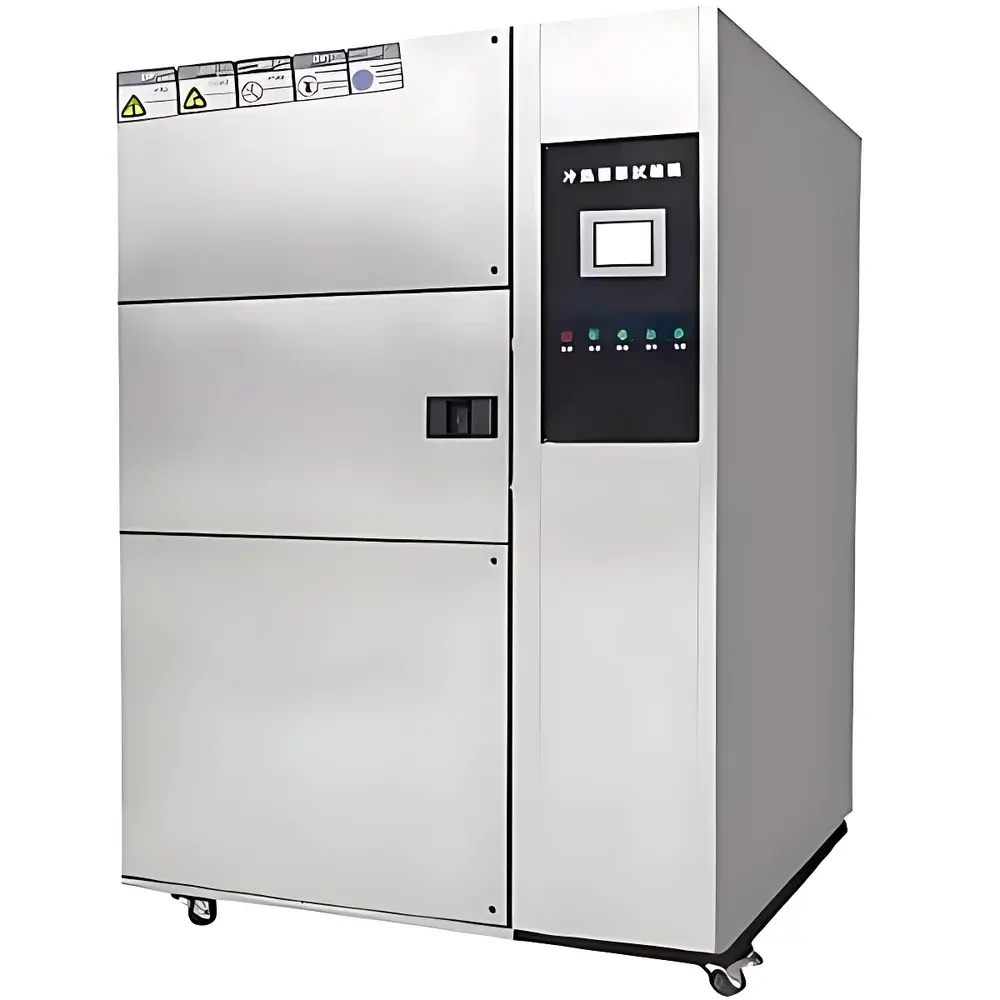
JianHu JH-Tri-Chamber Thermal Shock Test Chamber
| Brand | JianHu |
|---|---|
| Origin | Shanghai, China |
| Model | JH-Tri-Chamber |
| Temperature Range (High) | Up to +150 °C |
| Temperature Range (Low) | Down to −60 °C |
| Transfer Time (Hot → Cold) | ≤ 15 s |
| Temperature Uniformity in Test Chamber | ±0.5 °C |
| Control Accuracy | ±0.3 °C |
| Compliance | ISO 16750-4, ASTM D5229/D5229M, MIL-STD-810H Method 503.5, IEC 60068-2-14 |
| Cooling Method | Dual-mode (forced-air + optional liquid nitrogen) |
| Heating Method | High-efficiency tubular heaters |
| Chamber Configuration | Independent high-temp, low-temp, and test chambers |
Overview
The JianHu JH-Tri-Chamber Thermal Shock Test Chamber is an engineered solution for accelerated reliability assessment under extreme thermal transients. Unlike conventional single- or dual-chamber systems, this tri-chamber architecture physically isolates the high-temperature reservoir (+150 °C), low-temperature reservoir (−60 °C), and test chamber—enabling rapid, repeatable, and contamination-free thermal transitions. Its operational principle relies on pneumatic or mechanical transfer mechanisms that shuttle test specimens between thermally stabilized zones with minimal dwell time, thereby replicating real-world thermal stress events such as aircraft ascent/descent cycles, automotive powertrain cold-start scenarios, or semiconductor reflow-soldering thermal excursions. Designed for laboratories requiring high-fidelity thermal shock profiling, it delivers deterministic temperature ramp rates (up to 60 K/min), sub-second transfer repeatability, and strict adherence to international qualification standards.
Key Features
- Tri-chamber architecture with fully independent, sealed high-temperature (+150 °C), low-temperature (−60 °C), and test compartments—eliminating cross-chamber thermal bleed and ensuring measurement integrity.
- Dual-mode cooling system: standard forced-air refrigeration for routine operation; optional liquid nitrogen injection for extended low-temperature capability and faster recovery times.
- High-stability heating system using corrosion-resistant tubular heaters with PID-controlled zone modulation for uniform thermal distribution (±0.5 °C within test chamber).
- Integrated high-precision Pt100 Class A sensors (IEC 60751) mounted at multiple spatial locations—providing real-time feedback for closed-loop control with ±0.3 °C accuracy over full range.
- Automated specimen transfer mechanism with programmable dwell timing, position verification via optical end-stop sensing, and fail-safe interlock protocols.
- Industrial-grade stainless-steel construction (SUS304 interior, powder-coated steel exterior) compliant with CE, RoHS, and UL 61010-1 safety directives.
Sample Compatibility & Compliance
The JH-Tri-Chamber accommodates samples up to 500 mm × 500 mm × 500 mm (W×D×H) and supports standardized test fixtures for PCBs, IC packages, MEMS devices, automotive ECUs, aerospace avionics modules, and polymer composites. It meets the thermal shock test requirements of ISO 16750-4 (road vehicles), ASTM D5229/D5229M (composite materials), MIL-STD-810H Method 503.5 (environmental engineering considerations), and IEC 60068-2-14 (change of temperature). All thermal profiles are traceable to NIST-traceable calibration records, and system validation includes IQ/OQ documentation per GMP/GLP guidelines. Optional audit-ready data logging satisfies FDA 21 CFR Part 11 electronic record requirements when paired with validated software.
Software & Data Management
Equipped with JianHu’s proprietary TSCore™ control platform running on embedded Linux, the chamber supports multi-segment thermal shock programming—including dwell, ramp, hold, and cycle repetition—with user-defined pass/fail thresholds. Real-time temperature curves, chamber status flags (compressor load, heater duty cycle, door seal integrity), and event logs are timestamped and stored internally (≥32 GB SSD). Data export is supported via USB 3.0, Ethernet (Modbus TCP/IP), or optional Wi-Fi 6 module. The platform integrates natively with LIMS environments and supports CSV/Excel-compatible reports compliant with ISO/IEC 17025 documentation frameworks. Optional cloud-based remote monitoring enables secure access to live diagnostics and historical trend analysis across distributed lab networks.
Applications
This system is deployed across industries where thermal resilience directly impacts functional safety and service life. In semiconductor manufacturing, it validates die-attach integrity and wire-bond fatigue resistance under JEDEC JESD22-A104 thermal cycling profiles. Automotive Tier-1 suppliers use it for ECU qualification per ISO 16750-4, particularly for ADAS sensor housings exposed to desert-to-alpine ambient swings. Aerospace labs apply it to turbine blade coatings and satellite solar array substrates per MIL-STD-810H, simulating stratospheric thermal gradients. Materials researchers employ it to quantify glass transition shifts in thermoplastics, embrittlement onset in cryogenic alloys, and interfacial delamination kinetics in multilayer packaging films—all with statistical process control (SPC) support for batch-to-batch comparability.
FAQ
What is the typical transfer time between temperature extremes?
Standard transfer from +150 °C to −60 °C is ≤15 seconds, verified per IEC 60068-2-14 Annex B.
Can the system operate unattended for extended qualification tests?
Yes—equipped with hardware watchdog timers, redundant temperature cutoffs, and automatic email/SMS alerts for out-of-spec conditions.
Is calibration documentation provided with delivery?
Each unit ships with factory calibration certificates traceable to NIST standards, including sensor linearity, chamber uniformity, and transfer timing validation reports.
Does the controller support custom thermal profiles beyond standard test methods?
Yes—TSCore™ allows user-defined ramp rates, non-linear dwell sequences, and conditional branching based on real-time sensor feedback.
What maintenance intervals are recommended for long-term stability?
Compressor oil and filter replacement every 2,000 operating hours; annual verification of sensor drift and chamber seal integrity per ISO/IEC 17025 internal audit protocol.



