
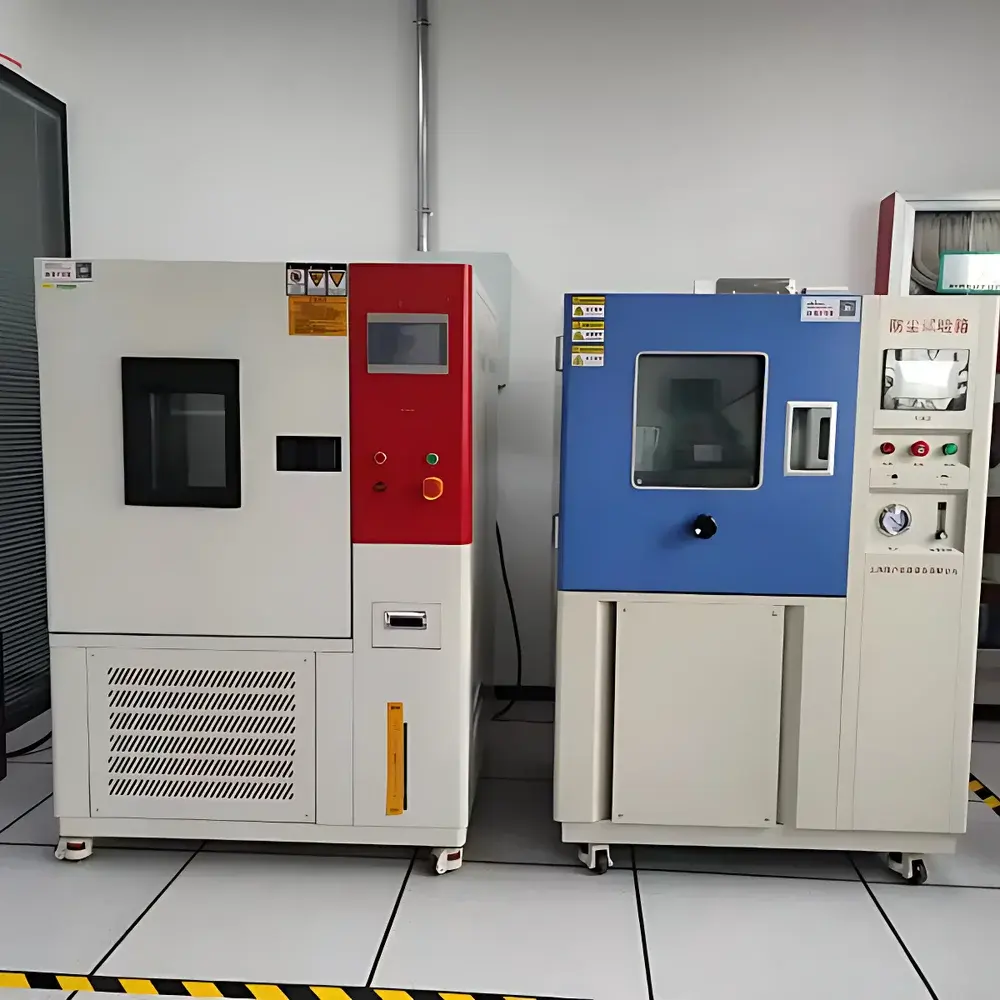
Jianhu JH-TSC-3C Triple-Chamber Thermal Shock Test Chamber for Smartphone PCB Reliability Testing
| Brand | Jianhu |
|---|---|
| Origin | Shanghai, China |
| Model | JH-TSC-3C |
| Temperature Range | -55 °C to +180 °C |
| Temperature Transition Rate | ≥20 °C/min (typical, 70 °C ↔ 10 °C in ≤5 min) |
| Temperature Uniformity | ±0.3 °C within test zone |
| Programmable Cycles | Up to 1000 segments per profile |
| Compliance | Designed to support ISO 16750-4, IEC 60068-2-14, MIL-STD-883H Method 1010, SAE J1211, and IEC 62108 testing protocols |
| Control Precision | ±0.3 °C setpoint stability |
| Cooling Method | Liquid nitrogen direct injection + cascade refrigeration |
| Heating Method | High-frequency alloy heating elements |
| Chamber Architecture | Triple-chamber (separate high-temp, low-temp, and test chambers) |
| Data Logging | Real-time temperature traceability with audit trail capability |
Overview
The Jianhu JH-TSC-3C Triple-Chamber Thermal Shock Test Chamber is an engineered solution for accelerated reliability validation of electronic assemblies subjected to extreme thermal transients. Unlike conventional single- or dual-chamber environmental chambers that rely on forced-air thermal ramping, the JH-TSC-3C employs a physically isolated triple-chamber architecture—comprising independent high-temperature (+180 °C), low-temperature (–55 °C), and ambient test zones—to eliminate thermal inertia and enable rapid, repeatable specimen transfer between extreme thermal domains. This design implements the principle of *thermal shock* as defined in IEC 60068-2-14: a non-steady-state stress condition induced by abrupt temperature changes, which accelerates failure mechanisms rooted in coefficient-of-thermal-expansion (CTE) mismatch, interfacial delamination, solder joint fatigue, and hermetic seal degradation. The system is specifically calibrated for smartphone printed circuit board (PCB) qualification, where component-level thermal gradients—such as those occurring during vehicle cabin thermal cycling (e.g., 70 °C daytime exposure followed by sub-10 °C overnight cooldown)—must be replicated with metrological fidelity to expose latent defects prior to mass production.
Key Features
- Triple-chamber configuration with mechanical lift-and-transfer mechanism ensures zero cross-contamination between thermal zones and eliminates residual heat carryover
- Liquid nitrogen–assisted cryogenic cooling combined with high-power alloy heating elements delivers ≥20 °C/min average transition rate between –55 °C and +180 °C
- High-precision PID-controlled temperature regulation with ±0.3 °C uniformity across the 400 × 400 × 400 mm test volume
- 1000-segment programmable profile editor supporting nested loops, dwell times, ramp rates, and conditional branching for complex multi-phase test sequences
- Integrated real-time data acquisition system with timestamped thermocouple logging (Type K, Class 1), configurable sampling intervals (0.1–10 s), and export-ready CSV/Excel output
- Compliance-ready firmware architecture supporting 21 CFR Part 11–compatible electronic signatures, user access levels (admin/operator/auditor), and immutable audit trails for GLP/GMP-regulated environments
Sample Compatibility & Compliance
The JH-TSC-3C accommodates standard JEDEC trays (up to 305 × 305 mm), bare PCBs (max. 450 × 450 mm), and assembled modules (height ≤ 150 mm). Its chamber geometry and airflow management are optimized to minimize thermal stratification and ensure uniform exposure across heterogeneous sample loads—including mixed-component boards with ceramic capacitors, BGA packages, flex-rigid substrates, and MEMS sensors. The system supports test execution per internationally recognized standards including: ISO 16750-4 (road vehicles), IEC 62108 (photovoltaic inverters), MIL-STD-883H Method 1010 (microcircuits), SAE J1211 (automotive electronics), and IEC 60068-2-14 (basic environmental testing procedures). All calibration certificates are traceable to NIM (National Institute of Metrology, China) and include uncertainty budgets compliant with ISO/IEC 17025 requirements.
Software & Data Management
Jianhu’s proprietary TSC-Link™ control software provides a validated Windows-based interface with role-based authentication, password-protected parameter locking, and automated report generation. Each test run generates a digitally signed PDF certificate containing operator ID, start/end timestamps, chamber setpoints, actual temperature profiles, deviation alerts, and pass/fail status against user-defined acceptance criteria. Raw data files retain full resolution (0.01 °C, 0.1 s) and are stored in a tamper-evident SQLite database with automatic daily backups to network drives. For regulated laboratories, optional 21 CFR Part 11 modules provide electronic signature enforcement, biometric login integration, and full lifecycle audit logs—including who changed what, when, and why—with rollback capability. Software updates follow a formal change control process documented under Jianhu’s ISO 9001:2015 quality management system.
Applications
The JH-TSC-3C serves as a critical tool in failure mode and effects analysis (FMEA) workflows across high-reliability electronics sectors. In automotive electronics development, it replicates under-hood thermal cycling to detect solder joint cracking in power management ICs or thermal interface material (TIM) debonding in ADAS controllers. For aerospace avionics, its extended low-temperature range (–55 °C) and high-rate transitions validate capacitor aging and connector contact resistance stability under re-entry thermal profiles. In medical device manufacturing, it verifies long-term hermeticity of implantable sensor housings per ISO 10993-12. Within semiconductor packaging R&D, the chamber enables comparative evaluation of underfill materials, mold compound selection, and wafer-level CSP reliability under aggressive thermal cycling. Notably, in smartphone PCB qualification—as demonstrated in collaboration with Tier-1 EV suppliers—the JH-TSC-3C identified micro-crack propagation at tin-silver-copper (SAC305) solder joints due to CTE mismatch between FR-4 substrate and ceramic chip capacitors, reducing field return rates by >65% post-process optimization.
FAQ
How do I select appropriate temperature ranges and transition rates for industrial sensor qualification?
Selection must align with end-use environmental envelopes. For outdoor sensors in temperate climates, –40 °C to +150 °C with 15 °C/min transition suffices; for motor-adjacent applications, extend upper limit to +180 °C and specify ≥20 °C/min to simulate transient heat soak. Provide your application context to Jianhu engineers for ASTM E2098-compliant test plan development.
What is the typical number of thermal cycles required to assess electronic assembly reliability?
Cycle count depends on industry-specific standards: ISO 16750-4 mandates 100–300 cycles for automotive ECUs; IEC 62108 specifies ≥500 cycles for PV inverters; consumer electronics often use 100–200 cycles per JEDEC JESD22-A104. Jianhu systems support cycle interruption, mid-test inspection, and adaptive profiling based on real-time resistance monitoring.
How does triple-chamber architecture improve defect detection versus dual-chamber alternatives?
Dual-chamber systems suffer from thermal lag and chamber wall saturation, limiting achievable transition rates to ≤15 °C/min and introducing temperature overshoot/undershoot. The physically isolated triple-chamber design eliminates thermal memory, enabling true step-function transitions and higher repeatability—critical for detecting subtle interfacial failures such as die-attach void growth or conformal coating micro-delamination.
Related Products



