
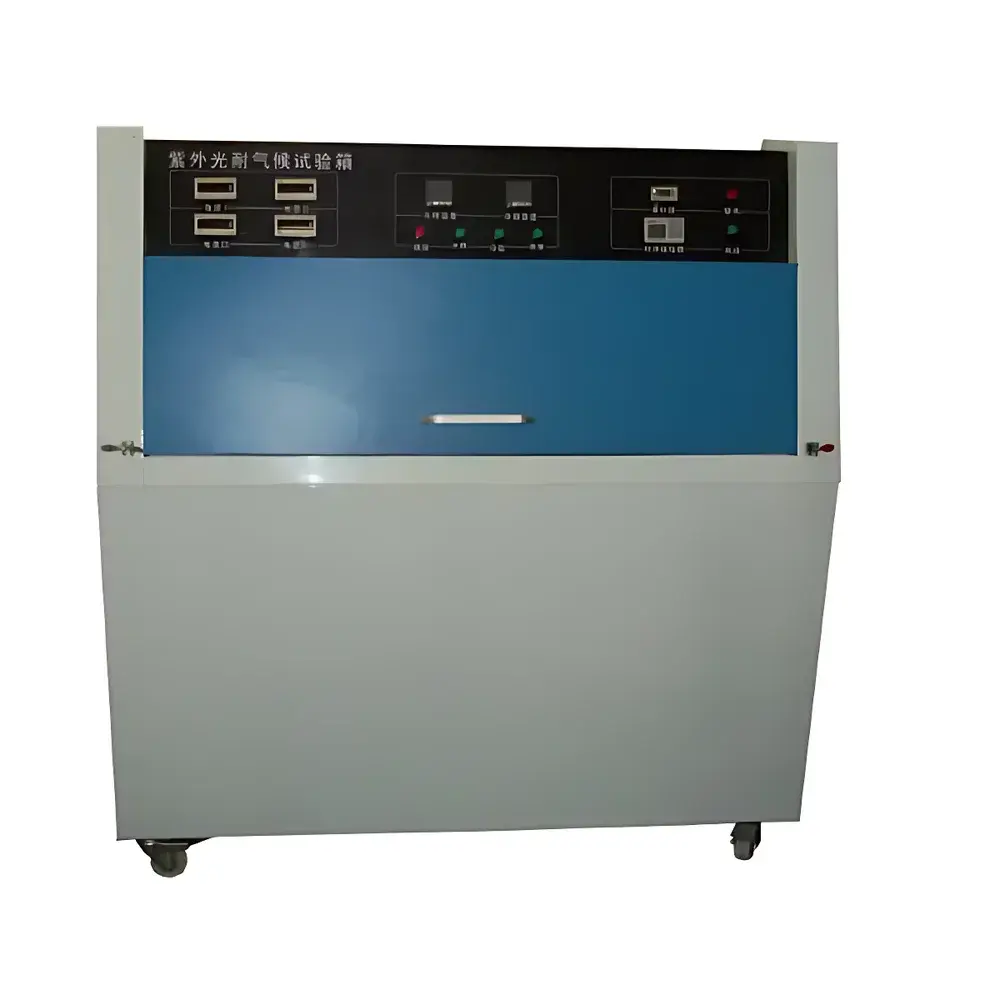
JianHu JH-UV Aging Test Chamber – Laboratory-Grade Precision Weathering Tester
| Brand | JianHu |
|---|---|
| Origin | Shanghai, China |
| Model | JH-UV Aging Test Chamber |
| UV Lamp Power | 40 W per lamp |
| Irradiance Range | 0.72 W/m² (adjustable up to 1.0 W/m²) |
| Test Duration | 1–9999 hours (programmable) |
| Lamp Spacing | 70 mm |
| Sample-to-Lamp Distance | 50 ± 3 mm |
| Effective Irradiated Area | 900 × 210 mm |
| Standard Sample Size | 75 × 290 mm |
| Internal Material | 304 Stainless Steel |
| Controller | Color Touchscreen Programmable Logic Controller (PLC) |
| UV Lamps | UVA-340 (standard), optional UVB-313 |
| Protection Features | Overload, short-circuit, over-temperature, and low-water-level safeguards |
| Temperature Range | RT + 40°C to 70°C |
| Humidity Capability | >90% RH (condensation cycle supported) |
| Cycles | UV irradiation, condensation, optional water spray (configurable) |
Overview
The JianHu JH-UV Aging Test Chamber is a laboratory-grade accelerated weathering instrument engineered for precision simulation of solar ultraviolet (UV) radiation, moisture condensation, and thermal cycling. It operates on the principle of fluorescent UV lamp exposure—primarily using UVA-340 lamps that closely replicate the critical short-wavelength UV spectrum (295–365 nm) found in terrestrial sunlight. This spectral match enables high-fidelity assessment of photodegradation mechanisms including polymer chain scission, chromophore degradation, surface oxidation, and hydrolytic breakdown. Unlike broad-spectrum xenon arc testers, the JH-UV chamber delivers repeatable, high-intensity UV exposure under tightly controlled thermal and humidity conditions—making it especially suitable for comparative durability screening of coatings, plastics, textiles, automotive trim, and photovoltaic encapsulants per ASTM G154, ISO 4892-3, and SAE J2020.
Key Features
- High-stability UVA-340 fluorescent lamps (40 W each) with calibrated irradiance output up to 1.0 W/m² at 340 nm—traceable to NIST-traceable reference standards
- Precision black-panel temperature control (RT + 40°C to 70°C) with PID-regulated heating and forced-air circulation ensuring uniform thermal distribution across the test plane
- Condensation cycle generation via bottom-mounted water reservoir and controlled chamber wall cooling—enabling realistic dew formation without external humidification systems
- Programmable touchscreen PLC controller supporting multi-step test profiles: UV exposure, dark condensation, optional water spray (via integrated nozzles), and inter-cycle transitions
- Robust 304 stainless steel construction (interior and exterior) with corrosion-resistant gaskets and insulated double-wall design for long-term operational integrity
- Comprehensive safety architecture: real-time lamp current monitoring, thermal cut-off at 85°C, automatic lamp shutoff during door opening, and fail-safe water level detection
Sample Compatibility & Compliance
The chamber accommodates standard specimens measuring 75 × 290 mm (up to 48 samples per cycle), mounted on an adjustable aluminum sample rack. Custom fixtures support non-standard geometries—including 3D automotive parts, flexible films, and composite laminates—while maintaining consistent 50 ± 3 mm lamp-to-sample spacing. All operational parameters—including irradiance intensity, black-panel temperature, condensation duration, and cycle sequencing—are fully compliant with regulatory test protocols required for ISO/IEC 17025-accredited laboratories. The system supports audit-ready documentation: test logs include timestamped irradiance values, temperature/humidity traces, and cycle event markers—aligned with GLP and FDA 21 CFR Part 11 data integrity requirements when paired with validated software extensions.
Software & Data Management
The embedded controller records all critical process variables at 10-second intervals and stores ≥12 months of compressed historical data onboard. Export options include CSV and PDF reports compatible with LIMS integration. Optional Ethernet-enabled firmware allows remote monitoring and alarm notification via SNMP or Modbus TCP. For regulated environments, the optional JianHu DataVault module provides electronic signature capability, user access tiers (admin/operator/auditor), and immutable audit trails—including operator ID, parameter changes, and calibration events—fully satisfying Annex 11 and ICH GCP traceability mandates.
Applications
This instrument is routinely deployed in R&D labs and QC departments for predictive lifetime modeling of organic materials exposed to outdoor service conditions. Key use cases include: evaluation of UV stabilizer efficacy in polyolefins and PVC formulations; qualification of anti-reflective and anti-soiling coatings for solar modules; validation of automotive interior trim resistance to gloss loss and cracking; shelf-life assessment of pharmaceutical packaging polymers; and accelerated aging of aerospace sealants per MIL-STD-810H Method 505.5. Its reproducibility and spectral fidelity make it a preferred tool for inter-laboratory round-robin studies and supplier qualification programs across Tier-1 OEMs and third-party certification bodies (e.g., TÜV Rheinland, UL, SGS).
FAQ
What UV spectral output does the standard UVA-340 lamp provide?
The UVA-340 lamp emits peak irradiance at 340 nm with a spectral bandwidth matching natural sunlight between 295–365 nm—per ASTM G154 Section 5.1.
Is black-panel temperature measurement included as standard?
Yes—the chamber integrates a calibrated black-panel sensor adjacent to the sample plane, reporting real-time surface temperature with ±0.5°C accuracy.
Can the system perform combined UV + water spray cycles?
Yes—optional front-mounted spray nozzles deliver deionized water mist during designated dark phases, simulating rain erosion per ISO 4892-3 Clause 7.3.
Does the controller support multi-segment programming?
Yes—up to 99 programmable steps per test sequence, each with independent UV intensity, temperature setpoint, and duration parameters.
What maintenance intervals are recommended for lamp replacement and calibration?
Lamps require replacement after 1600–2000 hours of operation; annual irradiance recalibration using a NIST-traceable UV radiometer is recommended for ISO/IEC 17025 compliance.



