
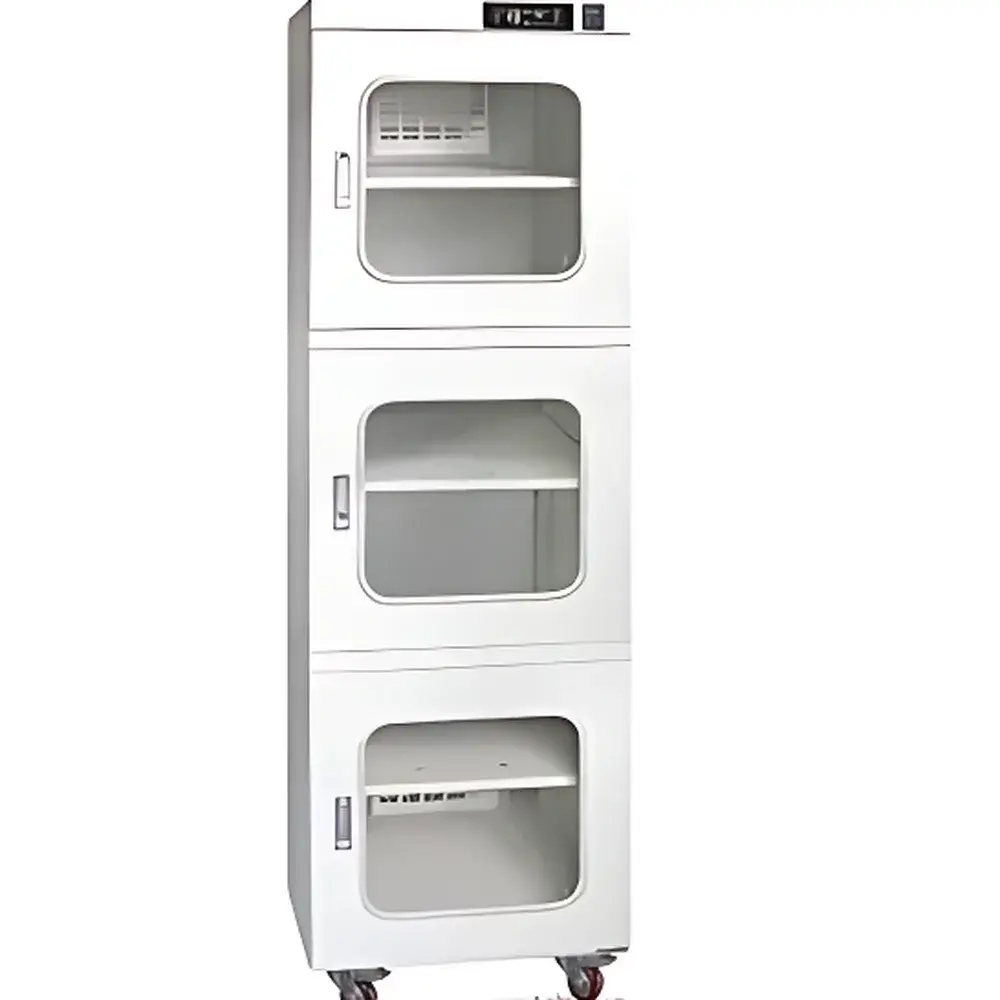
Jianhu JHM Series Electronic Dry Cabinet (Customizable Desiccator Cabinet)
| Brand | Jianhu |
|---|---|
| Origin | Shanghai, China |
| Manufacturer Type | Authorized Distributor |
| Country of Origin | China |
| Model | JHM(L)-160 / JHM(L)-320 / JHM(L)-490 / JHM(L)-500 / JHM(L)-730 / JHM(L)-1500 / JHM(L)-1510 |
| Humidity Control Range | 20–60% RH (JHM), 1–40% RH (JHL) |
| Humidity Accuracy | ±2% RH |
| Cabinet Construction | 1.2 mm Baosteel cold-rolled steel |
| Load Capacity | 150 kg |
| Display | High-resolution LCD with touch-sensitive microcomputer interface |
| Power Failure Resilience | Passive desiccation continues for up to 24 h after power loss |
| Core Desiccation Technology | Polymer-based moisture adsorption + shape-memory alloy (SMA) actuated regeneration system |
| ESD Option | Permanent anti-static coating (optional) |
| Warranty | 3 years on desiccant core, lifetime technical support |
Overview
The Jianhu JHM Series Electronic Dry Cabinet is an engineered environmental control solution designed for long-term storage of moisture-sensitive components—including PCBs, semiconductors, optical lenses, precision metrology tools, and hygroscopic reference standards. Unlike compressor- or refrigerant-based dehumidification systems, the JHM cabinet employs a solid-state, energy-efficient desiccation architecture centered on high-capacity polymer desiccants coupled with shape-memory alloy (SMA) thermal actuators. This hybrid mechanism enables precise, repeatable humidity regulation without condensation, oil contamination, or mechanical vibration—critical for cleanroom-adjacent and ISO Class 5–8 environments. The cabinet maintains stable setpoints within ±2% RH across its operational range (20–60% RH for JHM models; 1–40% RH for JHL variants), eliminating the need for frequent manual recalibration or consumable desiccant replacement.
Key Features
- Passive humidity buffering: Integrated polymer desiccant matrix retains moisture adsorption capacity during extended power outages—proven functionality for ≥24 hours without external power.
- Microcomputer-controlled environment: Touch-sensitive interface with high-contrast LCD display provides real-time monitoring of internal temperature and relative humidity, along with user-defined setpoint programming and historical trend logging.
- Structural integrity: Constructed from 1.2 mm Baosteel cold-rolled steel with reinforced load-bearing frame; certified static load capacity of 150 kg distributed evenly across adjustable shelves.
- Electrostatic discharge (ESD) compliance: Optional permanent conductive coating (surface resistivity <1×10⁶ Ω/sq) meets ANSI/ESD S20.20 and IEC 61340-5-1 requirements for electronics handling environments.
- Fire-resistant design: Cabinet housing and internal insulation materials comply with UL 94 V-0 flammability rating; no high-temperature heating elements or combustible refrigerants used in operation.
- Modular scalability: Seven standard volume configurations—from 157 L (JHM(L)-160) to 1452 L (JHM(L)-1500/1510)—support laboratory, pilot-line, and production-floor deployment with identical control logic and maintenance protocols.
Sample Compatibility & Compliance
The JHM cabinet accommodates a wide range of sample formats: bare wafers, tray-packed ICs, solder paste containers, calibration artifacts, and sealed glass vials. Its non-condensing, low-vibration operation ensures compatibility with MEMS devices, quartz crystal oscillators, and thin-film sensors prone to micro-fracture under thermal cycling. All models are CE-marked and conform to IEC 61000-6-3 (EMC emissions) and IEC 61000-6-2 (immunity). Optional ESD versions include documentation supporting GLP-compliant audit trails per ISO/IEC 17025:2017 Annex A.2. Cabinet dimensions and internal clearances align with standard ISO 14644-1 cleanroom cart integration requirements.
Software & Data Management
While the base unit operates via embedded microcontroller, optional RS-485 or USB-to-serial interface enables integration with facility-wide environmental monitoring systems (EMS). Logged data—including timestamped RH/temperature readings, door-open events, and system status flags—is exportable as CSV or XML. Firmware supports configurable alarm thresholds (audible/visual), automatic event-triggered data snapshots, and password-protected parameter modification—meeting foundational traceability expectations under FDA 21 CFR Part 11 for electronic records where local validation protocols are implemented.
Applications
- Pre-reflow storage of surface-mount components per IPC-J-STD-033D moisture sensitivity level (MSL) requirements.
- Long-term archival of NIST-traceable hygrometric standards and dew-point reference chambers.
- Controlled-humidity staging for semiconductor probe station calibration and wafer-level testing.
- Storage of analytical reference materials (e.g., USP hygroscopic standards, ASTM E104 saturated salt solutions).
- Stabilization environment for interferometric optical assemblies and laser cavity alignment fixtures.
- Compliance-ready storage for medical device components subject to ISO 13485:2016 clause 7.5.10 (control of monitoring and measuring equipment).
FAQ
What is the expected service life of the desiccant core?
The polymer desiccant matrix is rated for ≥20 years under typical laboratory conditions (25°C, 50% RH ambient); Jianhu provides a 3-year limited warranty on core performance degradation beyond ±5% RH deviation from factory calibration.
Can the cabinet be validated for GMP environments?
Yes—though the cabinet itself is not “GMP-certified,” its design supports IQ/OQ/PQ execution: all critical parameters (RH accuracy, recovery time, door-seal integrity) are quantitatively verifiable using NIST-traceable hygrometers and documented test protocols.
Is remote monitoring supported out of the box?
No—remote connectivity requires optional communication module installation and third-party EMS platform configuration; local LCD interface remains fully functional without network dependency.
Does the SMA regeneration cycle produce audible noise?
No—SMA actuation is silent and vibration-free; overall acoustic emission is <25 dB(A) at 1 m distance, suitable for quiet laboratory zones.
How often does the system require maintenance?
Annual verification of sensor calibration and door gasket integrity is recommended; no routine filter changes, oil top-ups, or refrigerant servicing required due to solid-state architecture.



