
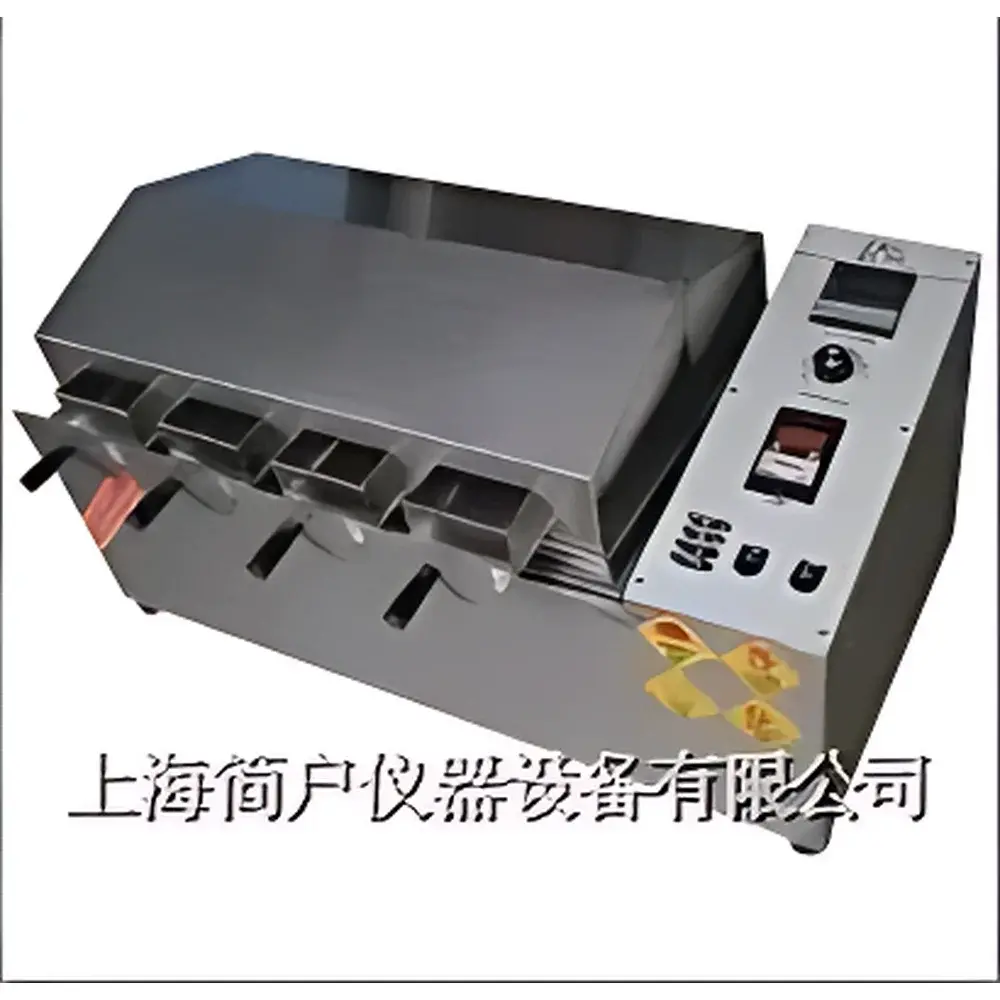
Jianhu JWVT-3(4) Steam Aging Test Chamber
| Brand | Jianhu |
|---|---|
| Origin | Zhejiang, China |
| Manufacturer Type | Authorized Distributor |
| Country of Origin | China |
| Model | JWVT-3(4) |
| Temperature Range | RT+10°C to 200°C (optional 300°C) |
| Temperature Uniformity | ±1% |
| Temperature Stability | ±0.3°C |
| Control System | PID + PWM + SSR with LED Digital Display |
| Sensor | PT-100 Platinum Resistance Thermometer |
| Temperature Resolution | 0.1°C |
| Air Exchange Rate | 0–200 cycles/hr (adjustable with digital wattmeter for power & airflow correlation) |
| Internal Dimensions (A/B/C) | 450×450×450 / 600×600×600 / 750×750×750 mm |
| External Dimensions (A/B/C) | 1070×1440×690 / 1220×1590×850 / 1370×1740×990 mm |
| Test Tray Size | 92×285×40 mm (3/4 set) |
| Heating Time (RT → 98°C) | ~50 min |
| Inner Chamber Material | SUS304 Stainless Steel |
| Outer Chamber Finish | Powder-Coated Paint |
| Compliance | GB/T, ISO 9001, ASTM D3574, UL 746C, CEN EN 60068-2-30 |
Overview
The Jianhu JWVT-3(4) Steam Aging Test Chamber is an engineered environmental simulation system designed for accelerated aging and oxidation resistance evaluation of electronic components under controlled saturated steam conditions. It operates on the principle of high-humidity thermal stress exposure—leveraging pressurized steam at elevated temperatures to accelerate surface oxidation, intermetallic diffusion, and solderability degradation mechanisms in metallic terminations, lead frames, and passive component electrodes. Unlike conventional dry-heat ovens, this chamber maintains a stable, reproducible steam-saturated atmosphere (≥95% RH at operating temperature), enabling standardized evaluation of tin-lead and lead-free solder wetting performance prior to wave or reflow soldering processes. Its architecture conforms to the thermal cycling and humidity preconditioning requirements specified in J-STD-020, IPC-9701, and JEDEC JESD22-A108 for reliability qualification of semiconductor packages and discrete devices.
Key Features
- Microprocessor-based PID + PWM + SSR temperature control system with LED digital display for precise thermal regulation and real-time monitoring.
- High-accuracy PT-100 platinum resistance sensor (Class A tolerance) ensuring temperature resolution of 0.1°C and long-term stability.
- Dual-stage overtemperature protection: independent mechanical and electronic cut-off circuits prevent thermal runaway during extended test cycles.
- Steam-specific safety interlocks including automatic water-level detection and dry-run prevention to eliminate heater damage during steam generation failure.
- Adjustable air exchange rate (0–200 cycles/hour) with integrated digital wattmeter, allowing users to correlate electrical power consumption with volumetric airflow for ISO 17025-compliant calibration traceability.
- SUS304 stainless steel interior chamber resistant to steam-induced corrosion and condensate accumulation; powder-coated carbon steel exterior for mechanical durability and cleanroom compatibility.
Sample Compatibility & Compliance
The JWVT-3(4) accommodates standard JEDEC trays, component reels, and bare PCBs up to 750 mm × 750 mm × 750 mm (Model C). Its steam chamber geometry supports uniform vapor distribution across multi-layer sample stacks, minimizing thermal stratification. The system complies with multiple international standards governing material aging and solderability testing—including GB/T 2423.22 (China), ISO 9001:2015 (quality management), ASTM D3574 (flexible cellular materials), UL 746C (polymeric materials for electrical equipment), and CEN EN 60068-2-30 (damp heat, cyclic). While not inherently FDA 21 CFR Part 11 compliant, its logging-capable controller can be integrated with external audit-trail software for GLP/GMP environments requiring electronic record integrity.
Software & Data Management
The embedded controller supports manual parameter entry and time-based program sequencing (up to 99 segments), with non-volatile memory retention for test profiles and historical run logs. Optional RS-485 Modbus RTU interface enables integration into centralized lab data acquisition systems (e.g., LabVIEW, SCADA) for automated data export and trending. All temperature setpoints, actual readings, elapsed time, and alarm events are timestamped and stored locally for post-test analysis. For laboratories requiring full compliance with ISO/IEC 17025 clause 7.7 (result reporting), third-party validation packages—including IQ/OQ documentation templates and calibration certificates traceable to NIM (National Institute of Metrology, China)—are available upon request.
Applications
- Evaluation of solderability degradation in QFP, SOP, and BGA component leads after steam aging per J-STD-020 moisture sensitivity level (MSL) preconditioning.
- Oxidation resistance testing of copper, nickel-palladium-gold (NiPdAu), and immersion silver (IAg) surface finishes on PCBs and connectors.
- Accelerated life testing of passive components (chip resistors, capacitors, inductors) to assess terminal adhesion and interfacial stability under humid thermal stress.
- Qualification of conformal coatings and encapsulants for moisture barrier performance in automotive electronics (AEC-Q200) and industrial control modules.
- Research-grade studies on SnAgCu alloy intermetallic growth kinetics at 100–150°C under saturated steam, supporting IPC-TR-579 and JEDEC JEP122G modeling efforts.
FAQ
What is the maximum allowable operating temperature for continuous steam exposure?
The standard configuration is rated for continuous operation up to 200°C; a high-temperature variant (JWVT-3(4)-HT) supports 300°C with upgraded gasketing and insulation—subject to reduced steam saturation above 120°C.
Can the chamber maintain true saturated steam conditions at 100°C?
Yes—when operated at atmospheric pressure with distilled water feed, it achieves ≥98% RH at 100°C; pressure-assisted modes enable higher saturation points up to 150°C.
Is calibration documentation included with shipment?
Each unit ships with a factory calibration report for the PT-100 sensor and temperature controller, traceable to national metrology standards via CNAS-accredited labs.
How is airflow quantified when the air exchange rate is set to “100 cycles/hr”?
The digital wattmeter measures total heating power; users apply empirical airflow conversion factors (provided in the technical manual) based on chamber volume and heater wattage to derive approximate volumetric exchange rates.
Does the system support remote monitoring via Ethernet or Wi-Fi?
Not natively—the RS-485 port requires a protocol converter (e.g., Moxa NPort) for TCP/IP bridging; optional OEM firmware upgrades add Ethernet-native Modbus TCP support.



