
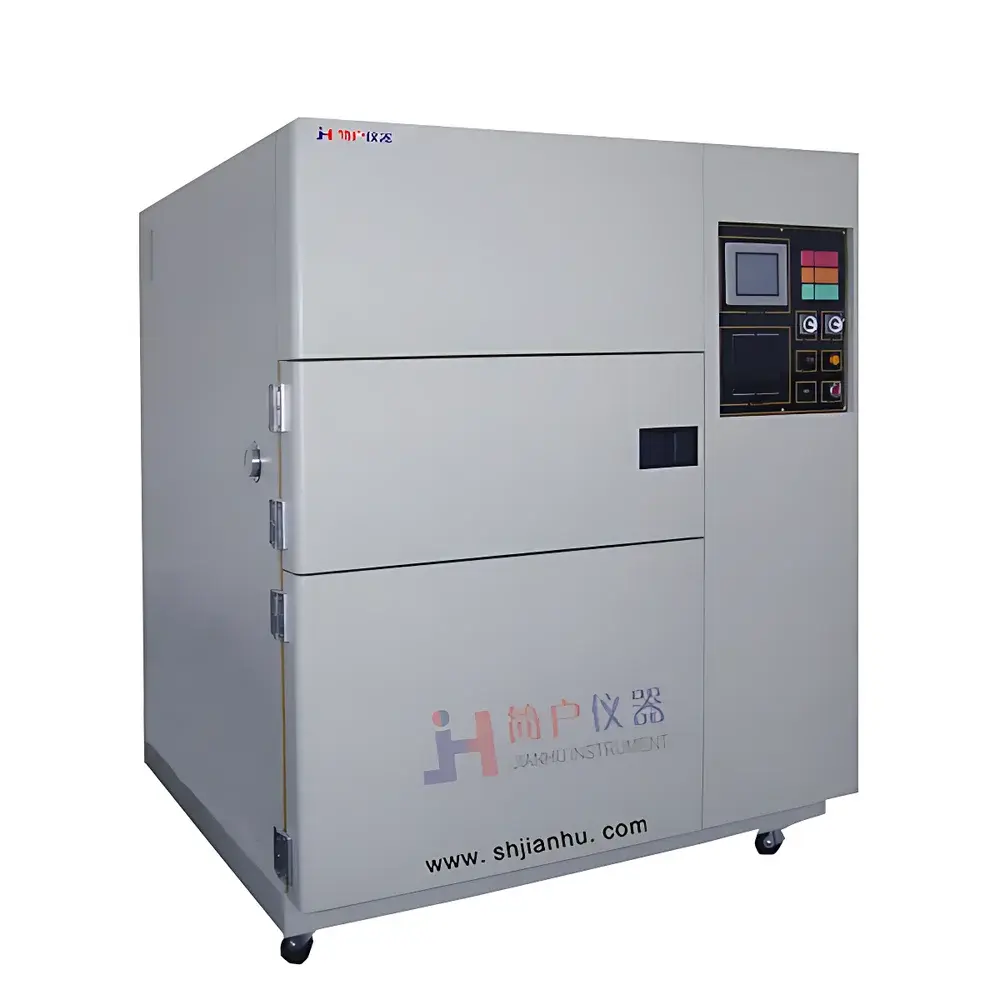
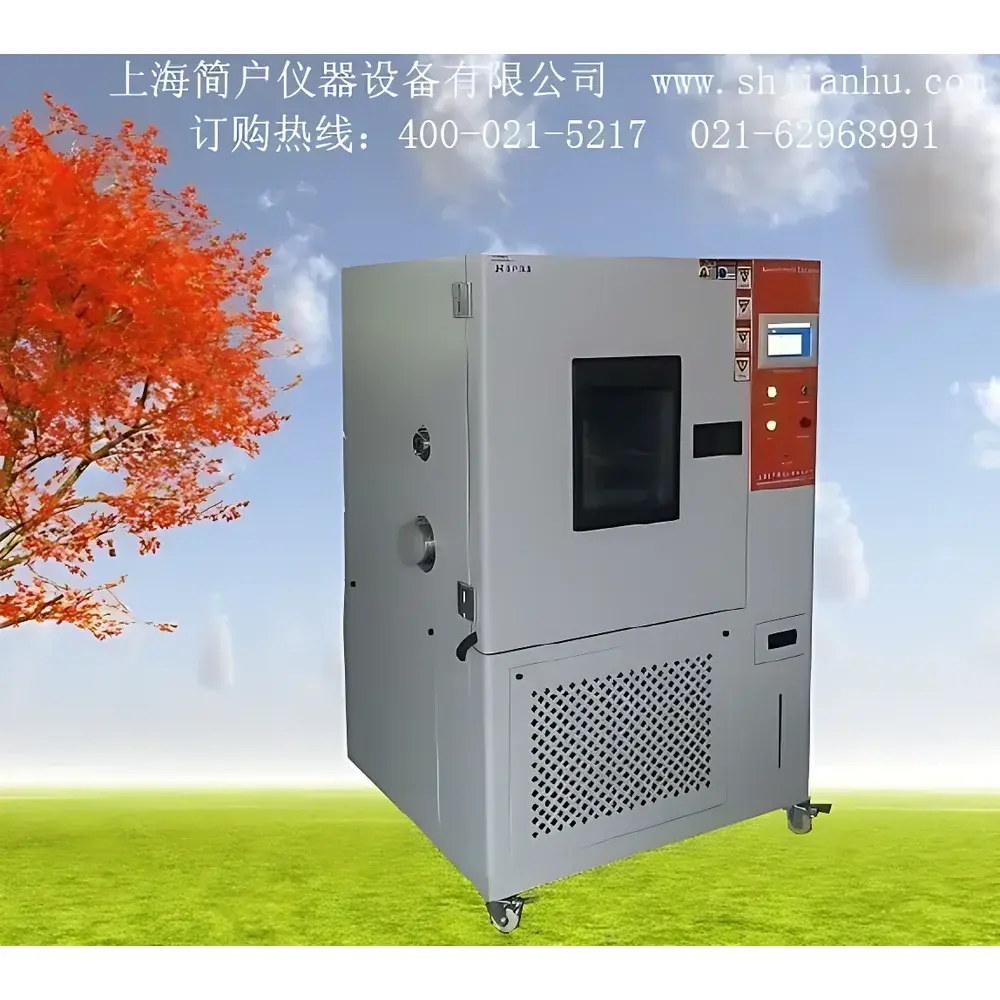
Jianhu LS-A3C / LS-B3C / LS-C3C Thermal Shock Test Chamber
| Brand | Jianhu |
|---|---|
| Origin | Shanghai, China |
| Model(s) | LS-A3C, LS-B3C, LS-C3C |
| Internal Dimensions (W×D×H) | 40×35×30 cm (LS-A3C), 50×40×40 cm (LS-B3C), 60×50×50 cm (LS-C3C) |
| Temperature Range | High Zone: +60°C to +150°C |
| Low Zone | −10°C to −65°C |
| Transfer Time (Hot ↔ Cold) | ≤15 s |
| Temperature Recovery Time | ≤5 min |
| Compliance | GB/T 2423.1–2023, GB/T 2423.2–2008, GB 10592–2008, GJB 150.3A–2009 |
Overview
The Jianhu LS-A3C / LS-B3C / LS-C3C series Thermal Shock Test Chambers are engineered for high-reliability environmental stress screening (ESS) of electronic components, aerospace hardware, automotive modules, and advanced materials subjected to rapid thermal transients. These three-zone (hot chamber / cold chamber / test zone) mechanical thermal shock systems operate on the principle of horizontal basket transfer—physically moving test specimens between independently controlled high-temperature and low-temperature environments within a single integrated enclosure. This architecture eliminates air-mixing artifacts common in single-chamber forced-air ramp systems, enabling true step-change thermal exposure per IEC 60068-2-14 and MIL-STD-810H Method 503.4. Each model supports programmable dual- or triple-point thermal profiles (e.g., −65°C → +150°C → ambient), with precise dwell time control and automatic cycle sequencing. The system’s structural integrity, insulation performance, and interlocked safety mechanisms meet industrial requirements for continuous unattended operation under GLP-aligned test protocols.
Key Features
- Independent dual-zone temperature control: Separate refrigeration and heating circuits for hot zone (+60°C to +150°C) and cold zone (−10°C to −65°C), minimizing cross-contamination and ensuring thermal stability during dwell phases.
- High-speed horizontal basket transfer mechanism: Achieves hot-to-cold or cold-to-hot specimen movement in ≤15 seconds, with position feedback and servo-controlled acceleration/deceleration to prevent mechanical shock to DUTs.
- Thermal recovery time ≤5 minutes after transfer, verified per GB 10592–2008 and GJB 150.3A–2009 test validation procedures.
- Interlocked safety architecture: Automatic power cutoff to circulation fans and basket drive motor upon door opening; redundant over-temperature and over-pressure sensors with fail-safe relay outputs.
- Standard top-mounted 50 mm diameter cable port with silicone gasket seal, rated for sensor leads, thermocouple wires, and data acquisition cables up to 8 mm outer diameter.
- Robust polyurethane foam insulation (150 mm thick walls, 200 mm ceiling/floor), achieving surface temperature rise <5 K above ambient during full-range operation.
Sample Compatibility & Compliance
The LS-series accommodates test specimens up to 30 kg (LS-A3C), 45 kg (LS-B3C), or 60 kg (LS-C3C) on its stainless-steel transfer basket. Specimen mounting fixtures, custom jigs, and non-metallic support trays are compatible with standard DIN 40050-9 and IPC/JEDEC J-STD-020D.2 footprint constraints. All models comply with national and defense standards including GB/T 2423.1–2023 (cold testing), GB/T 2423.2–2008 (dry heat), GB 10592–2008 (performance verification), and GJB 150.3A–2009 (thermal shock). Optional calibration certificates traceable to NIM (National Institute of Metrology, China) are available upon request. While not inherently 21 CFR Part 11 compliant, the system supports external audit-ready data logging when integrated with validated third-party software platforms.
Software & Data Management
Control is executed via an embedded Windows-based HMI running proprietary Jianhu TSC-OS v4.2 firmware. The interface provides real-time graphical display of zone temperatures, basket position status, elapsed cycle time, and alarm history. Users define multi-segment thermal profiles—including ramp rates (°C/min), dwell durations (s/min/h), and loop counts—with password-protected parameter editing. Data export is supported in CSV format via USB 2.0 port; optional RS-485 Modbus RTU and Ethernet TCP/IP interfaces enable integration into centralized MES or LIMS environments. System logs retain timestamped entries for all operator actions, setpoint changes, and fault events for minimum 30-day local storage—sufficient for internal quality audits under ISO 9001:2015 clause 8.5.2.
Applications
- Qualification testing of PCBAs, IC packages, and solder joints per IPC-9701 and JEDEC JESD22-A104E.
- Reliability assessment of battery cells and BMS modules under extreme thermal cycling (−40°C ↔ +85°C).
- Validation of optical coatings, adhesives, and composite laminates for coefficient-of-thermal-expansion (CTE) mismatch failure modes.
- Pre-screening of avionics enclosures prior to full MIL-STD-810G/H environmental qualification.
- Accelerated life testing of automotive ECUs, sensors, and lighting assemblies under AEC-Q200 stress conditions.
FAQ
What is the difference between a two-zone and three-zone thermal shock chamber?
This series employs a true two-zone (hot/cold) architecture with a movable test basket—functionally equivalent to a three-zone design. Unlike single-chamber air-shock systems, it avoids thermal inertia delays and ensures defined step-change exposure.
Can the chamber be calibrated to ISO/IEC 17025 standards?
Yes—Jianhu provides optional factory calibration services with uncertainty budgets reported per ISO/IEC 17025:2017 Annex A.3, using accredited reference probes traceable to NIM.
Is remote monitoring supported?
Standard Ethernet connectivity enables read-only web-based status viewing via HTTP; full remote control requires integration with enterprise SCADA or LabVIEW via Modbus TCP.
What maintenance intervals are recommended?
Compressor oil and refrigerant filter replacement every 24 months; door gasket inspection and cleaning every 6 months; annual verification of transfer timing accuracy and thermal uniformity per GB 10592–2008 Annex B.
Does the system support automated pass/fail evaluation against user-defined limits?
Not natively—the controller records raw temperature/time data only. Pass/fail logic must be applied externally during post-processing using exported CSV files.
Related Products



