
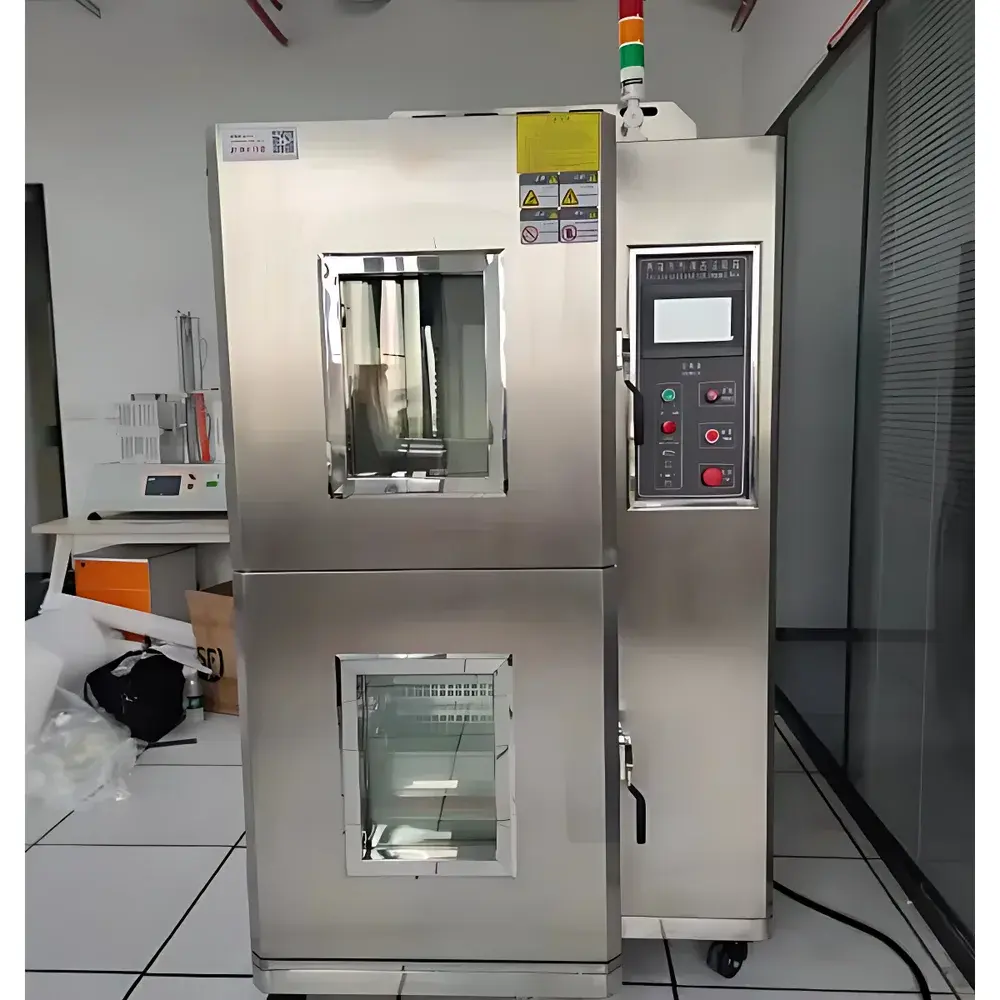
Jianhu PV Module Thermal Shock Test Chamber – Model JH-TSC-800
| Brand | Jianhu |
|---|---|
| Origin | Shanghai, China |
| Manufacturer Type | Authorized Distributor & OEM Integrator |
| Category | Domestic High-Performance Environmental Test Equipment |
| Model | JH-TSC-800 PV Module Thermal Shock Chamber |
| Temperature Range | -40°C to +85°C |
| Ramp Rate | Up to 10°C/min (typical), programmable gradient profiles |
| Control Accuracy | ±0.3°C over full range |
| Chamber Dimensions (W×D×H) | 2000 mm × 1200 mm × 1500 mm |
| Max Sample Size | 1640 mm × 992 mm (standard crystalline Si module), expandable to 2400 mm × 1600 mm |
| Compliance | IEC 61215-2 (MQT 11: Thermal Cycling), IEC 61730-2, GB/T 19064, ASTM E1447 |
| Data Synchronization | Integrated RS485/Modbus TCP interface for real-time power monitoring (Voc, Isc, Pmax) via external PV simulator or IV tracer |
| Software | JH-TestSuite v4.2 with GLP-compliant audit trail, CFR 21 Part 11–ready export, automated IEC report generation |
Overview
The Jianhu JH-TSC-800 PV Module Thermal Shock Test Chamber is an engineered environmental simulation system designed specifically for the accelerated reliability validation of photovoltaic modules under rapid, high-amplitude temperature transitions. Unlike conventional temperature cycling chambers operating at ≤5°C/min ramp rates, the JH-TSC-800 employs dual-mode thermal actuation—liquid nitrogen-assisted cryogenic cooling and infrared radiant heating—to achieve controlled ramp rates up to 10°C/min across a validated operational range of −40°C to +85°C. This capability enables precise replication of real-world diurnal thermal stress profiles observed in utility-scale and rooftop PV deployments, including extreme desert diurnal swings (>50°C/day), alpine freeze-thaw cycles, and urban rooftop thermal transients (e.g., −20°C overnight → +65°C midday surface temperature). The chamber operates on the principle of *accelerated thermal fatigue*, where differential thermal expansion between dissimilar materials—EVA encapsulant (CTE ≈ 220 × 10⁻⁶/°C), soda-lime glass (CTE ≈ 9 × 10⁻⁶/°C), and silicon cells (CTE ≈ 2.6 × 10⁻⁶/°C)—is dynamically amplified under rapid ΔT conditions, exposing latent interfacial delamination, solder joint oxidation, and backsheet microcracking that remain undetected in slow-ramp testing.
Key Features
- Photovoltaic-optimized test chamber: Removable, height-adjustable aluminum support frame accommodating rigid monofacial, bifacial, and flexible PV modules up to 2400 mm × 1600 mm; integrated airflow management prevents self-heating interference during in-situ power measurement.
- Programmable multi-stage thermal profiles: Supports sequential phases—low-temperature soak, rapid heating, high-temperature dwell, active cooling, and recovery—each independently configurable for duration, ramp rate, and setpoint.
- Real-time electrical performance synchronization: Standard MC4 and Tyco-compatible terminals enable direct connection to external IV tracers or PV simulators; temperature and electrical parameters (Voc, Isc, Pmax, FF) are time-stamped with ≤100 ms resolution and logged within a single dataset.
- IEC 61215-2 MQT 11–compliant automation: Preloaded test templates for standard thermal cycling (TC200), extended low-temperature cycling (−40°C/1000 h), and custom diurnal emulation (e.g., “−25°C → 60°C → 15°C” over 6 h).
- GLP/GMP-ready software architecture: JH-TestSuite v4.2 includes electronic signatures, user access levels, change history logging, and PDF/CSV report export conforming to FDA 21 CFR Part 11 requirements.
Sample Compatibility & Compliance
The JH-TSC-800 accommodates all mainstream PV module architectures—including monocrystalline PERC, TOPCon, HJT, CdTe thin-film, and emerging perovskite–silicon tandems—without mechanical constraint or thermal shadowing. Its internal geometry maintains ≥150 mm clearance around all sample edges to ensure uniform convective and radiative heat transfer. The system complies with IEC 61215-2 (MQT 11), IEC 61730-2, UL 61215, GB/T 19064, and ASTM E1447 for thermal cycling validation. All temperature sensors are NIST-traceable PT100 Class A probes, calibrated annually per ISO/IEC 17025 procedures. Chamber uniformity is verified at nine spatial points per zone (±2°C at −40°C, ±1.5°C at +85°C), documented in the factory acceptance test (FAT) report supplied with each unit.
Software & Data Management
JH-TestSuite v4.2 provides a unified platform for test definition, execution, and post-analysis. Users define complex thermal sequences using drag-and-drop logic blocks (soak, linear ramp, dwell, step jump) with conditional branching (e.g., “if Tsurface > 60°C, initiate cooling phase”). During operation, live plots display chamber air temperature, module backsheet temperature (via optional IR camera input), and synchronized electrical output. Post-test, the software auto-generates IEC-compliant summary reports—including efficiency drift vs. cycle count, maximum power degradation slope, and failure mode annotation—and exports raw data in HDF5 format for MATLAB or Python-based statistical analysis (Weibull, Arrhenius modeling). Audit trails record all parameter changes, user logins, and calibration events, supporting regulatory inspections under ISO 9001, ISO 14001, and IATF 16949 frameworks.
Applications
The JH-TSC-800 serves critical roles across the PV value chain: R&D teams use it to screen encapsulant formulations, evaluate solder alloy stability, and validate new cell interconnection technologies under thermally aggressive conditions. Manufacturing QA departments deploy it for incoming material qualification (e.g., EVA lot release), batch-level reliability sampling, and root-cause analysis of field return failures. Third-party certification labs integrate it into accredited test protocols for IEC 61215 requalification, UL listing extensions, and bankability assessments for project finance due diligence. Additionally, the chamber supports multi-stress integration—via Modbus TCP linkage—with Jianhu’s sand dust test chamber (GB/T 2423.37) and hail impact tester (IEC 61215-2 MQT 15)—enabling sequential or concurrent environmental stress screening aligned with regional deployment risk profiles (e.g., Gobi Desert: thermal shock → sand abrasion → hail impact).
FAQ
How should rooftop PV manufacturers configure thermal shock parameters for GB/T 19064 compliance?
For residential and commercial rooftop applications, we recommend a three-phase cycle: −30°C soak (2 h), 8°C/min ramp to +75°C (simulating peak roof surface temperature), 1 h dwell at +75°C, then 10°C/min ramp to +10°C (evening cooldown). Total cycle duration: ~5.5 h. Perform 300–500 cycles to simulate 5–8 years of service life. Regional adjustments (e.g., +65°C max for southern China, −25°C min for northern Europe) are supported via software profile cloning.
Can the chamber synchronize temperature and IV curve data without external hardware?
No standalone IV measurement is built-in; however, the chamber provides standardized analog/digital I/O and Modbus TCP interfaces to integrate with third-party IV tracers (e.g., Mettler Toledo, Keysight, or PVsyst-compatible units). All synchronized data streams share a common timebase and are stored in a unified database with sub-second timestamp alignment.
What distinguishes the JH-TSC-800 from generic thermal shock chambers?
Three domain-specific enhancements: (1) Photovoltaic-grade thermal uniformity control (±1.5°C at 85°C, not ±3°C typical of industrial chambers); (2) Dedicated electrical interface infrastructure (MC4 pass-through, isolated grounding, EMI-shielded cabling); (3) Firmware-level IEC report templating—eliminating manual data reformatting and reducing reporting time by >70%.
Is multi-environmental testing (e.g., thermal + sand + hail) possible on a single platform?
Yes—Jianhu offers a modular integration framework. Using programmable logic controllers (PLCs) and shared Ethernet backbone, the JH-TSC-800 can trigger sequential activation of companion units (sand chamber, hail impactor, UV aging cabinet) while maintaining synchronized cycle counting, cumulative stress logging, and consolidated failure analytics across all stress domains.



