
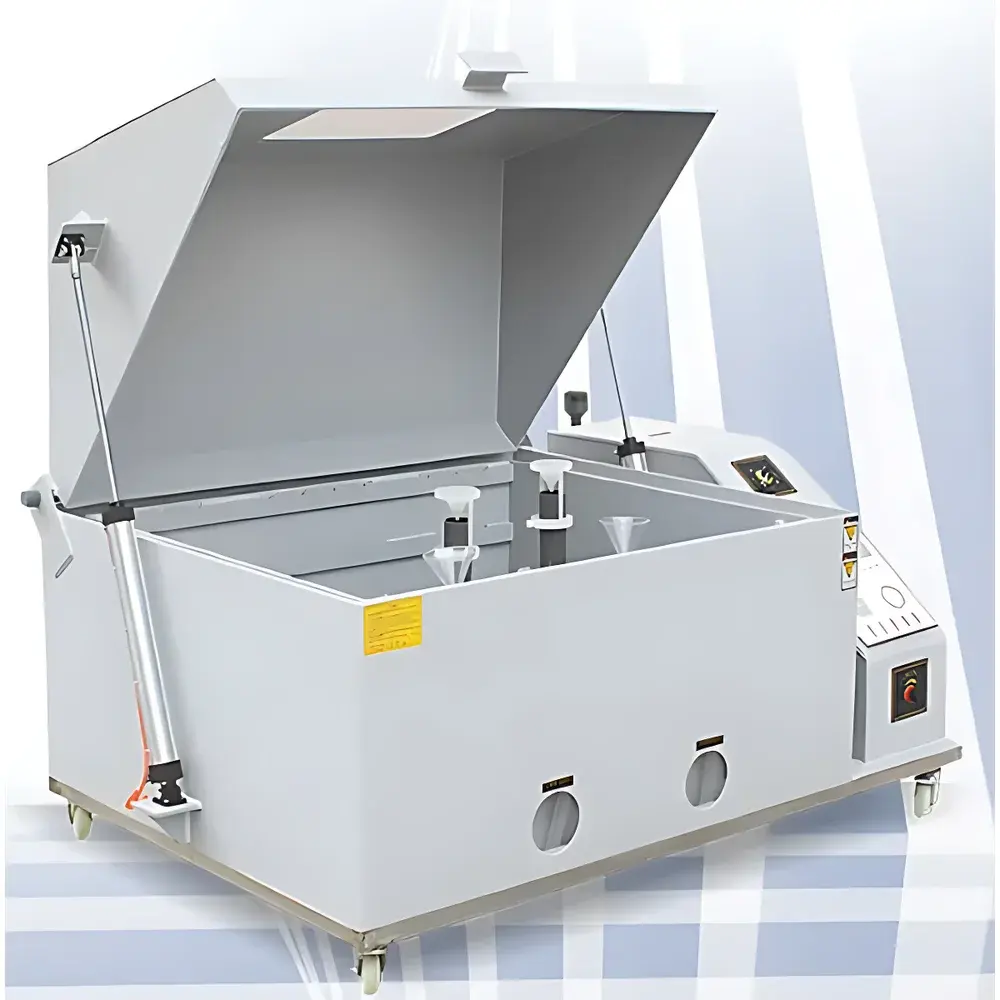
Jianhu SH-SST-600 Advanced Multi-Mode Salt Spray & Climate Cycling Test Chamber
| Brand | Jianhu |
|---|---|
| Origin | Shanghai, China |
| Model | SH-SST-600 |
| Spray Mode | Continuous & Cycled (Programmable) |
| Fog Output | 1.0–2.0 mL/(80 cm²·h) |
| Nozzle Pressure | 0.7–1.0 kg/cm² |
| De-fogging Method | Compressed-air-assisted exhaust |
| Temperature Range | –20°C to +60°C |
| Humidity Control | 30–98% RH (optional high-humidity mode) |
| Compliance | ISO 9227, ASTM B117, GB/T 2423.17, ISO 12944-5, IEC 60068-2-11 |
| Optional Coupling | Integrated vibration interface (20–100 Hz, up to 10 g), thermal cycling ramp rates: 3–5 °C/min |
Overview
The Jianhu SH-SST-600 Advanced Multi-Mode Salt Spray & Climate Cycling Test Chamber is an engineered solution for accelerated corrosion assessment of structural and functional metallic components under marine operational conditions. Unlike conventional single-factor salt spray chambers operating strictly per ASTM B117, the SH-SST-600 implements a physics-based multi-stress coupling architecture—integrating controlled NaCl aerosol generation, programmable thermal cycling (–20°C to +60°C), high-humidity saturation (>98% RH), and optional synchronized mechanical vibration—to replicate the electrochemical, thermo-mechanical, and hygroscopic degradation pathways observed on shipboard deck hardware.
This chamber is purpose-built for evaluating failure mechanisms in critical maritime assemblies—including carbon steel railings with fluorocarbon coatings, 316L stainless steel hatch cover fasteners, and welded anchor base plates—where chloride ion penetration, thermal fatigue-induced microcracking, and dynamic load-assisted delamination synergistically accelerate material degradation. Its design adheres to the mechanistic framework defined in ISO 12944-5 (Paints and varnishes — Corrosion protection of steel structures by protective paint systems) and supports accelerated test protocols aligned with real-world exposure severity indices derived from global oceanographic data (e.g., Northwest Pacific typhoon frequency, North Atlantic winter salinity gradients).
Key Features
- Multi-Mode Spray Control: Programmable operation between continuous fog (for severe marine simulation) and cyclic spray/air-dry sequences (e.g., 8 h spray / 16 h dry), enabling compliance with both ASTM B117 and ISO 9227 cyclic corrosion testing (CCT) standards.
- Wide Climate Envelope: Precise temperature control from –20°C to +60°C with ramp rates up to 5°C/min; humidity regulation from 30% to 98% RH using saturated steam injection and PID-controlled condensation management.
- High-Fidelity Fog Generation: Dual-nozzle system with pressure-regulated delivery (0.7–1.0 kg/cm²) ensures uniform deposition at 1.0–2.0 mL/(80 cm²·h); pH-adjustable salt solution reservoir (5.5–7.2) for simulating acidified stormwater or neutral seawater conditions.
- Modular Coupling Interface: Standardized mounting flange and signal synchronization port for integration with external electrodynamic shakers (20–100 Hz, ≤10 g), supporting combined salt fog + vibration protocols per MIL-STD-810H Method 514.7.
- Corrosion-Safe Construction: Interior chamber fabricated from PP-H (polypropylene homopolymer) and PVDF-coated stainless steel; non-corrosive PTFE-sealed solenoid valves, ceramic-tipped nozzles, and titanium-reinforced solution tanks ensure long-term stability in alkaline saline environments.
- Traceable Environmental Monitoring: Dual-channel calibrated sensors (Pt100 RTD + capacitive RH) with NIST-traceable certification; real-time logging of chamber ambient, sample surface, and fog saturation parameters.
Sample Compatibility & Compliance
The SH-SST-600 accommodates specimens up to 600 mm × 600 mm × 500 mm (W×D×H), supporting standardized test panels (ASTM G85 Annex A5), full-scale deck hardware (e.g., 300-mm-long railing sections, bolted flange assemblies), and multi-material coupons (steel/stainless/aluminum/rubber composites). All test configurations comply with GLP documentation requirements: automatic timestamped event logging, user-access-level audit trails, and electronic signature support for FDA 21 CFR Part 11 readiness.
Standard-compliant operation includes pre-conditioning cycles per ISO 20692 (marine coating qualification), salt concentration verification via conductivity titration (ISO 9227 Annex B), and post-test evaluation alignment with GB/T 1766–2008 (paint degradation rating) and ISO 4624 (adhesion pull-off testing). Optional accessories include corrosion current monitoring probes (for localized electrochemical analysis) and digital image-based corrosion mapping modules compatible with ASTM D610 grading algorithms.
Software & Data Management
Control and data acquisition are managed via Jianhu’s proprietary CorrVision Pro v3.2 software—a Windows-based platform compliant with IEC 62443-3-3 industrial cybersecurity standards. The interface enables full parameter scripting (temperature ramps, spray intervals, humidity setpoints, vibration triggers), real-time deviation alerts, and automated report generation conforming to ISO/IEC 17025 technical record requirements.
Data export supports CSV, XML, and PDF formats with embedded metadata (operator ID, calibration status, sensor drift compensation flags). Audit logs retain all user actions—including parameter overrides, manual interventions, and calibration events—for ≥10 years. Software validation packages (IQ/OQ/PQ documentation) and 21 CFR Part 11 configuration files are provided as standard deliverables for regulated laboratories.
Applications
- Maritime Structural Qualification: Accelerated life-cycle validation of deck railings, hatch covers, mooring bitts, and anchor windlass bases per classification society guidelines (DNV-RP-B401, ABS Steel Vessel Rules).
- Coating System Development: Screening fluoropolymer, epoxy-zinc, and ceramic hybrid coatings under coupled thermal-salt stress to quantify blistering onset, cathodic disbondment resistance, and interfacial adhesion retention.
- Weld Integrity Assessment: Detection of heat-affected zone (HAZ) susceptibility in austenitic stainless steels (e.g., 316L) through localized corrosion current density measurement (<0.05 μA/cm² threshold) during humid salt fog exposure.
- Material Selection Support: Comparative ranking of low-alloy steels, duplex stainless steels, and aluminum-magnesium alloys under scenario-specific protocols (e.g., “Typhoon Mode”: 5% NaCl, 40°C, 98% RH, 20–100 Hz vibration, 240 h duration).
- Regulatory Certification: Supporting evidence generation for IMO MSC.1/Circ.1212 compliance (corrosion resistance of lifesaving appliances) and EU Marine Equipment Directive (MED) type approval submissions.
FAQ
How does the SH-SST-600 differ from basic ASTM B117-compliant salt spray chambers?
It extends beyond static salt fog by integrating programmable thermal cycling, high-humidity saturation, and optional vibration coupling—enabling simulation of real-world marine degradation mechanisms rather than isolated chloride attack.
Can the chamber validate corrosion protection for rubber or polymer seals?
Yes—via low-concentration (3% NaCl) protocols with elevated temperature (60°C) and extended exposure (120 h), followed by leakage rate testing per ISO 13350 or ASTM D471 compatibility assessment.
Is third-party calibration and IQ/OQ documentation available?
Yes—factory-certified calibration certificates (traceable to NIM China), full installation qualification (IQ), operational qualification (OQ), and performance qualification (PQ) packages are included with each unit.
What maintenance intervals are recommended for long-term reliability?
Daily: nozzle inspection and solution tank cleaning; quarterly: sensor recalibration and pressure regulator servicing; annually: full chamber integrity verification and software security patching.
Does the system support remote monitoring and alarm notifications?
Yes—via secure HTTPS API integration with enterprise LIMS or SCADA systems; SMS/email alerts triggered by temperature deviation >±0.5°C, humidity loss >3% RH, or spray interruption >10 min.



