
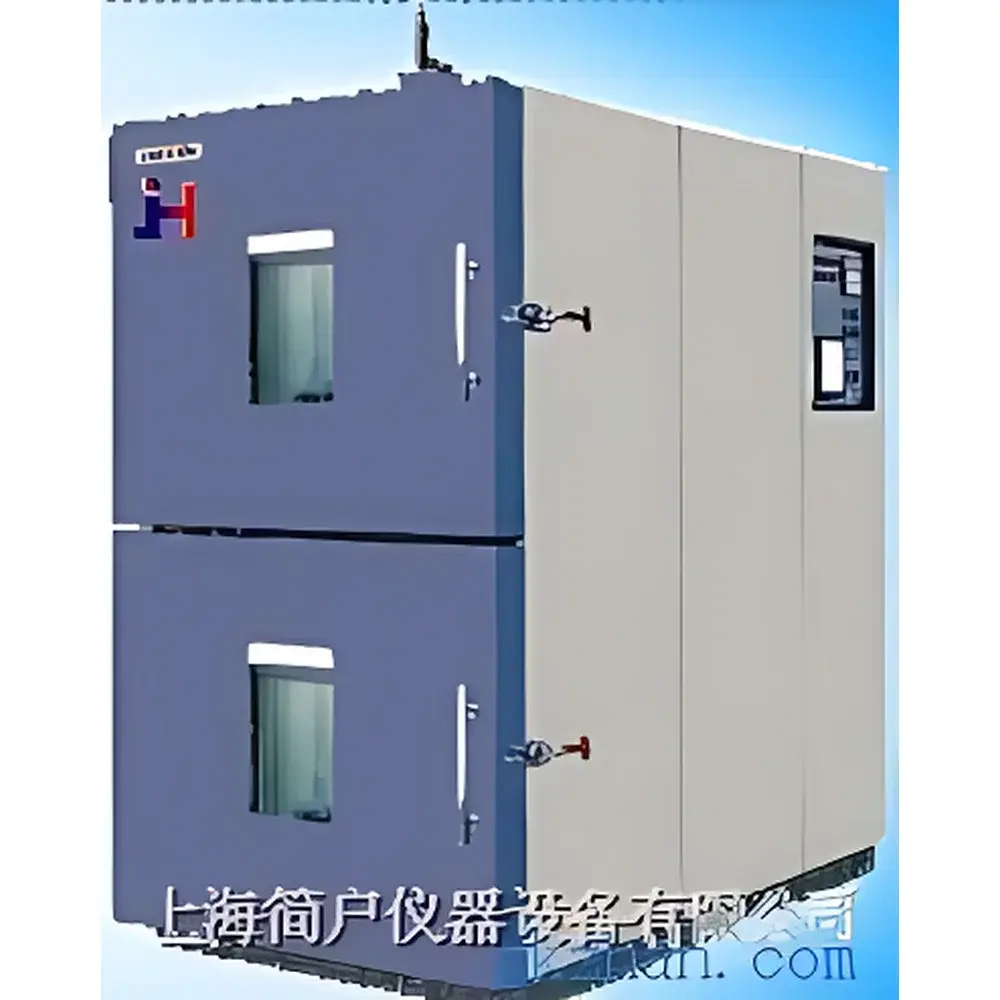
Jianhu TCT/TSG Series Thermal Shock Test Chamber
| Brand | Jianhu |
|---|---|
| Origin | Shanghai, China |
| Manufacturer Type | Authorized Distributor |
| Country of Origin | China |
| Model | TCT-301 to TCT-606 / TSG-301 to TSG-606 |
| High-Temperature Range | 80–200 °C |
| Low-Temperature Range | −10 to −35 °C (WST-30#), −60 °C (WST-50#), −70 °C (WST-60#) |
| Test Temperature Range | 60–150 °C / −10 to −35 °C, −60 °C, −70 °C |
| Temperature Uniformity | ±2 °C |
| Temperature Transition Time | ≤5 min |
| Internal Chamber Dimensions (W×H×D, cm) | 35×35×40 to 100×100×100 |
| External Dimensions (W×H×D, cm) | 160×190×140 to 280×220×200 |
| Control System | PLC-based microcomputer with LCD touchscreen interface (bilingual English/Chinese display) |
| Construction | Interior and exterior SUS304 stainless steel |
| Cold/Warm Zone Configuration | Dual-chamber or triple-chamber selectable |
| Refrigeration System | Twin-stage cascade refrigeration circuit with imported compressors and eco-friendly refrigerant (R404A/R23) |
| Optional Access Port | 50 mm diameter test port on left side |
Overview
The Jianhu TCT/TSG Series Thermal Shock Test Chamber is an industrial-grade environmental stress screening (ESS) system engineered for rapid, repeatable, and highly controlled temperature transitions between extreme thermal states. It operates on the principle of gas-coupled thermal shock, wherein test specimens remain stationary in a central test zone while high-velocity conditioned air—pre-chilled or pre-heated in dedicated cold/warm reservoirs—is rapidly switched via pneumatically actuated ducting. This architecture eliminates mechanical movement of samples, minimizing vibration-induced artifacts and ensuring measurement integrity during accelerated life testing. Designed to meet the rigorous demands of reliability engineering in electronics, automotive components, aerospace composites, and polymer-based assemblies, the chamber supports both two-zone (hot/cold) and three-zone (hot/cold/test) operational modes, enabling precise simulation of real-world thermal cycling stresses such as those encountered during solder joint fatigue, sealant delamination, or coefficient-of-thermal-expansion (CTE) mismatch failure.
Key Features
- Triple-zone modular design (high-temp chamber, low-temp chamber, and insulated test chamber) with independent PID-controlled temperature regulation for each zone
- PLC-driven control architecture with auto-tuning P.L.D. (Proportional-Integral-Derivative) algorithms ensuring stable setpoint maintenance within ±2 °C uniformity across the test volume
- LCD touchscreen HMI with bilingual (English/Chinese) interface supporting programmable multi-step profiles, real-time curve visualization, and event logging
- Cascade refrigeration system utilizing dual-compressor stages (imported from EU/US manufacturers) and environmentally compliant refrigerants (R404A/R23 blend) for reliable sub-zero operation down to −70 °C
- SUS304 stainless steel interior and exterior construction with electrostatic powder coating for corrosion resistance, ESD safety, and long-term dimensional stability
- Standard 50 mm diameter access port on the left sidewall, fitted with silicone gasket and clamping flange for seamless integration with external power supplies, data acquisition systems, or environmental monitoring sensors
- Compliance-ready firmware architecture supporting audit trails, user-level access control, and password-protected parameter modification—aligned with GLP and ISO/IEC 17025 documentation requirements
Sample Compatibility & Compliance
The TCT/TSG series accommodates a broad spectrum of sample geometries—from miniature IC packages and PCB assemblies to large-scale automotive harnesses and molded plastic housings—within its configurable internal volumes (35×35×40 cm to 100×100×100 cm). Its static test zone eliminates inertial loading, making it suitable for fragile MEMS devices, optoelectronic modules, and thin-film coated substrates where mechanical displacement must be avoided. The system is routinely deployed in laboratories adhering to ASTM D5229/D5229M (low-temperature impact resistance), IEC 60068-2-14 (change of temperature), MIL-STD-810H Method 503.5 (temperature shock), and JESD22-A104 (accelerated temperature cycling). While not certified to UL or CE as a standalone appliance, its subsystems—including refrigeration circuits, electrical enclosures, and control logic—conform to IEC 61000-6-2 (EMC immunity) and IEC 61000-6-4 (EMC emissions) standards.
Software & Data Management
The embedded control software provides full-cycle test management: profile definition (up to 99 segments per program), automatic transition timing calibration, deviation alarms with configurable thresholds, and timestamped data export in CSV format. All operational events—including door openings, compressor status changes, alarm triggers, and setpoint modifications—are recorded with millisecond resolution in non-volatile memory. Optional Ethernet or RS485 interfaces enable integration into centralized laboratory information management systems (LIMS) or SCADA platforms. For regulated environments, optional 21 CFR Part 11-compliant software add-ons are available, delivering electronic signatures, role-based permissions, and immutable audit logs traceable to individual operators and instrument IDs.
Applications
- Qualification testing of printed circuit boards (PCBs) and surface-mount technology (SMT) assemblies per IPC-9701
- Evaluation of thermal interface materials (TIMs), underfill epoxies, and conformal coatings under repeated expansion/contraction cycles
- Stress screening of lithium-ion battery cells and pack-level modules prior to BMS validation
- Verification of hermetic seal integrity in medical device enclosures and MEMS pressure sensors
- Accelerated aging studies of polymer adhesives, elastomeric gaskets, and composite laminates used in avionics housings
- Pre-conditioning of optical components (lenses, filters, laser diodes) prior to spectral or wavefront analysis
FAQ
What is the difference between two-zone and three-zone thermal shock configurations?
In two-zone mode, the test specimen alternates directly between hot and cold chambers; in three-zone mode, it remains stationary in a thermally isolated test chamber while conditioned air is routed from either reservoir—reducing thermal lag and improving repeatability.
Can the chamber be customized for non-standard internal dimensions?
Yes. Jianhu offers OEM engineering support for bespoke chamber volumes, specialized airflow manifolds, and custom port configurations upon request.
Does the system support automated data export to Excel or LIMS?
Yes. Native CSV export is standard; optional OPC UA or Modbus TCP protocols facilitate direct integration with enterprise lab systems.
Is remote monitoring possible via network connection?
Standard Ethernet connectivity enables web-based status viewing and basic parameter adjustment through a secure HTTP interface; advanced remote diagnostics require optional service contract.
What maintenance intervals are recommended for the refrigeration system?
Compressor oil and filter-drier replacement every 24 months; annual verification of refrigerant charge and cascade stage balance by certified HVAC-R technician.



