
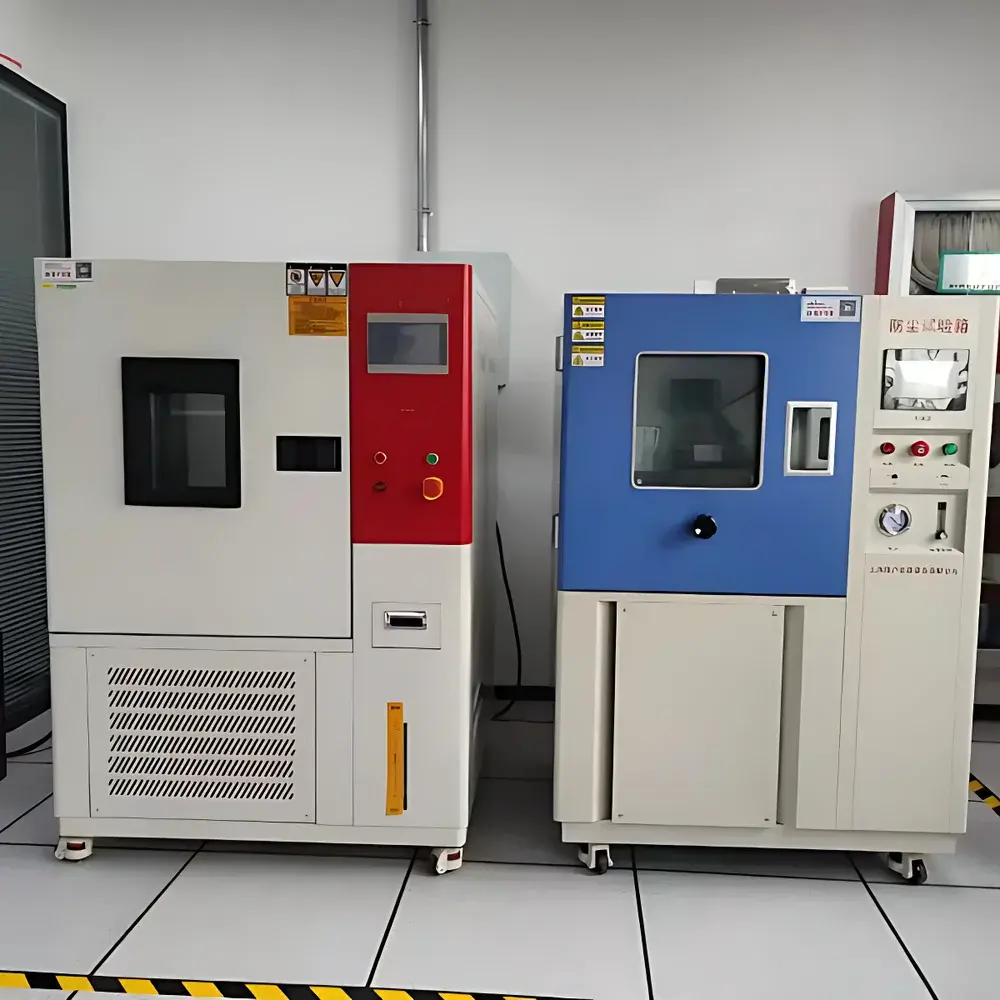
Jianhu Three-Zone Thermal Shock Test Chamber – Rapid Transfer for Semiconductor ICs & Industrial Sensors
| Brand | Jianhu |
|---|---|
| Origin | Shanghai, China |
| Model | Three-Zone Thermal Shock Test Chamber |
| Temperature Range | -70°C to +150°C |
| Refrigeration | Compressor-based |
| Explosion-Proof | Yes |
| Temperature Fluctuation | ±0.5°C |
| Temperature Uniformity | ±2.0°C |
| Temperature Deviation | ±2.0°C |
| Heating Time | ≤60 min (from -40°C to +150°C) |
| Cooling Time | ≤45 min / ≤60 min / ≤80 min (depending on configuration) |
| Chamber Dimensions | Customizable (non-standard) |
Overview
The Jianhu Three-Zone Thermal Shock Test Chamber is an engineered solution for high-fidelity, high-repetition thermal stress validation under extreme temperature transitions. Unlike conventional two-chamber systems relying on sequential heating/cooling of a single test space, this chamber employs a tri-zone architecture — comprising independent high-temperature, low-temperature, and test chambers — enabling true *mechanical transfer* of samples between thermally stabilized environments. This design eliminates thermal inertia delays inherent in single-chamber cycling, achieving transfer times as low as 10–30 seconds and thermal transition rates up to 20°C/min. The system operates on the principle of *controlled thermal shock*, defined by rapid, repeatable exposure to discrete, stable temperature extremes — a critical requirement for qualifying electronic components against JEDEC JESD22-A104 (Temperature Cycling), IEC 60068-2-14 (Change of Temperature), and MIL-STD-810H Method 503.4. Its robust thermal control architecture ensures stability within ±0.5°C fluctuation and uniformity across the working volume within ±2.0°C, supporting up to 5,000 programmable cycles with reproducibility better than ±1.2% (per cycle-to-cycle deviation).
Key Features
- Tri-zone independent thermal control: High-temp chamber (up to +180°C), low-temp chamber (down to -80°C), and insulated test chamber — eliminating cross-contamination and thermal lag.
- Pneumatically actuated sample transfer mechanism with fail-safe interlock, ensuring precise positioning and zero thermal overshoot during transitions.
- Explosion-proof construction compliant with IEC 60079-0 and GB 3836.1 standards, suitable for testing sensors and modules in hazardous process environments.
- Compressor-based refrigeration with cascade staging for stable sub-zero operation down to -70°C, optimized for rapid cooldown without oil carryover or frost accumulation.
- Programmable multi-step thermal profiles: Supports ramp-hold-soak sequences, dwell time control, and conditional logic triggers (e.g., initiate next step upon temperature stabilization).
- Real-time thermal mapping capability via optional calibrated PT100 sensor array (up to 9 points), traceable to NIST standards.
Sample Compatibility & Compliance
The chamber accommodates semiconductor packages (QFP, BGA, CSP, SiC MOSFETs, IGBT modules), automotive-grade MCUs, MEMS pressure/temperature sensors, and industrial transducers used in metallurgy, petrochemical, and power generation applications. It meets functional requirements for JEDEC JESD22-A104 (Temperature Cycling), IEC 60068-2-14 (Change of Temperature), and ASTM F1879 (Standard Practice for Thermal Cycling of Microelectronic Packages). Optional humidity integration enables combined thermal-hygrothermal stress testing per IEC 60068-2-30 (Damp Heat, Cycle). All control firmware supports audit trails and electronic signatures aligned with FDA 21 CFR Part 11 and GLP/GMP data integrity requirements.
Software & Data Management
Equipped with Jianhu’s proprietary WinTestPro v4.2 software, the system provides full IEC 62443-compliant HMI with role-based access control (operator, engineer, administrator). Software features include: real-time multi-channel temperature logging at 1 Hz resolution; automatic generation of PDF test reports with embedded calibration certificates; CSV export compatible with MATLAB, JMP, and Minitab; configurable alarm thresholds with email/SMS notification via SMTP/Modbus TCP; and built-in compliance templates for ISO/IEC 17025 accredited labs. All raw data files are stored with SHA-256 hash verification and timestamped metadata, supporting full traceability from test initiation to final report sign-off.
Applications
- Semiconductor reliability screening: Validating solder joint integrity, die attach delamination, and wire bond fatigue under repeated -55°C ↔ +125°C transitions — essential for AEC-Q100 Grade 0 qualification.
- Power electronics validation: Assessing thermal resistance shift and VCE(sat) drift in IGBTs under simultaneous thermal shock and DC bias loading (via optional external power supply interface).
- Industrial sensor qualification: Simulating cold-start-to-hot-operation scenarios for RTDs, thermocouples, and piezoresistive pressure sensors deployed in steel mills or refinery control loops.
- Optoelectronic module testing: Evaluating hermetic seal integrity and wavelength drift in laser diodes and photodetectors exposed to rapid ambient shifts.
- Material compatibility studies: Screening encapsulants, underfills, and conformal coatings for coefficient-of-thermal-expansion (CTE) mismatch-induced microcracking.
FAQ
What distinguishes a three-zone thermal shock chamber from a two-zone system?
A three-zone design decouples temperature stabilization from sample exposure: the test chamber remains at ambient or neutral temperature while samples are physically transferred between pre-conditioned hot and cold zones. This eliminates thermal recovery time, enabling faster cycle rates, tighter temperature control, and higher repeatability.
Can the chamber be integrated into an automated test line?
Yes — it supports RS-485 (Modbus RTU), Ethernet/IP, and optional SECS/GEM protocol stacks for seamless integration with MES, SCADA, and robotic handling systems.
Is calibration documentation provided with delivery?
Each unit ships with a factory calibration certificate traceable to CNAS-accredited laboratories, including as-found/as-left data for all critical sensors and actuators.
What maintenance intervals are recommended?
Compressor oil and filter replacement every 2,000 operating hours; annual verification of door gasket integrity, pneumatic valve response time, and thermal sensor linearity per ISO/IEC 17025 Annex A.2.
Does the system support remote monitoring and diagnostics?
Yes — via secure HTTPS web interface with TLS 1.2 encryption, allowing real-time status viewing, log download, and predictive fault alerts based on compressor current harmonics and refrigerant pressure trends.



