
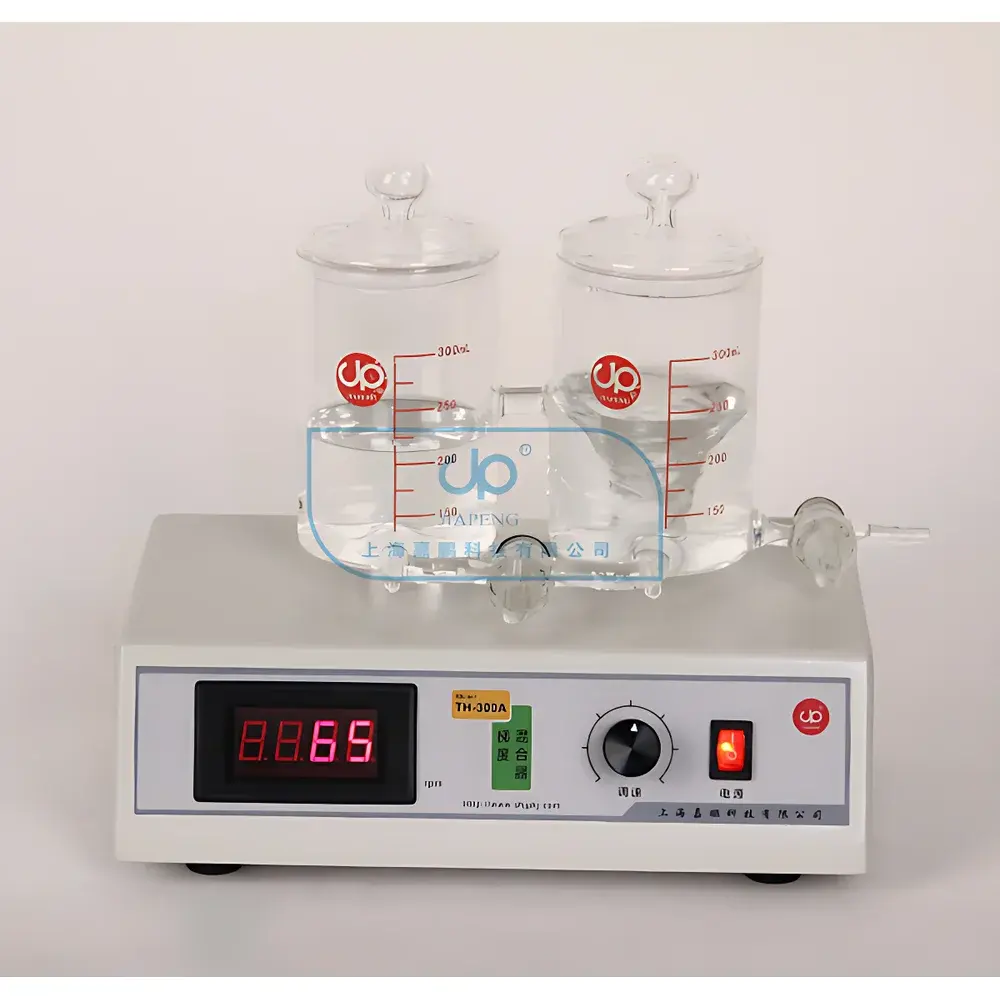
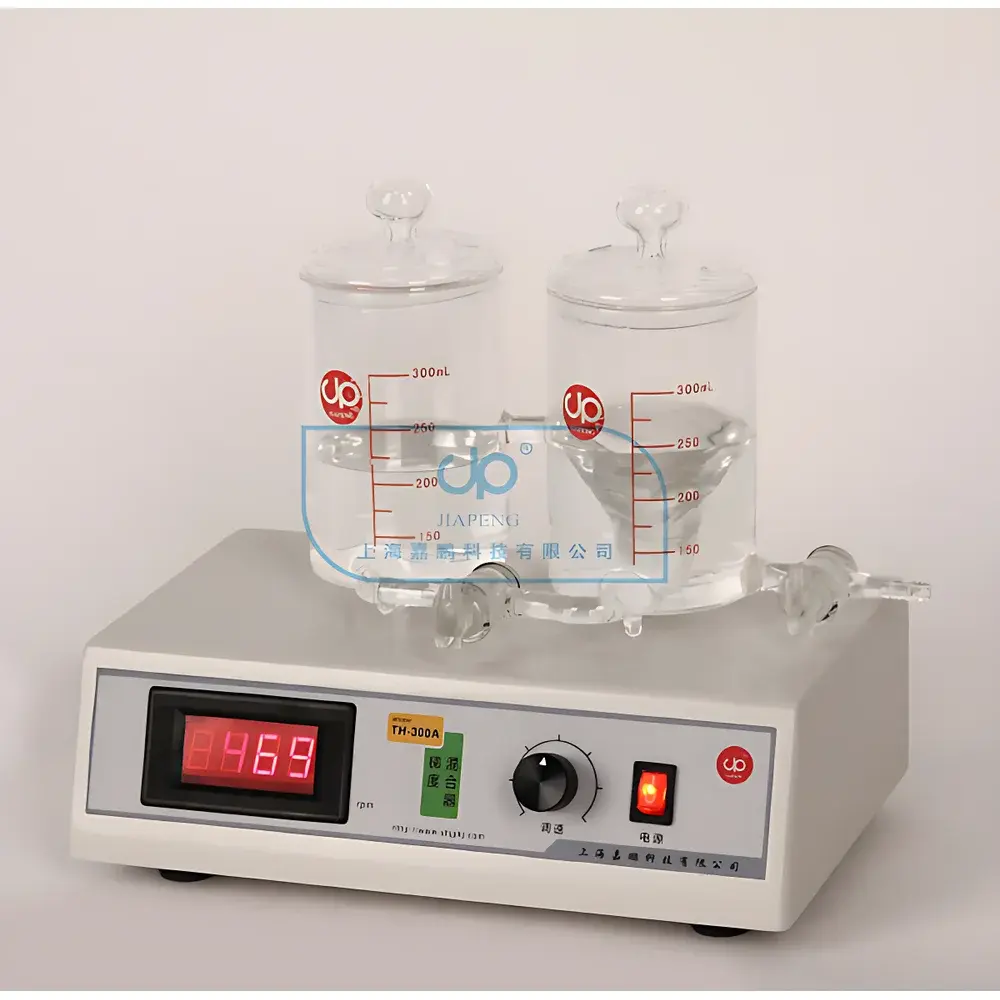
Jiapeng TH-300A Gradient Mixer
| Brand | Jiapeng |
|---|---|
| Model | TH-300A |
| Gradient Volume | 600 mL |
| Gradient Profile | Linear |
| Solvent Compatibility | Organic-solvent resistant |
| Display | LED digital speed indicator |
| Power Supply | AC 220 V, 50/60 Hz |
| Dimensions (W×D×H) | 270 × 170 × 90 mm |
| Weight | 1.2 kg |
| Instrument Type | Magnetic Stirrer-Integrated Gradient Mixer |
Overview
The Jiapeng TH-300A Gradient Mixer is a precision-engineered laboratory instrument designed for controlled, time-dependent generation of linear solvent or concentration gradients in analytical and preparative applications. It operates on the principle of dual-reservoir volumetric displacement, where two independently adjustable peristaltic or gravity-fed streams—typically representing concentrated and diluted solutions—are combined at a precisely regulated flow ratio. This enables reproducible linear gradient formation over a defined volume range (up to 600 mL), essential for techniques such as column chromatography (e.g., flash, HPLC method development), pH titration profiling, and multi-step extraction protocols. Unlike fixed-ratio mixers, the TH-300A maintains dynamic equilibrium between reservoirs through synchronized motor-driven impeller rotation and calibrated outflow control, ensuring minimal dead volume and high gradient fidelity. Its organic-solvent-resistant construction—including chemically inert tubing paths, PTFE-coated internal components, and sealed drive mechanisms—ensures long-term operational integrity when handling acetonitrile, methanol, chloroform, ethyl acetate, and other common organic eluents.
Key Features
- Linear gradient generation up to 600 mL with continuously adjustable slope via independent flow rate control of both input reservoirs
- Dual-function design: operates as a standalone magnetic stirrer (with external magnetic stir bar) or as a gradient mixer with integrated stirring capability
- LED digital display showing real-time rotational speed (rpm) of the mixing mechanism, enabling precise correlation between motor output and gradient delivery rate
- Chemically resistant housing and fluid pathway materials compliant with ISO 8573-1 Class 4 particulate standards for lab-grade solvent handling
- Compact benchtop footprint (270 × 170 × 90 mm) optimized for fume hood integration and space-constrained analytical workstations
- AC 220 V, 50/60 Hz universal power input with internal voltage regulation and thermal overload protection
Sample Compatibility & Compliance
The TH-300A is validated for use with aqueous buffers, acidic/basic aqueous solutions, and common organic solvents including but not limited to methanol, ethanol, isopropanol, acetonitrile, tetrahydrofuran (THF), dichloromethane (DCM), and ethyl acetate. All wetted surfaces are constructed from PTFE, borosilicate glass (optional reservoir adapters), and EPDM-free elastomers to prevent leaching or swelling. The device conforms to IEC 61010-1:2010 safety requirements for electrical equipment used in laboratory environments. While not certified under GLP or GMP frameworks per se, its repeatable gradient output supports method validation per ASTM E2656 (Standard Practice for Validation of Liquid Chromatography Systems) and facilitates documentation of mixing parameters required for SOP-based workflows in QC/QA laboratories.
Software & Data Management
The TH-300A is a manually operated, analog-controlled instrument without embedded firmware or digital connectivity. Gradient parameters—including target volume, approximate linear slope, and nominal rpm—are set via front-panel mechanical dials and verified via the LED digital readout. For traceability in regulated environments, users are advised to record operational settings in laboratory notebooks or electronic lab notebooks (ELNs) alongside chromatographic or separation run logs. No data export, USB interface, or remote control capability is provided; this design prioritizes mechanical reliability, electromagnetic interference (EMI) immunity, and compatibility with sensitive detection systems (e.g., UV-Vis, MS detectors) in shared instrumentation suites.
Applications
- Method development for reversed-phase and normal-phase flash chromatography
- Preparative fractionation of natural product extracts requiring gradual polarity shifts
- pH gradient generation in ion-exchange chromatography and electrophoresis buffer preparation
- Controlled co-solvent addition in crystallization studies and polymorph screening
- In situ dilution series preparation for calibration curve generation in spectrophotometric assays
- Stirring-assisted dissolution testing of poorly soluble compounds under gradient solvent conditions
FAQ
Can the TH-300A generate non-linear (e.g., concave or convex) gradients?
No—the TH-300A is mechanically configured for linear gradient output only. Non-linear profiles require programmable pump systems or third-party gradient controllers.
Is the unit compatible with vacuum or pressurized systems?
It is designed for ambient-pressure, gravity- or low-head pressure-driven operation only. Integration with vacuum manifolds or pressurized reservoirs is not supported and may compromise seal integrity.
What maintenance is required for long-term organic solvent use?
Routine inspection of tubing elasticity, cleaning of the magnetic coupling zone with IPA, and periodic replacement of O-rings (recommended annually under continuous use) are advised.
Does the TH-300A meet FDA 21 CFR Part 11 requirements?
No—it lacks audit trail, electronic signature, and secure user access controls required for Part 11 compliance. It is intended for research-use-only or non-GxP environments.
Can it be used with corrosive acids or strong bases?
Yes, within concentration limits typical for HPLC mobile phases (e.g., ≤0.1% TFA, ≤50 mM phosphate buffer, ≤0.1 M NaOH); prolonged exposure to >1 M HCl or concentrated H₂SO₄ is not recommended.



