
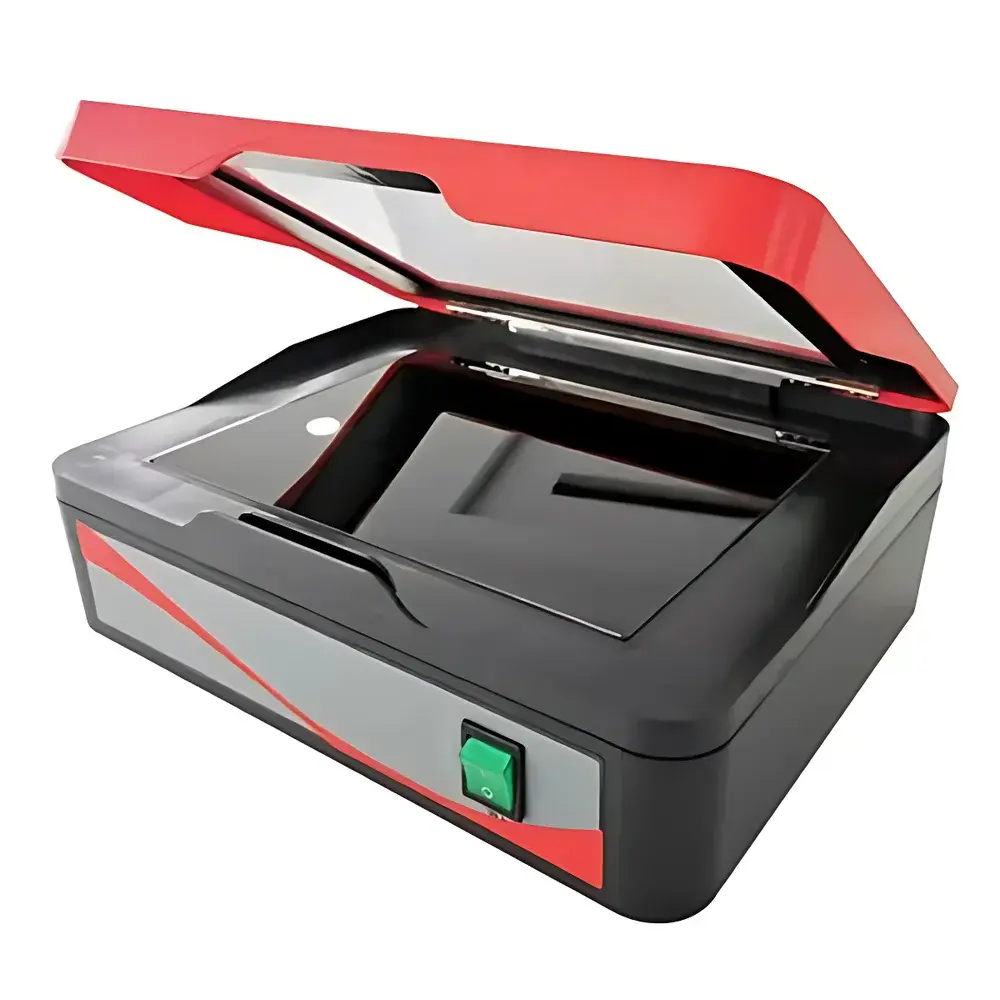
Jiapeng UV-1000 UV Transilluminator and Gel Cutter
| Brand | Jiapeng |
|---|---|
| Origin | Shanghai, China |
| Model | UV-1000 |
| Instrument Type | Benchtop |
| UV Wavelength | 302 nm (transmission) |
| UV Lamp Configuration | Eight 8 W low-pressure mercury lamps |
| UV Transmission Area | 200 × 250 mm |
| UV Filter Dimensions | 200 × 200 mm |
| Power Consumption | 64 W |
| UV Intensity | ≥20 µW/cm² at 20 cm distance (per JJF 1936–2021) |
| Cut Window UV Blocking Efficiency | >99% |
| Input Voltage | AC 220 V, 50/60 Hz |
| Dimensions (L×W×H) | 325 × 260 × 140 mm |
| Net Weight | 2.3 kg |
| Compliance | Designed and validated per JJF 1936–2021 “Verification Regulation for UV Analyzers” |
Overview
The Jiapeng UV-1000 UV Transilluminator and Gel Cutter is a benchtop dual-function instrument engineered for precise visualization, documentation, and excision of nucleic acid bands in agarose and polyacrylamide gels. It operates on the principle of ultraviolet-induced fluorescence: ethidium bromide (EtBr), SYBR Safe, GelRed, and other DNA-intercalating fluorophores absorb 302 nm UV light and emit visible orange-red fluorescence, enabling sensitive detection of dsDNA, ssDNA, RNA, and certain proteins under controlled illumination. Unlike broad-spectrum UV sources, the UV-1000 employs eight calibrated 8 W low-pressure mercury lamps with narrow-band 302 nm emission—optimized for maximum fluorophore excitation while minimizing DNA photodamage during routine gel inspection and band isolation. Its integrated transilluminator platform provides uniform irradiance across a 200 × 250 mm active area, conforming to the metrological requirements defined in JJF 1936–2021—the national verification regulation for UV analyzers in China, of which Jiapeng was a contributing drafting enterprise.
Key Features
- Stable 302 nm UV transmission source: Eight synchronized 8 W mercury-vapor lamps deliver consistent spectral output, validated to maintain ≥20 µW/cm² intensity at 20 cm working distance per JJF 1936–2021.
- Dual-mode operation: Simultaneous transillumination (302 nm) and side-mounted UV cut windows with >99% UV attenuation, allowing real-time visual monitoring during gel excision without exposure risk.
- Integrated dark chamber: Molded one-piece ABS enclosure eliminates ambient light interference; no external darkroom required for high-contrast imaging or low-background detection.
- Gel-cutting workstation: Includes one ergonomic cutting handle with four interchangeable stainless-steel blades (two straight, two curved), designed for reproducible excision of discrete bands while preserving adjacent lanes.
- Metrologically traceable design: Complies with national verification protocols; certified UV filter dimensions (200 × 200 mm) and lamp alignment ensure spatial uniformity and long-term radiometric stability.
Sample Compatibility & Compliance
The UV-1000 supports standard electrophoretic matrices including 0.8–2.0% agarose and 8–15% polyacrylamide gels stained with EtBr, SYBR Gold, GelGreen, or similar intercalators. It is routinely deployed in molecular biology workflows aligned with ISO/IEC 17025-accredited laboratories, where documented UV source performance is essential for method validation. While not FDA 21 CFR Part 11–compliant by default (as it lacks electronic audit trails or user authentication), its optical configuration satisfies prerequisite conditions for GLP/GMP-aligned nucleic acid analysis—particularly in QC labs performing PCR product verification, restriction digest confirmation, or DNA fingerprinting. All UV components meet RoHS Directive 2011/65/EU restrictions on hazardous substances.
Software & Data Management
The UV-1000 is a hardware-only instrument with no embedded software or digital connectivity. Image acquisition is performed externally using DSLR or scientific CMOS cameras mounted on optional tripod adapters (not included). Users are advised to employ calibrated camera settings (manual white balance, fixed ISO, shutter speed ≥1/30 s) and post-capture tools such as ImageJ or Fiji for band intensity quantification, background subtraction, and molecular weight estimation. For regulated environments, laboratory SOPs should define camera calibration frequency, lens cleaning protocols, and image metadata retention—including date/time stamp, exposure parameters, and operator ID—to support data integrity under ALCOA+ principles.
Applications
- Nucleic acid gel documentation: Routine visualization and photography of DNA/RNA bands post-electrophoresis.
- PCR product verification: Confirmation of amplicon size and specificity prior to cloning or sequencing.
- RFLP and DNA fingerprinting: High-resolution band pattern analysis for genotyping and forensic applications.
- Gel extraction preparation: Precise excision of target fragments for subsequent purification and downstream enzymatic processing (e.g., ligation, TA cloning).
- Thin-layer chromatography (TLC) and paper chromatography: Detection of UV-active compounds including nucleotides, amino acids, and small-molecule metabolites.
FAQ
Is the UV-1000 suitable for use with SYBR Safe or other non-EtBr dyes?
Yes—its 302 nm output aligns closely with the excitation maxima of SYBR Safe, GelRed, and GelGreen, delivering strong signal-to-noise ratios without requiring wavelength adjustment.
Does the instrument include safety interlocks or motion sensors?
No—it relies on passive engineering controls: a fully enclosed ABS dark box and >99% UV-blocking cut window. Operators must wear ANSI Z87.1-rated UV-protective eyewear and nitrile gloves during active use.
Can the UV lamps be replaced individually?
Yes—lamps are socket-mounted and field-replaceable using standard Phillips-head tools; replacement lamps must match original spectral output (302 nm ±2 nm) and wattage (8 W) to preserve metrological conformity.
What maintenance is required to sustain JJF 1936–2021 compliance?
Annual radiometric verification using a NIST-traceable UV radiometer is recommended; filter surfaces should be cleaned weekly with lint-free wipes and isopropanol to prevent transmission loss from dust or residue buildup.






