
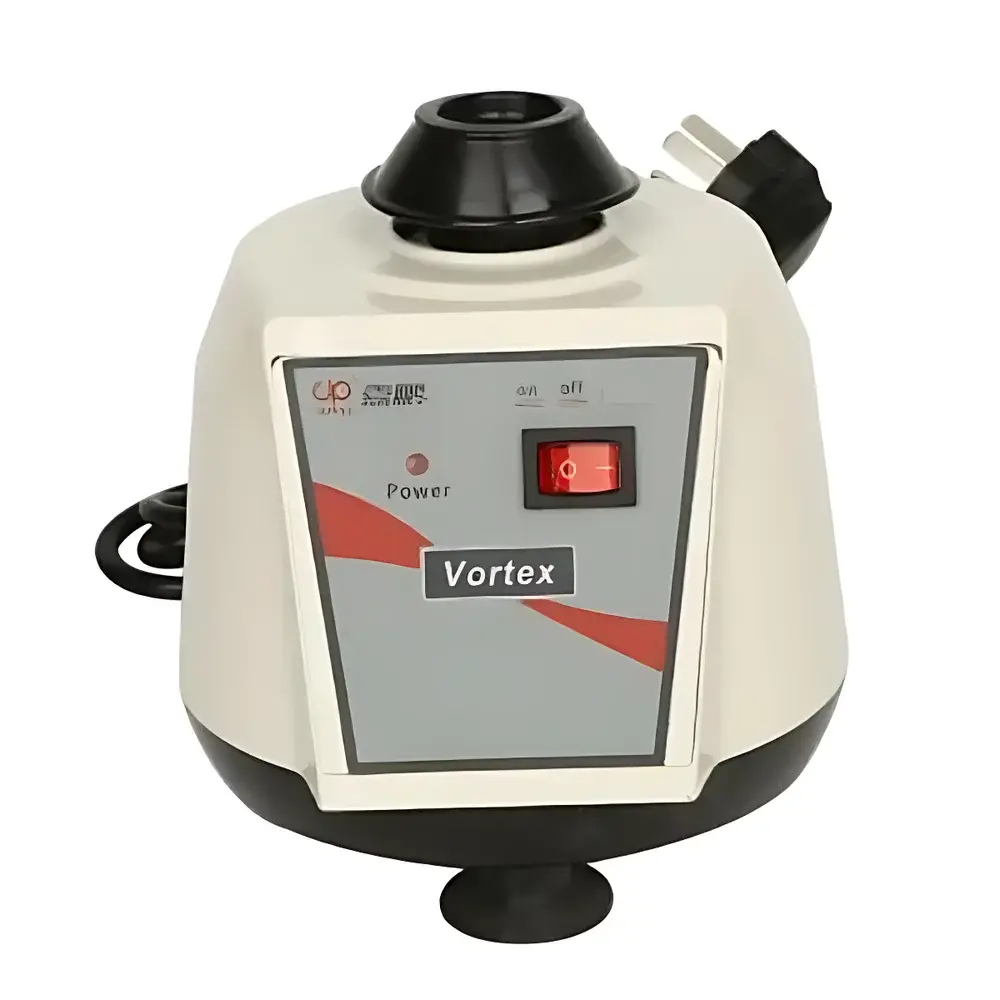
Jiapeng Vortex-2 Orbital Shaker
| Brand | Jiapeng |
|---|---|
| Origin | Shanghai, China |
| Model | Vortex-2 |
| Instrument Type | Orbital Vortex Mixer |
| Operating Mode | Continuous Operation |
| Speed Range | 0–2800 rpm |
| Oscillation Frequency | 50/60 Hz |
| Orbital Diameter | 4.5 mm |
| Motor Input Power | 60 W |
| Motor Output Power | 10 W |
| Ambient Temperature Range | 5–40 °C |
| Platform Type | Single Flat Platform |
| Platform Material | Wear-Resistant Rubber Surface |
| Housing Material | Reinforced Engineering Plastic (Acid/Alkali Resistant, Impact Resistant) |
| IP Rating | IP56 |
| Voltage | 198–242 V AC |
| Dimensions (W×D×H) | 140 × 145 × 145 mm |
| Net Weight | 1.75 kg |
| Compliance | Designed for GLP-compliant laboratory environments |
Overview
The Jiapeng Vortex-2 Orbital Shaker is a compact, high-reliability vortex mixer engineered for consistent, reproducible sample homogenization in life science laboratories. It operates on the principle of orbital motion—generating controlled circular displacement of the platform to induce turbulent mixing within tubes and vials via inertial forces. With a nominal orbital diameter of 4.5 mm and a speed range spanning 0–2800 rpm, the Vortex-2 delivers efficient suspension of particulates, re-suspension of pellets, and uniform dispersion of reagents across microcentrifuge tubes (0.2–10 mL), PCR strips, and multi-well plates when used with optional adapters. Its continuous-operation design supports unattended incubation-integrated mixing protocols, making it suitable for routine applications in molecular biology, clinical diagnostics, immunoassay preparation, and radioisotope handling workflows where mechanical consistency and thermal stability are critical.
Key Features
- Single flat platform constructed from wear-resistant rubber, optimized for secure tube retention and minimized vibration transmission to adjacent equipment
- Reinforced engineering plastic housing rated IP56—providing protection against dust ingress and low-pressure water jets, enabling safe operation in humid or splash-prone lab zones
- Thermally stable motor assembly with 10 W output power and 60 W input rating, designed for sustained duty cycles without thermal derating in ambient conditions of 5–40 °C
- Fixed-frequency drive (50/60 Hz) ensuring stable rotational timing under variable line voltage (198–242 V AC), minimizing speed drift during extended use
- No digital display or programmable timer—engineered for simplicity, reliability, and reduced electromagnetic interference in sensitive instrumentation areas
- Modular accessory compatibility: supports standardized adapter plates for 0.2 mL, 0.5 mL, 1.5 mL, 2.0 mL, 5 mL, and 10 mL tubes, as well as 96-well plate holders (sold separately)
Sample Compatibility & Compliance
The Vortex-2 accommodates standard conical-bottom and round-bottom microcentrifuge tubes, snap-cap vials, and PCR strip carriers. Its orbital motion profile ensures effective mixing without foaming or excessive shear in viscous or protein-rich solutions—validated for use with ELISA buffers, cell lysates, antibody diluents, and radiolabeled tracer preparations. While not certified to IEC 61000-4 electromagnetic compatibility standards out-of-box, its passive control architecture minimizes RF emissions. The device is intended for use in laboratories adhering to Good Laboratory Practice (GLP) frameworks; users may establish instrument-specific calibration intervals per ISO/IEC 17025 requirements using external tachometric verification. No built-in audit trail or user authentication—suitable for non-GxP environments or as a secondary mixing tool within GMP-controlled facilities where procedural controls govern usage logs.
Software & Data Management
The Vortex-2 operates as a standalone analog instrument with no embedded firmware, network interface, or data logging capability. This architecture eliminates cybersecurity vulnerabilities, firmware update dependencies, and software validation overhead—aligning with risk-based validation strategies outlined in FDA Guidance for Industry: General Principles of Software Validation (2005). All operational parameters (speed, duration, tube type) must be documented manually or integrated into electronic lab notebook (ELN) systems via SOP-defined entry fields. For laboratories requiring 21 CFR Part 11 compliance, external time-stamped video recording or calibrated handheld tachometer logs may serve as objective evidence of mixing parameters during audits.
Applications
- Resuspension of lyophilized reagents and bacterial pellets prior to downstream analysis
- Homogenization of immunoassay reaction mixtures in ELISA and lateral flow assay development
- Pre-analytical mixing of whole blood, serum, or plasma samples prior to centrifugation or nucleic acid extraction
- Dispersion of nanoparticles and colloidal suspensions in nanomedicine formulation studies
- Radioimmunoassay (RIA) sample preparation involving iodinated tracers, where mechanical consistency reduces inter-assay variability
- Supporting automated liquid handlers by pre-mixing master mixes before dispensing into assay plates
FAQ
Does the Vortex-2 support timed operation or programmable cycles?
No. The unit operates exclusively in continuous mode with manual start/stop control. Timer functionality is not integrated and must be managed externally.
Is the platform temperature-controlled?
No. The Vortex-2 does not include active heating or cooling elements. Ambient temperature must be maintained between 5–40 °C per specifications.
Can the Vortex-2 be used with deep-well plates or 15 mL conical tubes?
Not natively. Only accessories explicitly validated for orbital shakers—including shallow-well adapters and low-profile tube holders—are recommended. Deep-well plates require higher torque platforms and are incompatible.
What maintenance is required?
Periodic inspection of platform adhesion surface for wear or residue buildup; cleaning with 70% ethanol or isopropanol; no lubrication or internal servicing is specified by the manufacturer.
Is calibration documentation provided?
No factory calibration certificate is included. Users are responsible for establishing and verifying speed accuracy using NIST-traceable tachometers at installation and at defined intervals per internal quality procedures.




