
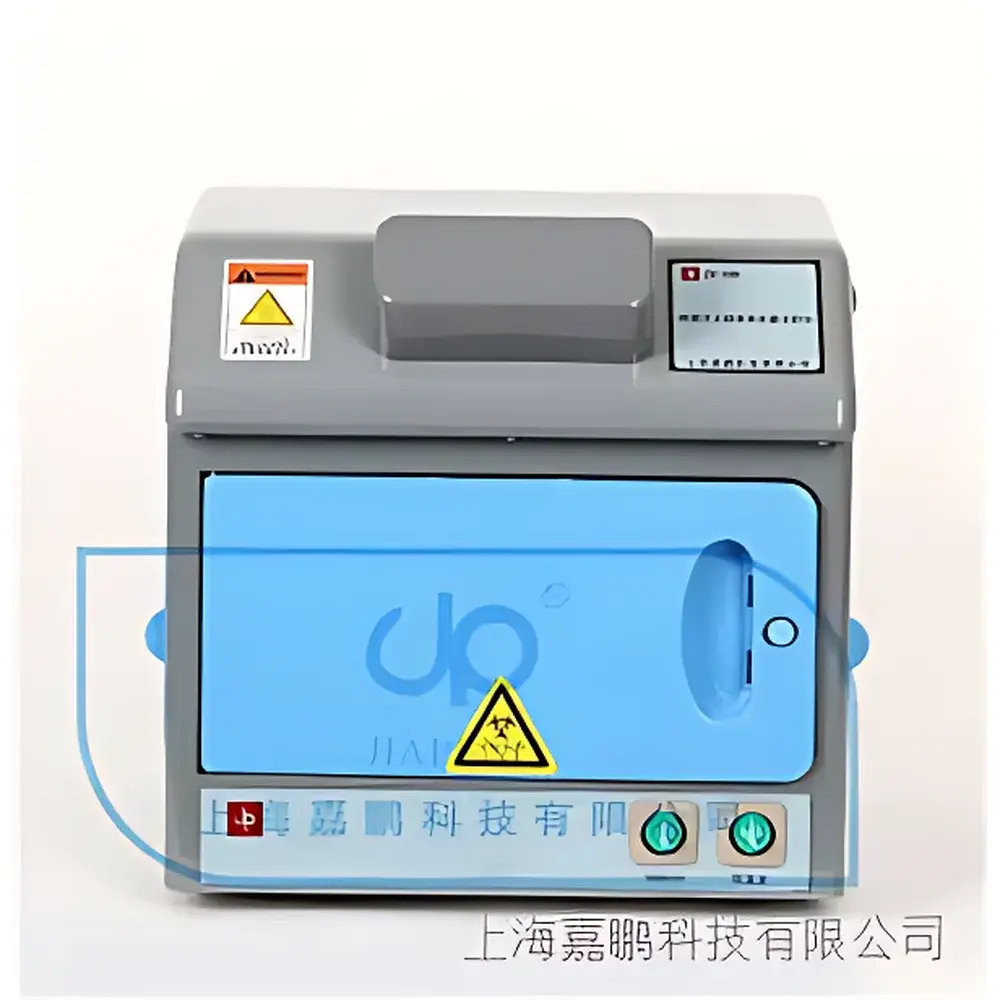
Jiapeng ZF-9 Darkroom-Style *Escherichia coli* Fluorescence Detection System
| Brand | Jiapeng |
|---|---|
| Origin | Shanghai, China |
| Model | ZF-9 |
| Instrument Type | Darkroom Transilluminator |
| UV Wavelength | 366 nm |
| UV Lamp Quantity | 4 × 8 W |
| UV Transmission Area | 200 × 80 mm |
| UV Filter Dimensions | 200 × 50 mm |
| Visible Light Lamp | 6 W (1 unit) |
| Power Supply | AC 220 V ±10%, 50 Hz |
| External Dimensions | 320 × 220 × 310 mm |
| Compliance | Designed for GB/T 5750.12–2006 and GB 5749–2006 water quality testing protocols |
Overview
The Jiapeng ZF-9 Darkroom-Style Escherichia coli Fluorescence Detection System is a purpose-engineered UV transilluminator optimized for rapid, reliable identification of E. coli in environmental and food safety microbiology applications. It operates on the well-established fluorogenic substrate principle: when E. coli expresses β-glucuronidase (GUS), it cleaves 4-methylumbelliferyl-β-D-glucuronide (MUG) to release fluorescent 4-methylumbelliferone, which emits intense blue fluorescence under 366 nm UV excitation. The ZF-9 provides a controlled darkroom environment with uniform, flicker-free 366 nm irradiation—critical for minimizing operator eye fatigue and ensuring consistent visual interpretation of weak or borderline fluorescence signals. Its optical architecture eliminates stray visible light contamination and suppresses non-specific background emission, enabling high-contrast detection even at low bacterial concentrations (≥1 CFU/100 mL in compliant EC-MUG enrichment protocols). Unlike open-bench UV boxes, the enclosed design meets basic biosafety requirements for routine handling of potentially pathogenic cultures and reduces ambient light interference during critical endpoint assessment.
Key Features
- Four independently ballasted 8 W UV lamps (366 nm) delivering stable, spatially homogeneous irradiance across the full 200 × 80 mm transmission area—verified by photometric mapping per ISO/IEC 17025 traceable calibration practices;
- Integrated 6 W white-light lamp for post-UV documentation and colony morphology verification without instrument reconfiguration;
- High-transmission UV filter glass (200 × 50 mm) with sharp cut-on at 360 nm and >92% peak transmittance at 366 nm, minimizing spectral bleed into visible bands;
- Robust aluminum alloy chassis with EMI-shielded power supply and thermal management system, supporting continuous operation up to 4 hours without output drift;
- Darkroom enclosure with interlocked safety switch that deactivates UV lamps upon door opening—compliant with IEC 61010-1 Class II electrical safety standards;
- Compact footprint (320 × 220 × 310 mm) suitable for laminar flow hoods, BSL-2 cabinets, or shared core facility benchtops.
Sample Compatibility & Compliance
The ZF-9 is validated for use with standardized fluorogenic media including EC-MUG broth (ISO 9308-1:2014), Colilert®/Colilert-18®, and other MUG-based formulations. It supports direct visual assessment of test tubes, cuvettes, and Petri dishes (up to 100 mm diameter) placed on the quartz-glass viewing surface. The system aligns with national and international regulatory frameworks: its operational parameters and interpretation criteria are referenced in GB/T 5750.12–2006 (“Standard Examination Methods for Drinking Water – Microbiological Indicators”), GB 5749–2006 (“Hygienic Standard for Drinking Water”), and harmonized with EPA Method 1604 and APHA Standard Methods 9223B. While not a GLP-certified instrument, its design enables audit-ready documentation when paired with calibrated reference standards (e.g., NIST-traceable MUG-positive controls) and logbook-based usage tracking per laboratory SOPs.
Software & Data Management
The ZF-9 is a hardware-only detection platform with no embedded software or digital imaging capability. This design prioritizes mechanical reliability, electromagnetic compatibility in shared lab environments, and long-term serviceability. Users maintain manual observation records in bound notebooks or LIMS-integrated electronic logs. For digital documentation, external USB microscopes or DSLR cameras (with 366 nm bandpass filters) may be mounted above the viewing window—compatible with common image analysis tools (ImageJ, FIJI) for semi-quantitative fluorescence intensity comparison against control standards. No firmware updates, cybersecurity patches, or FDA 21 CFR Part 11 compliance modules are applicable, as the device performs no data acquisition, storage, or processing.
Applications
- Routine screening of drinking water, wastewater effluent, and recreational water samples per national regulatory mandates;
- Food and beverage industry QC testing of raw ingredients, finished products, and environmental swabs using MUG-based enrichment;
- Academic teaching labs demonstrating enzymatic reporter systems and microbial indicator principles;
- Validation of membrane filtration methods where colonies on selective agar (e.g., EMB, MacConkey) require confirmatory MUG testing;
- Supporting ISO/IEC 17025-accredited microbiology laboratories performing method verification for GUS-based E. coli detection.
FAQ
Does the ZF-9 comply with ISO/IEC 17025 requirements for accredited testing?
The ZF-9 itself is not certified, but its optical performance and documented usage protocols can be incorporated into a laboratory’s scope of accreditation when validated per ISO/IEC 17025 Clause 7.2.2.
Can it be used for ethidium bromide-stained DNA gels?
No—its fixed 366 nm output is suboptimal for EtBr excitation (peak ~302 nm); it is specifically engineered for MUG fluorescence at 366 nm.
Is UV exposure time standardized in official methods?
Yes: GB/T 5750.12–2006 specifies observation at 5 h and 24 h post-inoculation; prolonged exposure (>2 min per sample) is discouraged to prevent photobleaching and false negatives.
What maintenance is required?
Annual lamp replacement (all four UV tubes simultaneously), periodic cleaning of filter glass with ethanol-dampened lint-free wipes, and verification of door interlock function before each use.
Is personal protective equipment (PPE) mandatory?
Yes—ANSI Z87.1-rated UV-blocking safety goggles and nitrile gloves are required during operation; skin and ocular exposure to 366 nm UV must be minimized per ACGIH TLV® guidelines.




