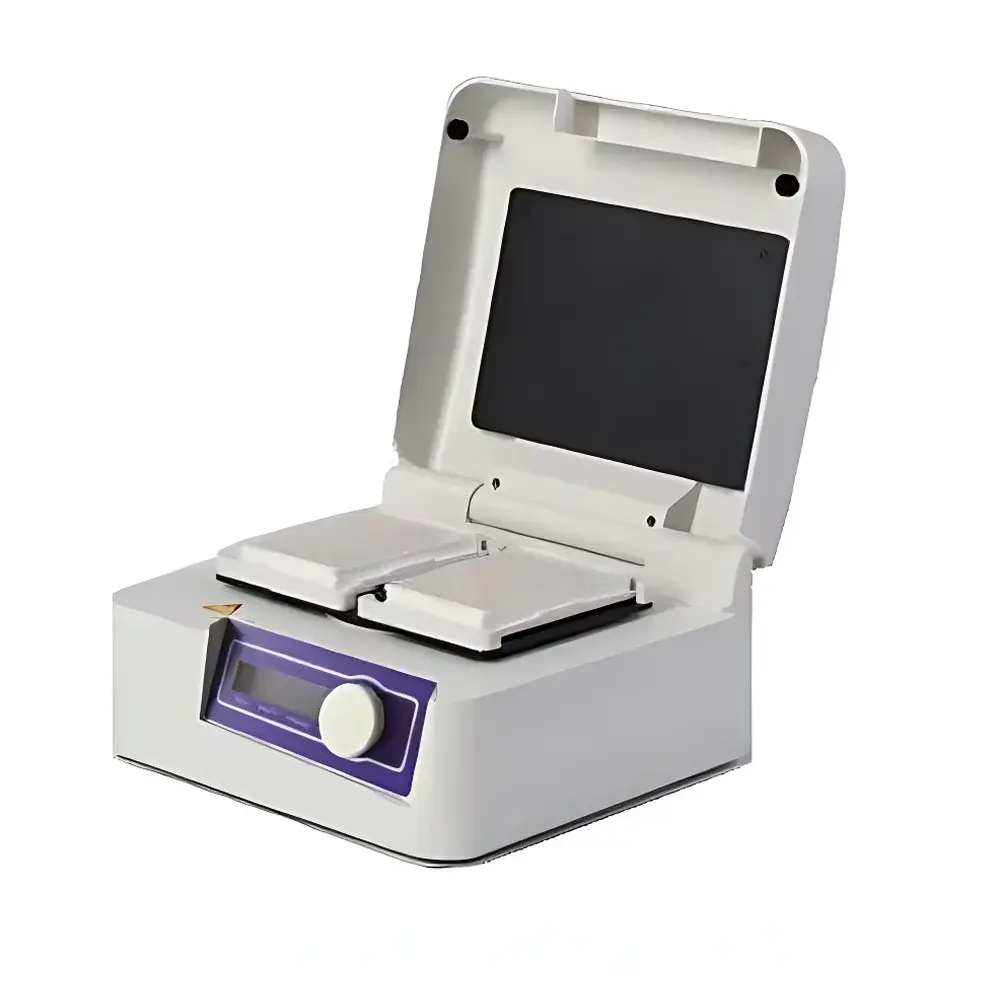
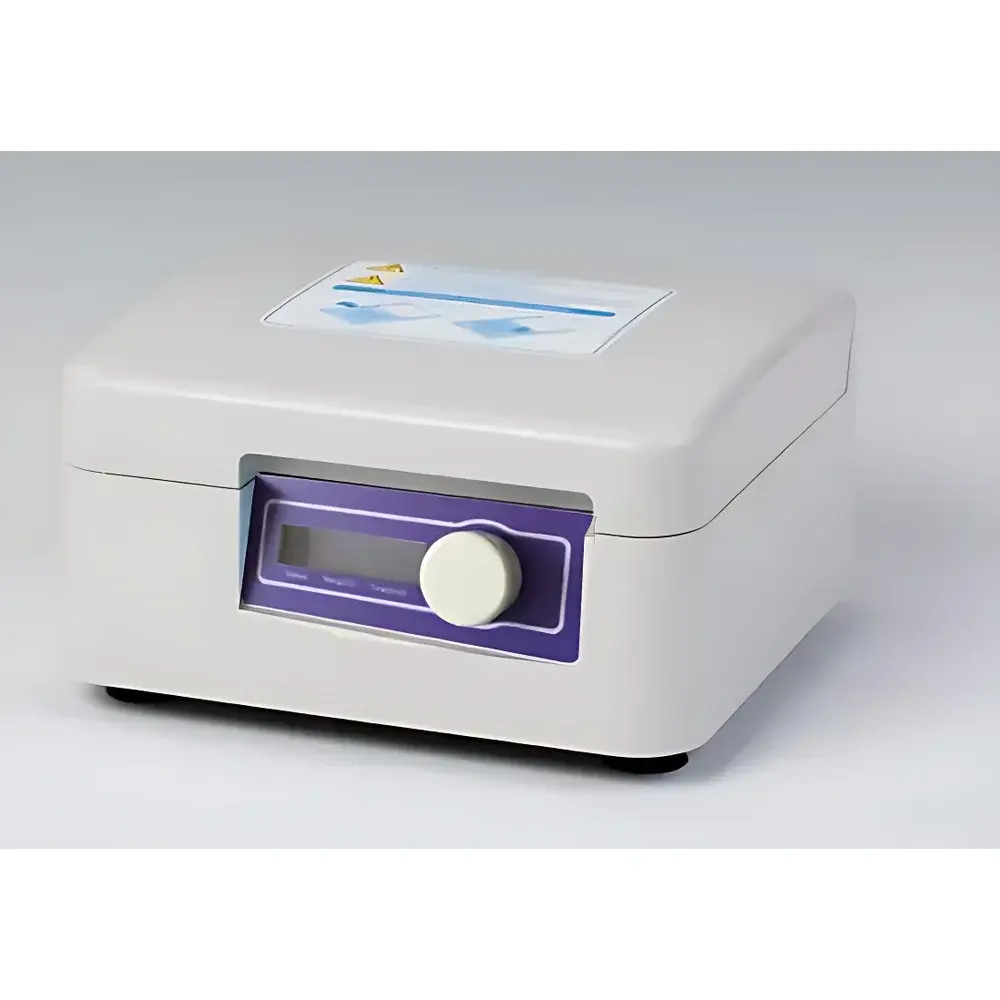
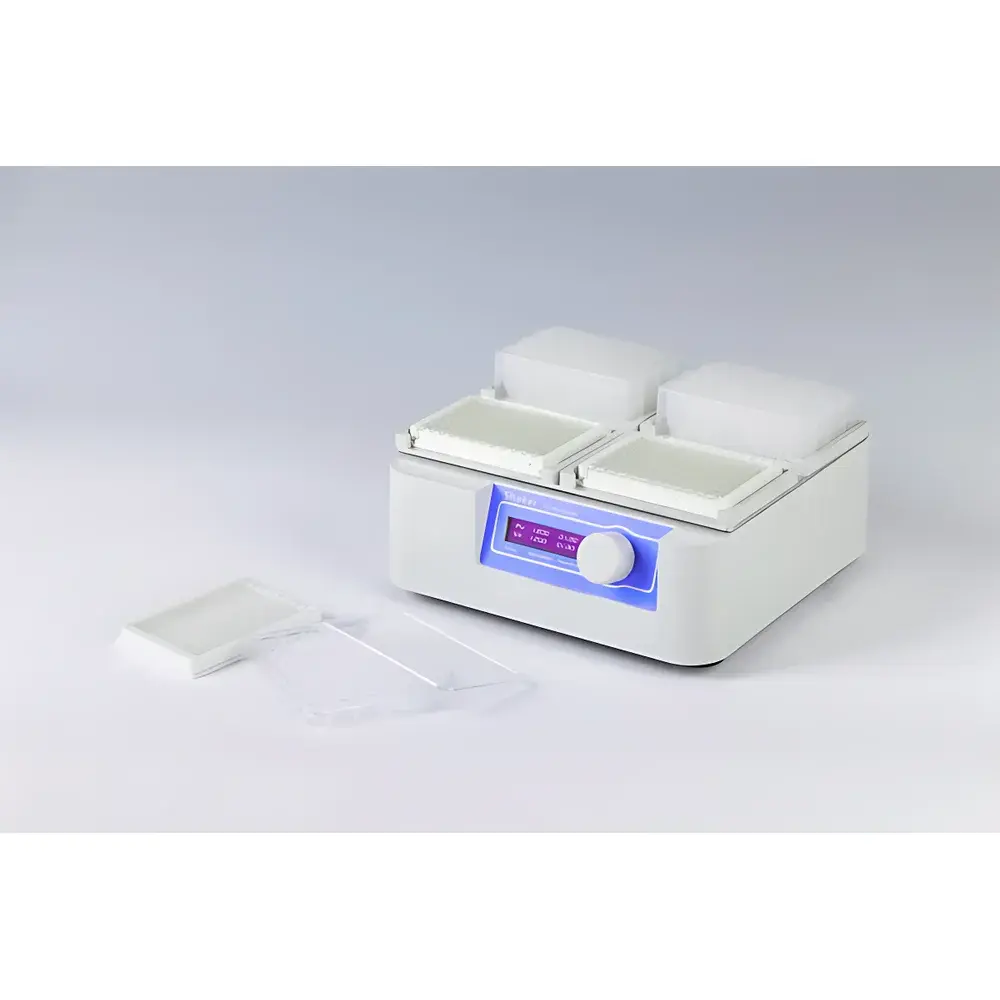
Jiayuan MB100-4A Microplate Incubator Shaker
| Brand | Jiayuan |
|---|---|
| Origin | Beijing, China |
| Model | MB100-4A |
| Timer Range | 0–9999 min |
| Oscillation Frequency | 100–1200 rpm |
| Oscillation Amplitude | 2 mm (horizontal orbital) |
| Temperature Range | Ambient +5°C to 70°C |
| Number of Shaking Platforms | 4 |
| Temperature Uniformity | ≤ ±0.5°C |
| Temperature Stability | ≤ ±0.2°C |
| Heating Accuracy | < ±0.3°C at 37°C |
| Ramp Time | < 25 min (20°C → 70°C) |
| Max Power Consumption | 250 W |
| Dimensions (W×D×H) | 345 × 310 × 178 mm |
Overview
The Jiayuan MB100-4A Microplate Incubator Shaker is an engineered solution for precise temperature-controlled orbital shaking of standard microtiter plates in life science laboratories. Designed around a PID-regulated heating system and brushless DC motor drive, it delivers stable thermal environments and reproducible agitation across four independent horizontal orbital platforms. Its operation conforms to the physical principles of convective heat transfer and controlled orbital motion—ensuring uniform thermal distribution across all wells of 96-well, 384-well, deep-well, or cell culture plates without condensation-induced edge effects. Unlike ambient-air incubators, the MB100-4A integrates bottom-and-top plate heating to minimize vertical thermal gradients, supporting applications requiring strict thermal consistency—such as ELISA development, antibody binding kinetics, microbial suspension culturing, and enzyme reaction optimization.
Key Features
- Four independently accessible horizontal orbital platforms—each accommodating one standard microplate (e.g., ANSI/SLAS-compliant 96-well, 384-well, or deep-well formats)
- PID-controlled dual-zone heating system with top-and-bottom thermal regulation ensures ≤ ±0.5°C temperature uniformity across full plate surface area
- Brushless DC motor provides maintenance-free operation, low acoustic emission (<50 dB(A)), and long-term speed stability (±2% deviation over 24 h at 600 rpm)
- LCD interface displays real-time values for setpoint and actual temperature, oscillation speed (rpm), and remaining time—enabling immediate verification during GLP-compliant workflows
- Programmable timer supports durations from 1 minute to 99 hours 59 minutes; auto-shutdown with audible alert upon completion
- Integrated safety architecture includes overtemperature cutoff, motor stall detection, and plate misalignment sensing—certified to CE standards (2014/35/EU Low Voltage Directive and 2014/30/EU EMC Directive)
Sample Compatibility & Compliance
The MB100-4A accommodates all ANSI/SLAS-standard microplates—including flat-bottom, U-bottom, V-bottom, and skirted configurations—without adapter requirements. It supports common labware materials: polystyrene, polypropylene, cyclo-olefin copolymer (COC), and glass-bottom plates. Temperature performance meets ISO 13485-relevant thermal validation criteria for in vitro diagnostic (IVD) assay development. While not FDA 21 CFR Part 11–validated out-of-the-box, its parameter logging capability (via optional RS232/USB data export) supports audit-ready documentation when integrated into validated laboratory information management systems (LIMS). The unit complies with IEC 61010-1:2010 for electrical safety in laboratory equipment and satisfies basic environmental requirements per IEC 60068-2 for operational reliability under typical lab conditions (15–30°C ambient, ≤80% RH non-condensing).
Software & Data Management
The MB100-4A operates via embedded firmware with no external PC dependency. All operational parameters are stored in non-volatile memory and retained after power cycling. Optional serial (RS232) or USB connectivity enables integration with custom LabVIEW, Python, or MATLAB scripts for remote parameter setting, real-time monitoring, and timestamped log export (CSV format). Exported logs include temperature setpoint/actual, speed setpoint/actual, elapsed time, and event flags (e.g., “heating complete”, “timer expired”). When deployed in regulated environments, users may configure periodic calibration checks against NIST-traceable thermistors and tachometers—supporting internal quality assurance protocols aligned with ISO/IEC 17025 clause 7.7.
Applications
- ELISA and immunoassay plate incubation with simultaneous agitation to accelerate antigen–antibody binding kinetics
- Suspension culture of bacterial, yeast, or insect cells in microplate format under controlled thermal and mixing conditions
- Enzymatic reaction profiling—including kinase assays, protease activity, and ligand-binding studies—requiring precise thermal control and homogeneous mixing
- High-throughput screening (HTS) workflows where plate-level thermal homogeneity directly impacts Z’-factor reproducibility
- Cell-based assays involving adherent or semi-adherent lines, where gentle orbital shaking prevents detachment while enhancing nutrient/gas exchange
- Pre-analytical sample preparation steps such as bead-based nucleic acid extraction or magnetic particle washing
FAQ
Does the MB100-4A support 384-well plates?
Yes—it accommodates all ANSI/SLAS-standard microplates, including 384-well formats, provided they conform to footprint dimensions of 127.76 × 85.48 mm.
Can temperature and shaking be controlled independently on each platform?
No—temperature and oscillation parameters are synchronized across all four platforms; individual platform control is not supported.
What is the minimum recommended ambient temperature for stable operation at 70°C?
For sustained operation at maximum setpoint, ambient temperature should remain between 15°C and 25°C with adequate ventilation clearance (≥10 cm on all sides).
Is the unit suitable for use inside a CO₂ incubator?
No—the MB100-4A is designed for ambient-air operation only; internal electronics and heating elements are not rated for humidified, CO₂-enriched atmospheres.
How often does the unit require calibration verification?
We recommend quarterly verification using traceable reference sensors, especially when used in GxP-regulated workflows; calibration certificates can be generated using external metrology tools per ISO/IEC 17025 guidelines.
Related Products